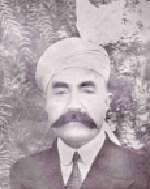
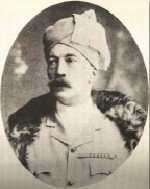
 In an earlier post I had described the different Pugrees worn across Pakistan, including the famed and flamboyant Peshawari Patkaiy or Kullah. There is an interesting story passed down by generations of students of Islamia College Peshwar about how this particular turban, once part of the prescribed college uniform, was abandoned by the College.
As a background information I should add here that Islamia College Peshawar (ICP) was founded in 1913 by Sir Sahibzadah Abdul Qayyum, a Pushtun, and Sir George Roos-Keppel, the then British Chief Commissioner of NWFP, who was a virtual Pushtun in that he spoke Pushto fluently and also understood and adopted many of Pushtun customs.
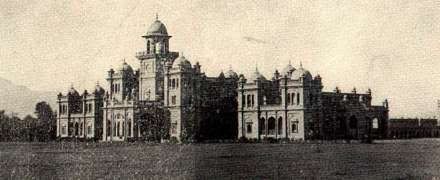
While founding the ICP the two gentlemen tried to model their institution after the Aligarh Muslim College, which was founded 35 years earlier by Sir Syed Ahmed Khan. Following Aligarh’a example they also chose black achkan as part of the uniform for ICP students. To the achkan they added the local turban as head-wear. Both gentlemen, I should add, we proud turban-wearers themselves.
Thus the Peshawar Kullah along with black achkan, white shalwar, and black chaplis/shoes became the uniform of ICP students. However, the turban didn’t last long and was soon discarded. One reason for giving it up was that it didn’t sit too well on mostly 16-17 year olds who were usually too skinny at that age to sport this bulky head-wear. The other reason was more interesting and requires a bit of explanation.
In all the college hostels (there were 7) a bell would ring early in the morning and the students would stream out of their rooms into the hostel’s courtyard and line up, all dressed up in black achkan, white shalwar, black shoes and, of course, the Patkaiy or turban. First there would be a roll call to ensure that everyone was present, followed by an inspection. The hostel superintendent would pass by each student to see if he was properly dressed, which meant a properly buttoned up achkan, its collar hooked, no azarband hanging loose, the shoes shined and the shamla of the turban flared and proudly standing up.
Ditching the “dress parade” (that is what it was called) or turning up improperly dressed at the parade was considered almost a felony and the culprit was fined. Since boys were and will always be boys, they couldn’t resist pulling pranks on each other. When everyone was rushing out of his room to join the dress parade, one tug at the tail of someone’s turban would unravel the turban and the student would end up missing the parade.

And this happened not too infrequently. As an insurance against such mishaps the students would keep an extra turban ready to wear. If one were pulled apart at the last minute, the ‘victim’ would quickly fetch the other, don it and rush back to join the parade.
But there was not always a happy ending to such episodes. So, legend has it, the college administration mercifully decided to abandon the turban altogether – to the relief of the latter generations including mine.
Mast Qalandar is a proud alumnus of Islamia College Peshawar.Originally published at ATP on December 20, 2006.




Very interesting. Uniform was, of course, a big thing. I am not even sure any college now has a prescribed uniform. Also not sure if they should. However, I think ‘looking neat’ was and is a virtue which has, unfortuantely, been lost.
Adil, yes, it was ICP’s picture. And, what an elegant building!
On another note (pun intended), while I did not know that the elegant picture on the old 5 Ruppee note was of Khojak Tunnel until I read Owais’s post, I do beleive that the picture at teh back of the old 100 ruppee note (the red one) was of Islamia College Peshawar.
MQ and Anwar, I never met Prof. Close but have heard of him from others. There were otehr such legendary teachers too in various institutions. One of teh thing we want to do at ATP is to write about these institutions and these individuals all over. I did read Amjad Hussain’s article on him and was hoping to do a post on him… however, I have not been able to find a photogrpah of his and would very much like to find and use one…. any hints on where one might find one?
Adnan,
Yes, Islamia College to NWFP will be what GC Lahore was to Punjab. There is another very old and very good, some say even better, college in Peshawar. Edwards College. Edwards would be what FC college was or is to Lahore.
Pervaiz Alvi Sahib,
You will find some information about Sahibzada Abdul Qayyun on Wikipedia. Incidentally, he belonged to village Topi or Topai, which is the place where GIKI situated.