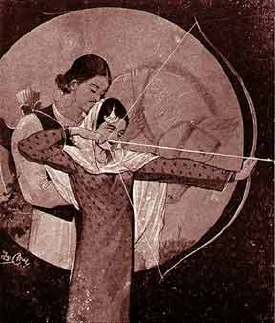
 In an earlier post on Sohni Mahiwal I had said folklore was a mixture of beliefs, facts and fiction and that it was always a poet who immortalized a love story. But, it is also true that a poet chose to sing a particular story, and not the other, because of its inherent beauty, drama and poignancy. Mirza-Sahiban is one such poignant story of blind love.
The story came down to us through a 17th century Punjabi poet, Piloo (Peeloo), in oral or ballad form. Since then, many poets and writers have written the story. But, because of its unique rustic style, brevity and boldness, Piloo’s version of the story became popular, and is widely sung and celebrated in rural Punjab even today.
The story has also been translated into Urdu, both in poetry and prose, and a short version in English is included in a book ‘The Legends of the Punjab’ written, in 1884, by one Captain R. C. Temple.
The story has also been translated into Urdu, both in poetry and prose, and a short version in English is included in a book ‘The Legends of the Punjab’ written, in 1884, by one Captain R. C. Temple.
The Education Department of Punjab, Lahore, published Mirza-Sahiban in Urdu in 1951, interestingly, with the title: Mirza Sahiban (for adults)!
Since most of the ATP readers, I assume, are adults, I have no qualms in relating the story to them, as I know it.
The dates are controversial, but the events of the story are generally believed to have taken place around the time of the Mughal king Akbar. And the geographical area where all this happened was located somewhere between the rivers Ravi and Chenab.
In a village called Khewa, near present day Jhang, a woman named Nooran gave birth to a boy. Nooran died when the child was still in infancy. Therefore, the boy was wet-nursed by another woman who had a suckling daughter. Thus, according to the traditions of the time, the boy and the girl became siblings. The boy grew up to become the chief of his village and also of the Sayyal tribe, which inhabited the area. He came to be known as Khewa Khan. His “sister” grew up to become Fateh Bibi and was married to a man named Wanjal (or Banjal), of the Kharral tribe, who lived in village Danababad, which, today, is in Tehsil Jarranwala, district Faisalabad.
The towns, Khewa and Danabad, were short of a day’s ride apart on horseback.
Mirza, the hero of our story, was born to Fateh Bibi and Wanjal while Sahiban, the heroine, was the daughter of Khewa Khan. As already explained, since Fateh Bibi and Khew Khan were suckled by the same woman, Mirza and Sahiban ended up being “cousins” according to the prevailing traditions.
Mirza must have been 8 or 9 when his parents decided to send him to Khewa to live with his “maternal uncle”, Khewa Khan. It was not unusual those days for parents to send their children to live with their mother’s or father’s relatives for education or for other reasons.
Khewa Khan enrolled both Mirza and Sahiban at the local mosque, the usual place for basic education those days. A student would start off with alphabet, or patti as it was called, and then graduate to reading the Quran, chapter by chapter, and then to other subjects, if any, depending on the interest of the student and his/her parents. The imam of the mosque, commonly called maulvi or qazi, would be the sole teacher.
 Like most teachers of his time, the maulvi who taught Mirza and Sahiban was a stickler for pedagogical rules, and his golden rule was: Spare the rod and spoil the child. As a tool of punishment, he used what in Punjabi is called a chimmak. It is a long, thin, green twig or branch of a tree, shorn of the leaves or any thorns. When struck on any part of the body it sends a flaming sensation through the body — and the soul, too, I guess.
Years passed, and both Mirza and Sahiban advanced into adolescence and to adulthood. They discovered that they liked to be in each other’s company. Actually, Mirza and Sahiban had fallen head over heals in love with each other — a love that was honest, blind and reckless. Often in the “class”, they would be more absorbed into each other than to paying attention to the maulvi. The maulvi had to resort to the use of chimmak to get their attention.
According to the story, Sahiban, once, when struck by the maulvi for not memorizing her lesson correctly, addresses him thus:
Na maar qazi chimkaaN, na day tatti nooN taa
Parrhna sada reh gaya lay aaye ishq likha
O qazi, don’t beat me with the stick; don’t burn me. I am already burning [with love]. Books are of no use to us, for love is now writ in our destiny.
Sahiban had grown into a beautiful young woman. Piloo, the poet, describes her beauty with the usual poetic exaggeration. He says, when Sahiban went shopping, the grocer would be so distracted by her beauty that he would place wrong weights in the weighing scale (tarakri), and that instead of oil she wanted he would pour honey for her. At another place the poet says, when Sahiban walked past the fields the farmers would stop plowing and would stand transfixed by her beauty.
Mirza also grew into a strapping, handsome young man. He had shoulder length hair, was a good horseman, was known for his physical courage, and was a deadly shot with his bow and arrow. His marksmanship was legendary.
Mirza and Sahiban’s love affair soon became the talk of the town. When Sahiban’s father heard of it, he was mad. He would have none of it, and soon packed Mirza off to his home in Danabad. Also, a suitable young man, named Tahir Khan, from the same tribe, was found to marry Sahiban, and a date was set for the wedding.
Sahiban, when she came to know of her imminent marriage, sent an emissary to Mirza asking him to come and get her before she was bundled off to a new home.
Mirza couldn’t and wouldn’t let this happen. He announced his decision to go to Khewa and get Sahiban. His parents and sister tried to dissuade him saying that the Sayyal women could not be trusted, and that he was taking a big risk going to Khewa. His father’s words of advice and warning are quite revealing of the values of the time, some of which persist even today. He says: “To hell with these women. Their brains are in their heels. They fall in love laughing and, later, tell their story to everyone crying.” Strange as it may sound, the father goes on to say: “One should not step inside the house of a woman with whom he is in love.” However, when the father realized that Mirza would not be dissuaded, he relented, saying: “I see you are determined to go. Now, go, but don’t come back without Sahiban. It’s a question of our honor. Bring her with you!”
Mirza readies his horse, collects his bow and quiver and sets off to Khewa on the day Sahiban’s wedding is to take place. He reaches Khewa when the wedding party (barat) has just arrived and is being feasted. Sahiban, decked in her bridal dress, her hands and feet died with henna, is tucked away in a room somewhere upstairs.
Mirza, knowing the layout of the house from the years he had spent in it, quietly slips inside and asks a woman confidante to alert Sahiban of his arrival. He, then, climbs up to her room, brings her down, helps her into the saddle on his horse and, with Sahiban clinging to him, gallops away into the night.
It takes a while for Khewa Khan’s household to find out what has happened. Sahiban’s brother, Shamair, accompanied by his other brothers, the bridegroom and others set off on their horses after the runaway couple.
Confident that he had gained sufficient distance and that it would not be easy for his pursuers to catch up with him, Mirza wants to stop and rest for a while. He was too tired.
Sahiban warns him that her brothers might catch up with them and urges him not to stop. But Mirza boastfully tells her that, first, they won’t be able to catch up with them and even if they did it would take only one arrow to take care of Shamair, and one more to get rid of her betrothed. And that he had sufficient arrows to take care of the whole bunch of the Sayyals. Confident but tired, he lies down under a clump of trees — and dozes off while Sahiban keeps watch.
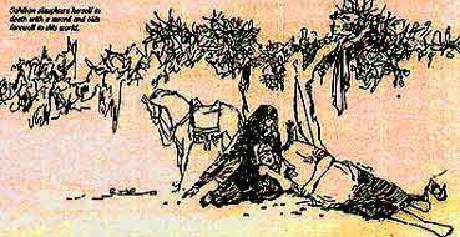
In the quiet of wilderness, Sahiban is assailed with doubts. What if they catch up and kill Mirza? What if Mirza, quick and accurate marksman that he was, kills his brothers? Like a typical Eastern sister, her love seem to be divided between her lover and her brothers. She doesn’t want either of them to be killed. Somehow, she believes, or hopes, that this whole thing could end without bloodshed. So, she quietly takes Mirza’s quiver and hangs it on a branch, out of his reach.
Soon, there is the drumming sound of hoofs, and in no time the pursuers appear on the scene. Sahiban shakes Mirza out of sleep. Mirza wakes up with a start and instinctively reaches for his quiver but doesn’t find it there. In that split second, an arrow from Shamair’s bow pierces Mirza’s throat and he falls to the ground. Another arrow pierces his chest. With two arrows stuck in his body, Mirza looks accusingly into the eyes of Sahiban and utters those memorable words, somewhat reminiscent of Shakespeare’s “Et tu, Brute?”:
“Bura kitoyee Sahiban, mera turkish tangiya jand!”
[Sahiban, you did a terrible thing by hanging the quiver away from my reach!]
Sobbing and shaking, Sahiban throws herself over Mirza’s body to cover him from any further hits. A shower of arrows rains on Sahiban. Her body twitches and then lies still, and Miraz and Sahiban enter the world of lore and literature.
In Punjabi literature today, just as Ranjha is identified with his flute and Sohni with her un-fired water pitcher (kacha gharra), Mirza has become a metaphor of courage and marksmanship. This is evident in one of Munir Niazi’s poignant poems when, engulfed in a pall of gloom, the poet invokes Ranjha and Mirza in the following lines:
Jattan karo kujh dosto, toRo maut da jaal
Pharr murli O Ranjhiya, kadh koi teekhi taan
Maar koi teer O mirziya, khich kay wal asmaanDo something, friends, lift this pall of despair
O Ranjha, take out your flute and play an enchanting tune
O Mirza, shoot an arrow at the sky to pierce this web of gloom
Note: The story is based mostly on Piloo’s ballad of Mirza-Sahiban, as discussed by Professor Hamidullah Hashmi in his book.




Zia, I also saw an old black and white film version of this story on PTV some years ago. I don’t remember the title or who was acting in it. Does anybody else know?
Very nice!. I have always loved our folk stories. Heer Ranjha, Sohni Mahinwal, Mirza Sahibaan along with Laila Majnoon, Shirin Farhad and Azra Wamiq…all of these had so much about life which you do not understand till you grow up and experience.
As for Mirza Sahiban, there was a song by an Indian singer Gurdaas Maan I found it on youtube.Thought I should put the link here
http://www.youtube.com/watch?v=bIl8X4e6U3A
Jabir, my grandparents had a love marriage. But many years ago I think young people going into marriage had a better idea of what it entailed. They raised seven children on small means which I think today’s generation would not be willing to do.
I realize this is an almost taboo subject, but frankly many arranged marriages to do not work out either even though the couple may stay together out of some different pressures. I know middle aged people who aren’t speaking to each other and living on different floors of their house. But hey it’s not a divorce, so……
Allow me to illustrate, my grandmother on the other side was widowed young so she married my grandfather’s brother as does happen. So who I grew up calling grandfather was really my great-uncle. Anyway she raised thirteen children in total but the marriage was very miserable from the beginning–in fact her marriage to the first brother was not better also. So here we have everybody doing their duty and following the customs but nobody happy.
If you can find love, then love is the best. I am sorry that some immature young people give love marriages a bad name.
Also a comment on the cousin marriage—in the States in rural areas cousin marriage happened until recently, and was banned not long ago for the reason stated above. Like I said, I know the people who support cousin marriage dispute the medical science behind this decision, which I am not qualified to argue one way or the other, I am just putting the information out there.
I find it very interesting that the author of the poem created a link of “cousinship” (is that a word) in which the lovers were not actually related. Was it to create the tribal conflict or what I don’t know…..perhaps if they were “real” cousins there would not have been barriers to their marriage.
tina you are right about the difference between infatuation and love. But the problem is, the present day consumer driven, cheap media bombarded societies and the resulting junk generations are unfortunate enough to distinguish between true love and infatuation.
A couple of my friends took the path of love marriage. Their marriages are shattered now, nearly all of them. The one or two that survived are nothing short of a nightmare. I think the prices of houses in their neighborhood must have fallen drastically because of their four seasons bickering and fighting’s. My conclusion is, true love manifests from a higher moral standing and sacrificial instincts. Present day lot is nothing less than moths, hopping between nectar laden flowers.
I am glad to hear about the successful marriage between your grandparents, good luck to them. I am curious to know their take on present day situation.
And as far as educational arrangements in 1700 Punjab are concerned, we shall give credit to the ‘openness’ of the maulvi. Though they were children but they were interested more in each other than paying attention to the education.
As a side note, do you know the literacy rate of sub-continent was around 80% before the English abolished the whole system and replaced it with their own? After more than 150 years we have not been able recover from that disaster.
Jabir, marriage between biological first cousins is disallowed in the States, like marriage between brother and sister. However you will notice in the story that the lovers are not biological cousins.
Arranged marriage between first cousins in places like Pakistan is looked down upon by Westerners as being the cause of many inherited medical problems. If you reply please understand that I will not be getting into any discussion about it, pro or con.
I don’t know enough about Punjabi educational arrangements in the 17th century to answer your other questions, but I imagine that in a small town with limited options all students may well have shared a room. If they are all children, why not?
Also the author of the story has to have some way of getting the hero and heroine together.
Psychologists are not talking about love but infatuation. Infatuation lasts such a short time. Love is different. My grandfather after 65 years of marriage to my grandmother said that on the day he met her she was the most beautiful girl in the room and she still was in his eyes. Recently in our locale we had a couple celebrate 80 years of marriage, both are in their 90s and still “in love”.
So the comment of Mirza’s father, that one should avoid being in love to protect oneself is very sad in my opinion. Unfortunately many still do this, don’t they?