Adil Najam
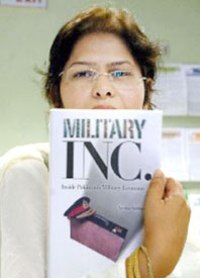
As was expected – but much more so than expected becasue of its timing – Ayesha Siddiqa’s new book Military Inc.: Inside Pakistan’s Military Economy is causing waves in Pakistan and abroad.
True to form, the establishment has bothed up things even more than usual by trying to mess with the book’s launch in Islamabad. That only made the launch an even bigger news than it would have been. Here, for example, is the top of the page, front page news item from Dawn (June 1, 2007):
A book putting a critical spotlight on the military’s business nooks was launched from a virtual sanctuary on Thursday and some high-profile political reviewers seized upon it to denounce the army’s role in Pakistani politics.
The launching of the book, Military Inc: Inside Pakistan’s Military Economy, by Dr Ayesha Siddiqa, a military analyst, was due to have taken place at the capital’s elitist Islamabad Club. But the author told a surprised audience that not only the club cancelled the booking of its auditorium, “all hotels in Islamabad were also told� by unspecified authorities not to allow the use of their halls for this, forcing the organisers to find a sanctuary at a third floor room provided by a non-governmental organisation.
PPP’s legal star Aitzaz Ahsan said the time had come to stand up against the military dominance while PML-N Information Secretary Ahsan Iqbal accused Pakistan army generals of not learning a lesson from other countries that said goodbye to military rule. But some other speakers had a dig also at politicians for doing little to keep the military in check while being in power and at times celebrating the ouster of their rivals. Mr Aitzaz Ahsan said the expose of Ayesha, who puts the net worth of the army’s commercial empire at Rs200 billion, had come at a “defining moment� in Pakistan’s history following President Pervez Musharraf’s controversial charge-sheeting and suspension of Chief Justice Iftikhar Mohammad Chaudhry.He narrated what he called the military’s moves in the past to convert Pakistan into a national security state contrary to the Quaid-i-Azam Mohammad Ali Jinnah’s vision of a welfare state and to forge an alliance with mullahs in search of an ideological justification for this, but said he thought now “a watershed has come�. Mr Ashan, who heads Justice Iftikhar’s legal team, saw “a turning point� in the March 9 presidential action against the chief justice that plunged the country into a judicial crisis and said: “We must grasp it.� Cheers went up in the congested premises of the NGO Leadership for Environment and Development as Mr Ahsan referred to what he called an unexpected “no� by the chief justice to the president’s demand for his resignation and, in a reference to the nationwide protest movement by lawyers, opposition political activists and the civil society, said: “The spillway of the Tarbela Dam has opened now.� He said although the chief justice would not speak about the presidential reference pending before the five-judge Supreme Judicial Council or his challenge to the reference before a 13judge bench of the Supreme Court, it was out of compulsion that an affidavit was filed on his behalf on Tuesday about what happened to him during his March 9 meeting with the president and for some days afterwards. “We were compelled to file that affidavit,� Mr Ahsan said, citing comments made by President Musharraf about the case as the reason.
Mr Iqbal rejected as a myth usual accusations holding politicians responsible for four military coups in Pakistan’s history and put the blame on what he called ambitions of army chiefs who toppled civilian governments from General Mohammad Ayub Khan, who later became field marshal, to General Musharraf. Comparing the ills of military interventions in politics to what cancer does to human body, he said Ayub Khan struck in October 1958 to pre-empt scheduled elections next year, while General Yahya Khan snatched power from him in 1969 at “virtual gunpoint� to prevent a handover to a National Assembly Speaker from then East Pakistan in the midst of a national democratic movement.
General Mohammad Zia-ulHaq, he recalled, seized power on June 5, 1977 a day after then prime minister Zulfikar Ali Bhutto and the opposition Pakistan National Alliance had agreed to hold fresh elections. He said Pakistan faced no bankruptcy despite international sanctions for its 1998 nuclear tests and “everything was normal� when General Musharraf, after being sacked, toppled then prime minister Nawaz Sharif on Oct 12, 1999. Mr Zafar Abbas, resident editor of Dawn, Islamabad, and Dr Farrukh Saleem, also complimented the 292-page book published by the Oxford University Press.
It speaks about the role of the military power in transforming the Pakistani society, armed forces becoming an independent class entrenched in the corporate sector and their five giant welfare foundations, or conglomerates, running thousands of businesses ranging from petrol pumps to industrial plants.
I have not yet read the book myself, however, I have talked about it with Ayesha many times – most recently in Boston some weeks ago – and am generally familiar with the thesis of the book. But, then, so is most of Pakistan. It is that the Military’s economic footprint has become too large for teh military’s own good. From cereal to banks to airlines, what she calls ‘Military Inc.’ is now everywhere in Pakistan’s economic life. Her argument is that this is nietehr good for Pakistan nor the military.
I am looking forward to reading and reviewing the book, which Ayesha has promised to send me soon. Meanwhile, we will keep an eye out for substantive reviews of this undoubtedly important work.



I am myself dyingto read the book and just put order on Amazon. But I do wonder if the author is working a little to hard to make thsi controversial.
This news in Daily Times shows that rumor about book being banned is wrong and the author is spreading some of these rumors herself to become controversial. That is not nice.
———-
Dr Ayesha Siddiqa’s book ‘Military Inc.’ has attracted a great deal of interest as testified by the fact that the first edition was sold out on the day it was released (Thursday). Dr Ayesha confirmed on Friday that all 1,000 copies sold out on the day of the launch. She also said she experienced tremendous pressure in the days leading up to the book launch. “Information Minister Muhammad Ali Durrani phoned me twice to persuade me to cancel the book launch. He also wanted to see me in person but then he did not turn up.â€
edward said gave an interview in which he discusses how myths are repeated by western media until those myths get accepted as facts. That interview is of great relevance here:
http://student.cs.ucc.ie/cs1064/jabowen/IPSC/articles/article0002772.html
…Why do you think certain Arab authors, professors, and specialists residing in the U.S. are embraced and promoted by the major media and leading opinion journals, while others are ignored or downplayed?
ES: I think there’s a cultural war in this country between spokespersons for the West, the U.S. and Israel, on the one hand, and those who are perceived as pro-Arab, pro-Islam, pro-Palestinian, and therefore critical of U.S. policy, on the other hand.
This is a real cultural war. It has little to do with truth; it has little to do with seriousness of scholarship. It has to do with ideological interests. The first group is much more prevalent and receives more attention in the media, than the second group. If you are perceived as belonging to the second group, then you’re trashed and attacked in the most scandalous way.
…This is because there is a cultural war against Islam: Muslims are considered to be the enemies of the West. On the one hand, there’s a long history of that, and, on the other, there is a sense that Muslims are basically one homogeneous people, not subject to time and place, that there is some kind of mindset that keeps them imprisoned. This sort of racism has really not been combated on a very large scale. The important thing is that it’s aided and abetted by senior academic experts, like Bernard Lewis, Ernest Gellner, and others, who get their stuff published all the time without any serious effort being made to refute them except by a few individuals.
Ayesha Siddiqa deserves fullest commendations on apprising the nation about military atrocities through her present book. She is undoubtedly an authority on the subject.I hope she will get her book also translated in Urdu for the benefit of the masses. Military seems to have got addicted to the ecstasy and ‘luxuries’ of governing its own civilian lot. If the military does not stick to its professional duties and continues to indulge in national politics and clutch on power it will soon bring the country to the very edge of catastrophe. It is high time for the executive and judiciary to function separately and keep ”within their skins”. This is the need of time and the nation.
I salute Aisha saddiqa’s courage for informing us about the exploitation of the public resources by the lazy generals! Wouldn’t it have been better if she had written this book in Urdu language as majority of Pakistanis can’t read in English! Or she wrote it in English just to inform the outside world. If that be the case then why should foreign/western powers be concerned about Pakistan Army’s corruption. The westerners prefer a corrupt/impotent army over a democratic rule!
actually there was excitement in islamabad aal rite but that was more to do with the visit of a certain imam of a little known mosque in saudi arabia. ordinary pakistanis dont have a clue about the wajoodh of dr sahiba nor i suspect, give a hoot about her agenda. primary consumers of this book will be goras who have a problem with muslims asserting their strength and this book will be used as further evidence of why armed muslim groups should be neutered. for her efforts, i predict dr sahiba will be handsomely rewarded possibly with a nice long stint at one of those neocon think tanks that bought you the iraq war. there is a cottage industry of muslims who make a living performing tumasha at the first snap of gora fingers. in this group i would include people like hirsi, asra nomani, adjami, haqqani et al. recent additions to this group include couple of reformed ex terrorists from indonesia and the middle east. soon i suspect, dr. sahiba might be added to this list.
the case of indonesian army in east timor provides a good example of dangerous consequences for muslim countries when conniving goras use local groups who drape themselves with the human rights cloak, to further their agendas. insurgencies have been raging all over south east asia – by muslims against buddhists in thailand and against christians in philippines. yet the only group to acquire independence has been the christian east timorese whose population is less than 1mm and the country has been in civil war since independence. in the middle east, the latest example is the drama staged by gora countries over hariri tribunal. israelis get billions in aid for killing popular palestinian leaders like dr. rantisi and shiekh yassin while syria is being ostracized even though there is no proof of syria’s involvement in hariri’s murder.
as far as army’s role in business is concerned, its being blown completely out of proportion and rationale for existence of these businesses is being completely ignored. the only sector where army linked entity (ALE) enjoys a dominant market share is fertilizer through fauji fertilizer which is a publicly listed company in which ALE’s share is about 45%. in comparison, mansha controls the following:
1.mcb – one of pakistan’s largest banks
2. adamjee insurance – pak’s largest insurance company
3. nishat – pak’s largest textile unit
4. dg khan cement – one of the largest if not the largest cement manufacturing
clearly mansha possess some magical power which enables him to control business whose size is far far greater than controlled by ALE. also to set the record straight, in business terms, gop is still the most powerful entity in pak through its majority or minority ownership of pak’s largest companies such as ogdc, natl bank, habib bank, nit etc. the reason for this is bhutto’s nationalization which paradoxically increased the position of ALEs because its entities were not nationalized. after nationalization, ALEs faced minimum competition from private sector and thus was able to increase market share. off course need for ALE’s arose because pakistan went to war right after its creation which resulted in armed forces acquiring dominance over other sectors. clearly there was need to look after the welfare of ex army people and given the large size, any project involving the army would automatically acquire large size.
more on this topic later.
What the book fails to mention and has been a major hurdle in true democrarcy (Haqeqeqi Jamorait) is the collusion between Politician and the Army. Especially in case of B.B ji who without any doubt will be back before any announcement of elections..Its political parties like the PPP and MQM who present a even bigger danger than the Military Inc…Things are going to get worse before they get better for pakistan..There is hope though..Real revolution can only come when we have a fresh start..An attitute like Imran Khan..No deals on core issues is needed to bring true will of people in pakistan
So far I have read the first few chapters of this book and it is a solid piece of scholarly writing on military interests in business and how the corporate shenanigans of the Pakistan military is destroying the very essence of the force and its relations with civil society.
Impeccably researched and very well written. She is a brave woman and may God protect her and her family from the corrupt feet that she has invariably stepped upon in writing this book.
I urge everyone who can afford it to buy this book so Ms Siddiqa gets the benefit and to really find out how the military is spreading its tentacles across every realm of Pakistani society with dire consequences.
Bravo Ms Siddiqa. I had read your articles in many newspapers before but this book is a masterpiece.
P.S. The front cover of the book I received from Amazon has a Pakistani soldier saluting while riding atop a tank during a parade. For some reason it shows him saluting with his left hand! Can someone with a military background confirm whether that is possible or is that a Photoshop editing error?
While we are at it, let me sincerely show my discomfort and worries over the Armed Forces’ attitude towards furthering the education. There are many bright minds in Army which unfortunately go unnoticed or played down because the “working of Army” don’t allow you to study formal education much further with fewer and fewer exceptions. As I mentioned, Signals Corps who comprises on the most educated wing of the Army is NOT the one who enjoys a better status and respect despite the rising needs of innovation, technological advancements and more professional attitude towards crisis-management (from technology standpoint).
Another area where Army has clearly been dumbfounded is the notorious ISPR. Now, ISPR is not just an equivalent of “Ministry of Information and News of Army” they are much more because of the relationship and working of Army. I wish someone bring it to parliament and decide to disjoint (of the sorts) ISPR with the regular Army and only those could joing ISPR who have journalistic ambitions as well as can be freely allowed and encouraged to study more. I know there are many who have masters and even PhD degrees but fewer and fewer among different corpses. Not just that but anyone from Artillery or Services or even Signals could go and join ISPR for couple of months/years and then join back. Sure it would have some merits but how come you never know about these matters? I find this particular issue falling under the domain of Parliament because of its unique role of “information and news reporting” beside other related jobs to the civil society as well as within the three forces.
While they have Fox and CNN, they do have many many Iraqi Vets or even serving Iraqi Soldiers who blog, post pictures at Flickr and so on. If Pakistani Government finds inspiration in Western media (most definitely Fox and CNN et al.) why can’t they allow more open-ended discussion and dialogue between civil and army?
I think it’s just about the time we start treating them like Human Beings and our brothers. Nothing more nothing less.