Adnan Ahmad
hoi muddat ke Ghalib mar gaya par yaad aataa hai
woh har ek baat pe kehna ke yooN hota to kia hota
From time to time at these very pages of ATP, we have disussed national and international personalities that are larger than life, including poets like Faiz, Faraz, Qasmi, Munir Niazi and others. In such context it is just apt that we share our thoughts on a man whose poetry has inspired millions of Pakistanis and has given root to Pakistani Urdu poetry and to our intellectual thinking at large.
One such person is Mirza Asadullah Khan Ghalib. Given his towering and well-known stature, instead of writing purely a biographic piece I will be short and mention a few of his verses and a few of the highlights of this wizard’s life.
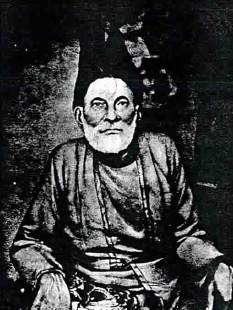
Ghalib’s portrait to the right is from urdustan.com
Through earlier years of my life the name Mirza Ghalib invoked a stereotypical image in my mind about yet another old poet from the subcontinent writing on the classical subjects of romance and appearing thoroughly outdated in my world.
That was until I came across Gulzar‘s serial Mirza Ghalib and found outsides of Ghalib and meanings of his verses that I had not known before.
Here is a sample:
![]()
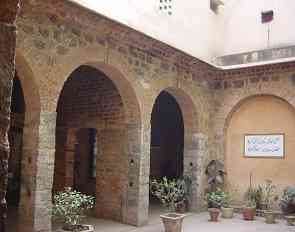
The year was 1990 and someone in our family had gained access to the tapes that were not available in the market yet. Over the course of next few years of my high school I watched the serial over and over again, read his poetry and about his life, with each attempt increasing my fascination with the poet and his poetry. Photo to the left is the ‘haveli’ where Ghalib lived.
And there are still days when I find new meanings in his verses I had heard and known for ages. All this gets better when one considers the fact that the deewan-e-Ghalib, as we know it, was completed by age twenty-five (many argue that it was finished by age 19).
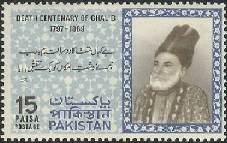
Image to the right is a postal stamp issued by Government of Pakistan in commemoration of Mirza Ghalib
This is the collection of poems about which a famous Urdu critic from the 19th century, Abdul Rehman Bijnori, once said that there are two books sent from the heaven to the sub-continent, one is Holy Geeta (muqqaddas Vaids) and the other is deewan-e-Ghalib. Still it baffles me to think how a 25-year old can express such mature sorrow in a verse like:
ghar meiN tha kia ke tera gham osay ghaarat karta
woh jo rakhtay the hum ik hasrat-e-taameer so hai
And another verse which goes like this:
hoa jab gham se yooN be-hiss to gham kia sar ke kaTnay ka
na hotaa gar juda tan se to zaanoo par dharaa hota
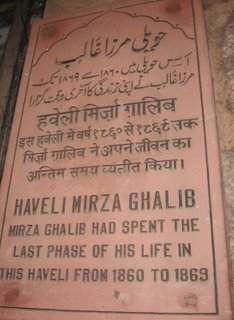
Photo to the right is a plaque at mazar-i-Ghalib
I think whatever he claimed for himself was an understatement. Many including myself, do consider him a philosopher, a great scholar and even a wali (saint) of his time. And on that tangent, I don’t think I’ve heard a better elaboration of tawheed (oneness of God) than his verse:
hum muwwahid haiN hamara kashe hai tark-e-rusoom
millateN jab miT gayeeN, ajzaa-i-imaaN ho gayeeN
In anoher instance he accepts God in a way few of us can:
jaaN dee, dee hoi osee kee thee
haq to ye hai ke haq adaa na hoa
Finally, a verse that stays with me all the time and unfolds itself in new ways each time I think about it.
hai kahaaN tammanna ka doosra qadam ya-rabb
hum ne dasht-e-imkaaN ko ek naqsh-e-paa paaya
Then, there is of course the letters Ghalib wrote. Here is a wonderful sample read by Zia Mohiuddin.
Recommended Website on Ghalib:
(1) There is a very good biography of Ghalib present at a webpage here.
(2) Best of Ghalib




Adnan: Thanks for the article. I am a v big Ghalib’s fan and I don’t have a problem in saying that many of his verses are worth billion dollers and some of his verses are heavier than whole devaan of Iqbal or Faiz. He does uses difficult words and I have to consult a dictionary many times to understand the meaning. I would also like to say we have forgotten him. The Gulzar’s Mirza Ghalib is classic. I think the combination of Ghalib’s poetry, Jagjeet & Chitra’s voice and ofcourse Naseer-uddin-Shah’s acting has made it something which could not be made again.
Nice post.
Ghalib-e-Khastaa ke baGhair kaunse kaam band haiN
roiye zaar zaar kyaa keejiye haaye haaye kyuuN
Pictures of Ghalib’s tomb in Delhi I clicked on my last visit can be seen at:
http://www.flickr.com/photos/mohib/428915292/
http://www.flickr.com/photos/mohib/428915285/
Thanks,
Mohib
I have always thought that the reason Ghalib has such stature is not JUST his poetry but also because he was what we would today call a COOL DUDE!
I find the website of Frances W. Pritchett at Columbia University very interesting. It gives multitude of interpretations by different scholars such as Nazm Tabatabai,Vajid,Bekhud,Josh,Baqir,Farooqi and his own as well.
This site is amazing as the magnitude of work done is enormous.
http://www.columbia.edu/itc/mealac/pritchett/00ghalib
No doubt he was a poet and a thinker extraordinaire!.
His verse “Jaan to dee, dee hui usi ki thee” like Moeen said is worth billion of dollars and probably the greatest verse I have ever heard in the area of “Tasawuff”.
aaLa post, I’m such a huge big time fan of ghalib. Most would think (the ones who havent read him) that he was the all-serious poet (as some of his time were), busy in nothing but ishq o aashiqi usually … But when you actually read Ghalib you come to know of the wit, depth, and so much more he offers you; that none offers. Few years back I did a post having few of his witty asha’ar too :>
Nicely done post … !
Good that you featured an Indian poet at ATP.
Dear Hindustani. I hope this is not a trolling attempt to turn a perfectly innocent post into a chuvinistic and nationalistic debate. That woudl be so childish. If it is, I hope my Pakistani friends will not fall for this tactic.
You want to consider him Hindustani, good for you. Go ahead. We will consider him an Urdu poet and therefore part of Pakistans heritage. There is plenty in his poetry for you as well as us to learn from and enjoy.
Lets focus on that.
great post.I would recommend ‘Sharah e deewan ghalib’ by Maulana Ghulam Rasool maher published by Feroz sons for all those who might be intersted in discovering Ghalib.This Sharah gives meanings of all the difficult words and explains all verses in a lucid manner.
Just one word for our Hindustani friend,majority of Indians can not read Urdu.I know many Indian friends who are fans of Ghalib thanks mainly to Jagjit n Chitra but can not recite his poetry,and they regret that.Its good enough that u call him Indian poet when u hear about his towering personality
Ghalib…simply a Genius!
Thanks, Aslam.
Adnan, I was introduced to Ghalib probably around the same time as you. Till today I find myself reciting urdu verses the way Naseeruddin Shah does in Gulzar’s Mirza Ghalib. It is a treasured collection for me.
Somehow I read Ghalib’s work, and about his life, the way people read about their forefathers. I could almost imagine Ghalib eating mangoes in his sehen, strolling around the crowded bazaars and participating in the Mushaariaa.
Thank you for a wonderful post.
Thinking of what is going on in this world:
Bas ke dushwaar hay her kaam kaa aasaan hona
Aadmi ko bhee muyassar naheen Insaan hona
A desertful of roses
by frances pritchett
http://www.columbia.edu/itc/mealac/pritchett/00ghalib/index.html
divan e ghalib
with translations and commentary by critics
with various indexes
Thank you Adnan for this post.Gulzar’s Mirza Ghalib is an all time classic. I am always so moved when I hear Jagjit Singh singing Aah ko Chahiye.
Unfortunately, I cannot read urdu( I promise myself that one of these days I will learn). Gulzar did a huge public service by introducing Ghalib to people like me.
Can anyone give me the name of a really good English translation of Ghalib’s poetry? I know it probably sounds sacrilegious, ( Ghalib in English :) )but…
who knows, ghalib might get his country back in one piece again, without company sarkar aur unki zaban ke… phir milayngay iss brake kay baad, dekhtay rahiye …
Kamala, please check out KC Kanda’s verse and ghazal translations of major poets like Ghalib. I found this to be a good selection of English translations. I have also found another one which is translation of Ghalib’s letters
Adnan, thank you for posting this. And my all time favorite
ghar meiN tha kia ke tera gham osay ghaarat karta
woh jo rakhtay the hum ik hasrat-e-taameer so hai
Another one of my favorites is
mehrban ho kay bulla lo mujhay chahoo jis waqt
main gaya waqt naheen hoon kay aa bhee na sakoon
I think the comparison of Ghalib with Iqbal and/or Faiz is pointless as the latter poets considered Ghalib in high esteem & a classical ustad
People mention Jagjit-Chitra duo as being responsible for their interest in Ghalib and this makes sense. The cassette culture revived the interest in classical poets. What I have the greatest pleasure with, is listening to Ghalib by Begum Akhtar. Especially ibn-e-marium hua karay koee & zikr us pareevash ka
In an interview when someone asked how Begum Akhtar felt at the twilight of her career & she poignantly quoted Ghalib
hum kahan kay daanaa thay, kis hunar main uqta thay
bay-sabab hua ghalib dushman aasmaan apna
It is mango season in Pakistan and believe me whenever I have a really sweet one, I think of Ghalib :)
I would have loved to know him; he must have been a great friend as appears from his letter. Very happy, Adnan, that you added a audio clip by Zia Mohuddin
hum kahan kay daanaa thay, kis hunar main uqta thay
bay-sabab hua ghalib dushman aasmaan apna
kia kehnay Naveed!! Or Ghalib, I should say. You think of Ghalib when you have a sweet mango but in all honesty like Bilal mentioned I think of him even when I have overpriced low quality mexican mangoes from a local desi store. People would find it interesting to know that he wrote long qaseedas on mangoe for bahadar shah zafar. Imagine him playing with words!
Thanks for all the editing and formatting Owais and adding the clips.
Nuskha-hi-Vafa by Faiz, Qulyat-e-Iqbal, and Dewan-e-Ghalab are three must for any Urdu lover. Mirza Ghalab’s great grand father was an Uzbek who like millions of other Persian and Turkic people migrated to Sub-Continental India during the Muslim period. His contributions to Urdu and Persian literature are immense. His mastery of Turkish and Persian literature and language shows up in his Urdu poetry as well. He is part our heritage and we love him. Thank you for this post. Please try to include some of his English translations here for those who are unable to read and understand his original work.
A pleasant break, this post, from the ongoing politico-religious squabbles.
Ghalib’s poetry is multi-layered — like an onion bulb. You peel one layer, and you will find another, and yet another.
He shares with Iqbal and Faiz and other great poets his disregard for the orthodox, but expresses it wittily rather than in anger or contempt. For example:
[quote] KahaN mae-khaanay ka darwaza, Ghalib, aur kahaN Waaiz
Par itna jaantay haiN, kal who jata tha keh ham niklay [/quote]
[quote]The Shaikh hovers by the tavern door,
But believe me, Ghalib,
I am sure I saw him slip in,
As I departed [/quote]
You can see Ghalib chuckling in the above couplet.
In another banter on Paradise he wrote to a friend:
[quote] In Paradise it is true that I shall drink at dawn the pure wine mentioned in the Koran, but where in Paradise are the log walks with intoxicated friends in the night, or the drunken crowds shouting merrily? Where shall I find there the intoxication of the monsoon clouds? Where is there is no autumn how can Spring exist? If the beautiful houris are always there, where will be the sadness of separation and the joy of union? Where shall we find there a girl who flees away when we would kiss her? [/quote]
One can see in this paragraph both masti and mysticism at its ultimate.
Kamala: You might find Ralph Russel’s books on Ghalib useful. The above quotes are from his book.
ATP editors:
Can you please get rid this italic script? It’s not easy to read. How did it get in?
Naveed and MQ thanks a million for your suggestions!
[quote post="720"]Where is there is no autumn how can Spring exist?[/quote]
Gave me goosebumps when I read it.I can only imagine how you lucky urdu speakers must feel reading it in the original.
I am not much of a poetry expert but I must say I always find Ghalib funny. His wit is suberb
beautiful rendition of dil he to hai na …
don’t know how to embed the video, may be some one else could do it. here is the link: http://www.youtube.com/watch?v=wA3zQRtL_iw
Dear Adnan
Wonderful piece of writing. In our home there used to be a ‘deewan-e-ghalib’ with ‘naqsh-e-Chughtai’. When I was in grade V, I had to take part in a forced ‘bait-baazi’. My teacher just forced me to take part there. I was 10 years old and didn’t even know any ‘sher’ except national anthem. So i came home, opened this ‘deewan-e-ghalib’ and started memorizing from the first page. So my first ever real ‘sher’ that I learnt by heart in life, also happened to be the first ‘sher’ on deewan-e-Ghalib. I had no clue what it meant but I learnt it anyways. Do I still remember it? lets see:
naqsh faryyaadi hai kis ki shokhi-e-tehreer ka
kaaghazi hai perahan har pekar-e-tasweer ka
I also learnt Ghalibs signature ‘sher’ for my bait-baazi. Ghalib used to sign his name in the form of sher too.
banda Ali, ibn-e-Abi Talib
Assad ullah Khan Ghalib
And then in 2005, I bought my very own copy of deewan-e-Ghalib from the book store in departure lounge of Jinnah Terminal.
The first page of this ‘aks’ reads Ghalib’s name as:
Najm-ud-daula Dabeer-ul-mulk Nawab Mirza Assadullah Khan Ghalib Dehlavi :)
Ok, back to my ‘bait-baazi’ of grade V. My team lost the competition because we couldn’t figure out any ‘sher’ with ‘t’ sound. The opposing team guy, used a ‘sher’ from Course book’s ‘hamd’ and won. I still remember the pain of that loss :) The final ‘sher’ with which we lost was:
tauseef os khuda ki
kia likhay musht-e-Khaki
On another note, i don’t think we can claim Ghalib as a Pakistani poet. Afterall Pakistan didn’t even came into being for 78 years after Ghalib’s death. Therefore Ghalib should be considered as an Urdu poet who is revered both in India and Pakistan. Probably little bit more in Pak b/c of Urdu’s evolution here as the ‘lingua franca’ in the past 60 years, and Urdu’s subsequent decline in India. I was watching TV a year or so ago and somebody (Fatima Surraya Bajjiya?) said something which went like this:”Urdu Delhi meiN paidaa hoi, Lucknow meiN palli-baRhi aur ab Pakistan mein ‘jawaN’ hai”.
Thanks Adnan for a wonderful piece with choicest selections of Ghalib’s verse. Indeed, “hai kahaaN tammanna ka doosra qadam ya-rabb” reflects the depths of Ghalib’s thought and the ability of his poetry to capture the infinite metaphysical possibilities.
Another favourtie ghazal with translation can be found here:
http://razarumi.wordpress.com/about/man-bitten-ghalib-introducing-himself/
I have posted some pictures of Ghalib tomb too:
http://razarumi.wordpress.com/2006/10/09/pictures-from-delhi-getting-to-nizamuddin-and-ghalib/
Also, many thanks for the web-links.
Salamalikum,
Quite frankly, I was enjoying this post until I read: “Many including myself, do consider him a philosopher, a great scholar and even a wali (saint) of his time.” near the end. A wali? It left a karwa taste in my mouth the rest of the way. Uff, what a gross misjudgment. I don’t really believe in tasawwuf, but even most of those who do won’t accept designating Ghalib as a wali. May I need to remind you where he openly professes about his sins (and openly professing sins is no good deed), and he liberally drank! May Allah forgive him and us. Khair, I’ve come to accept such ridiculous claims from time to time here. I don’t want to pick a fight and actually shouldn’t complaining much kuiNkay baqaul Ghalib:
جب توقع Û
Salamalikum,
[quote post="720"]banda Ali, ibn-e-Abi Talib
Assad ullah Khan Ghalib[/quote]
You might know more, but I thought it was:
جواب کا طالب،غالب
[Jawab ka talib, Ghalib.]
MQ,
That was sublime prose. He wraps this entire thought into this verse:
hawas ko he nishaat-e-kaar kia kia
na ho marna to jeenay ka maza kia he
Raza, True. Whenever I think about this verse I feel as if I am floating somewhere outside this world. But may be even more than that.. since he is essentially talking about the unknown unknowns.
The following well-known couplet gives a glimpse into how Ghalib looked at religion:
[quote]Taa’t maiN ta rahay na maa’y-o-angabeeN ki laag
Dozakh maiN daal do koyee lay kar behisht ko [/quote]
A rough translation and paraphrasing would be:
Please, someone, toss this place called Paradise into Hell
So that we may be rid of the greed for the promised wine and honey [and do good for the sake doing good]
Reference comment by Ibrahim:
Ghalib has said about himself:-
“Yeh masaa’il e tassawuf yeh tera bayaan Ghalib
Tujhay hum wali samujhtay jo na bada khwar hota”.
Thanks Mr. Adnan Ahmed for re-kindling fond and blissful memories. Again, quoting immortal Ghalib:
“Daikhnan taqrir ki lazat kay jo usnay kaha
Maine yeh jaana keh goya yeh bhi meray dil mein hai”.
Reference comment by Ibrahim:
Ghalib has said about himself:-
“Yeh masaa’il e tassawuf yeh tera bayaan Ghalib
Tujhay hum wali samujhtay jo na bada khwar hota”.
Thanks Mr. Adnan Ahmad for re-kindling fond and blissful memories. Again, quoting immortal Ghalib:
“Daikhnan taqrir ki lazat kay jo usnay kaha
Maine yeh jaana keh goya yeh bhi meray dil mein hai”.
i remembered a Ghalib sher just now:
ishrat-e-qatra hai darya mein fanaa ho jana
dard ka hud se guzarna hai dawaa ho jana
Since MQ sahab has brought religion in the post, I would like to say the famous shair of ghalib regarding religion was:
Hum ko Maloom hey Jannat k Haqeeqat Lekin
Dil ko behlaney ko Ghalib ye khyal acha hay
but same ghalib when suffered severly had no option other than accepting the power of God
Na Tha kuch tu Khuda tha,kuch na hota tu Khuda hota
Maybe MQ sahab was not aware of these shairs? :-)
@Ibrahim, I am not surprised. The famous piece said by Ghalib “Bazicha-e-Atfal hey dunye mere agey”, does give impression that ghalib was being some saint while what he was not. Actually it did give me impression that Ghalib had read Quran with translation, maybe I’m wrong, Still that ghazal is amazing specially first four shairs and then:
Imaan mujhe rokey hey,kheenchay he mujhe kufr
Ka’aba mere peechay,Kaleesa(Church) merey agay
About life and sorrows. Awesome piece!
Qaid-e-Hayat-o-Band-e-Gham,asal mey dono ek hain
Maut se pehle aadmi, gham se nijat paye kion
[quote comment="51565"]Actually it did give me impression that Ghalib had read Quran with translation, maybe I’m wrong, Still that ghazal is amazing specially first four shairs and then:
Imaan mujhe rokey hey,kheenchay he mujhe kufr
Ka’aba mere peechay,Kaleesa(Church) merey agay
[/quote]
and how about this one??
Yah Masayl e Tasawuf- Yah Tera Bayaan Ghalib
Tujhay Hum Wali Samajhtay Joo Naa Bada’ah Khwar Hota
Here is Ghalib, it seems, speaking to Pakistani diaspora:
[quote]kartay kis muNh say ho ghurbat ki shikayat, Ghalib
Tum ko bay mehri-e-yaraan-e-watan yaad nahiN?[/quote]
Roughly translated:
With what face you complain of being away from home
Don’t you remember how your compatriots treated you?
Ghurbat = exile or being in a strange place or country
hooN meiN bhi tamashaai nairang-e-tammanna
matlab nahiN kuch is se ke matlab hi bar aaway
manzoor thi ye shakal tajjalli ko noor ki
qismat khuli teray qadr-o-rukh se zahoor ki
Chacha say mazrat key saath
Gayee(Cow) kee Dum(Tail) beyMaqsad nahi Ghalib
Kuch tu hey jis kee parda daari hay
Jis ko dekho bana bhateeja hey
duum uthaata hoon jis ki bakri hey !
Here is a quip from Ghalib as reported by Hali and quoted and translated by Ralph Russel in his book:
[quote]A man in Ghalib’s presence, strongly condemned wine drinking, and said that the prayers of the wine-bibber are never answered. ‘My freinde’, said Ghalib, if a man has wine, what else does he need to pray for?’[/quote]
Ahmed2, are you there?
It’s like this;
Wa iz sharab peeney dey masjid mien beth kar
ya woh jagah bata ke jahan per khuda na ho !
MQ and Ahmed2, By way of discourse, as I wrote to Adil before sending this post, part of the intent of writing this post was to focus on Ghalib that he was claiming to be a saint because majority of the people who haven’t read him in detail know that he was a badakhwaar, had affairs while being married and was a failure in material achievements. But very few people know his ideas on tauheed, on the limitations of our physical existence and on the entire idea of jaza and saza on which all religions seem to be hung up on. Verses in the post were chosen carefully for that purpose. As you know one could easily start writing a dissertation on some of his verses.
I consider Socrates a prophet of his time. But then there are people who would end the conversation by calling him gay, pretty much like the government of Athens at the time that ended his life.
Mr. Adnan Ahmad: Your points are well taken, and you can see how many well-selected and ‘maa’Nay-khez’ verses of Ghalib have enriched this post.
Mr. Mazhar Butt’s quote above reinforces MQ’s comment about the many layers of meaning which as he describes them are like an onion bulb one can continue to peel and reflect upon. This analogy brought to my mind Iqbal’s verse:
“Tar aankhain to ho jati hain par kya lazzat oos ronay mein
Jab khoon e jigar ki aamaizash say ashk piyazzi ban na saka”.
The last two comments were about wine; Ghalib has written so often and in such a variety of ways about it. (Of course there is also the sharab e tahoor) Here are two verses of the worldly kind:-
“Mai say gharaz nishat hai kis ru-siyah ko
Aik goona bekhudi hamain din raat chaa’eyay.”
“Ghalib chhuti sharab par ab bhi kabbhi kabbhi
Peeta hoon roz e abr o shabey mahtab mein.”
One can write dissertations on so many of his verses as Mr. Adnan Ahmad so rightly says above.
Someone has asked here, about a good english translation of Ghalib. As one who can converse in nine languages, should know how difficcult it is to translate between languages. Translating poetry and then Ghalib, is much harder.
NONETHELELESS, I would highly recommend a translation of Selections of Ghlib’s Urdu and Persian Ghazals by RALPH RUSSEL – THE SEEING EYE OR Deeda-i-Beena. A 60 page introductory write-up on Urdu Ghazal and Ghalib is among the best I have read in a language other than Urdu.(Published by Alhamra Printing, Islamabad http://www.alhamra.com – ISBN:969-516-123-5.)
The volume derives its Title from Ghalib’s insightful Couplet, also shown on the inside cover, viz:
“QATREY MAIN DAJLA DIKHAYEI NA DEY AUR JUZW MAIN KUL
KHAEL LARKOON KA HUWA, DEEDA-I-BEENA NA HUWA”
“Unless the sea within the drop, the whole within the part
Appear,you play like children;you still lack the seeing eye”
INCIDENTALLY, Ghalib in its totality and particularly this couplet was my inspiration several decades ago, to adopt Deeda-i-Beena as my own nom de plume.
hindustani’s comment is shameful. i apologise on behalf of the sane indians. artistes are sans borders, religions and any barriers. ghalib was one of the greatest poets of the sub continent, be it urdu or pharsee (which I believe, was his main language of writing).
Hi …kabse hun kya bataun jahan -e -kharab mein ..
ta phir intezaar mein neend aaye na umr bhar
aane ka ahad ker gaye aaye jo khwab mein
HI Aslam,
please ignore such message…
har ek baat pe kehte ho tum ke too kya hai
tumheeN kaho ke yeh andaaz e guftgoo kya hai
ragoN main daud phirne k hum nahi kaayal,
jab aankh hi se na tapke to lahoo kya hai………
so plz off such arguments
hum bhi muhn mien zuban rakhtay hein
Kash pucho key muda’a kiya hey Mirza Ghalib
Hafiz Jalandhari says :
Hum hi mien thi na koi baat, yaad ne tum ko a sakay
Tum nay hamien bhulaa dia, ham na tumhen bhola sakay
Baqaul shair : Bichar gaiy hen kahan humsafar khuda janay
noqoush pas bhi nehein gurd-e-karrawan bhi
nehein.
Yaar zindah sohbat baqui.
Dear Aslam,
You are write such a great person cant be pulled in political debate, he was just ammazing i have never been si immpressed by any human, he is just to great, if you remember his closest fried was a hindu, and he even use to celebtated Diwali, he was above any relligion or cast he was much more than what we consider him as, he was trully a great man , he spread love among people , once he asked his muslim fried from when laddu became hindu and immrathi became muslim.
I think who ever has read Ghalib with some interest must feel the same way as I feel. Galibs poetry has something in it that makes you wana be in a state where you just wana be by yourself, like meer said…
“Hum waHan hain jahan say hum ko bhee
Kuch Hamari Khabr naHi aaTi”
I was a kid when I started reading ghalib and after reading ghalib i felt like a grown up man. I felt very intellectual, even thought I was not emotionally involved with a lady at that age, yet I felt love in the air. I have read a lot of other poets after that but with all honesty no one strikes the way dewaan e ghalib has. His selections of words are just amazing. Ghalibs poetry almost covers all forms of human behaviors be it love, or passion or intellectualisms or daily activities or spiritualisms. Someone once read these lines to me and I still remember him..
Nukta chin hay Gham-E-Dil isko sunaY na BaNayy
Kya BaNayy Baat JaHan BaaT BaNayy na BaNay
And yes
Dunya e sher o adab par,Ghalib kal bhi ghalib the , aaj bhi Ghalib haiN aur kal bhi sheri dunya par Ghalib hi raheiNge, koi dosra Asadullah khan paida hone ka koi imkaan mit tee huvi urdu zaban o tahzeeb mai door door tak nazar nahi aata.
Mahtab
dear viewers.
hey.
i am very fond of reading hindi gazals and sad shayro-syari but i do not find according to my taste .in case any viewer has got treasure of sad gazals and sad sayers. please post it to my mail .i shall be grateful .
Rajan
sweden
You can use an alternative program service called http://urlsmash.com which is a direct competitor to tinyurl with better features. You can choose among many domains as well as your own aliases too.
first all Eid milad un Nab PBUH congrulation that you are a great person . I like you and appriciate you .You are doing a great work on our old poet. I hope that God must give you reward doing this work
Well, one of the greatest from the subcontinent. I would think that as long as you have good taste and a dictionary you can enjoy the poet. i don’t think i want to argu over this and it seems trivail detail but he was born in Delhi and was part of the Indian diaspora long before pakistan came into being.
baazeechaa-e-atfaal hai duniya mere aage
hota hai shab-o-roz tamaasha mere aage
hota hai nihaaN gard meiN sehara mere hote
ghisata hai jabeeN KHaak pe dariya mere aage
Let’s enjoy the great weaver of words that “Galib” was..
Here is parts of an English translation of one of Ghalib’s ghazals, one of my favorite. “Rahiye ab aiysee jagah chal kar jahaan koi na ho…”
I long to live in utter loneliness
With none to speak to, none to share my thoughts
With none to tend me if I’m sick and prostrate
And none to mourn me if I pass away.
Man is a multitude of thoughts, even by himself
I feel I have company around, when I’m most alone.
Here’s sort of Ghalib’s side not familiar to many.
Kalkattey(Calcutta) kaa jo zikr kiya tumne hamnasheen,
Ek teer merey seeney pey maaraa key hai hai.
This was when Ghalib visited Calcutta, (Calcutta was the capital of British India back then), and he saw all these white gorgeous women walking around with their men, arm in arm, it overwhelmed him with desire. This was in line with his another couplet. It goes like this… and is quite famous…
Chand tasveere butaan, chand haseenon ke khatoot,
Baad marne ke mere ghar se yeh saamaan nikla.
Somesh : Ghalib was not born in Delhi
Anil Razdan: Chand tasveere Butaan was not written by Ghalib
Na tha kuch to Khuda tha, Na hota kuch to Khuda Hota
Meray Honay nain daboya mujhko, Na main hota to kya hota!
Naeem, you have murdered the shaer :-)
Na tha Kuch to Khuda tha, kuch na hota to khda hota
DooboYa much ko honay nay, no hota maen to kia hota.
غالب کی عظمت کوئی کرے کیسے بیان
نو ا ے سروش کا ہوتا ہے ایک الگ جہاں
اقبال نے جب کہہ دیا گہوارہ علم و ہنر
وکیل میں اب کچھ کہنے کی ہمت کہاں
س م و احمد
I WANT VERSES