Custom Search

World Human Rights Day (Decemebr 10): Indignity and Injustice in Pakistan

Posted on December 10, 2007
Filed Under >Adil Najam, Law & Justice, Politics, Society
40 Comments
Total Views: 24916

Share

Adil Najam

Today, December 10, marks the World Human Rights Day. The theme for this year’s World Human Rights Day is Dignity and Justice For All of Us. One could not possibly think of a more tragic reminder of the state that our country has descended into. It is easy, perhaps too easy, to focus only on the dimensions of injustice and indignity that are highlighted by Pakistan’s current political crises. The reality, however, is that the scars of economic indignity and economic injustice run even deeper.

"Candle

The sad news is that he state (i.e., the government apparatus) has turned Pakistan into the land of indignity and injustice. The good news is that, divided as it is, society continues its struggle for dignity and justice. The State, with all the recourses that it has at its command, continues to employ ever harsher instruments of control leading to ever greater indignities and injustice for the citizenry. The resilience of society, however, stands tall and speaks out loud. At least for now.

And that is the great question that stares at us on this World Human Rights Day. Will the State’s instrumentality of oppression triumph over Society’s resilience and quest for dignity and justice?


I wish I could be as optimistic as I have been in the past, but right now its a 49-51 proposition and I do not know which side has the 51. I root, however, as I always have for society’s resilience which, even when beaten down, has a way of rising again and again despite the odds in what remains, in my view, a democratic society trpped within an undemocratic state.

The evidence is spread all over this blog and elsewhere. But it remains inconclusive.Society’s desire for justice and dignity is clear, it was best exemplified in the aftermath of was was labeled the ‘CJ Crisis‘ and the triumph of the popular movement to restore the Chief Justice gave great sustenance to civil society. But the same spirit has been seen in other areas ranging from citizen demands to save the Karachi coastline to the more recent civil society rising by journalists, lawyers and students. The government’s ability to take ever-harsher and ever-more stringent actions whether against those protesting against their ‘missing’ relatives or against lawyers and judges or against the media or against political opponents is also not in doubt. But what makes this a more difficult situation to call is the silence, even connivance (here and here), of the political parties who have either remained missing in action in most of the great struggles of recent months or have chimed in conveniently but often in ways that were "too little and too late." Also disturbing is the violent streak within society that bursts out most disturbingly amongst those on the religious extremes but sometimes also inflicts (although, till now, at much much lower levels) those with more liberal agendas (here and here). It only serves to delegitimize even the legitimate aspects of their agendas.
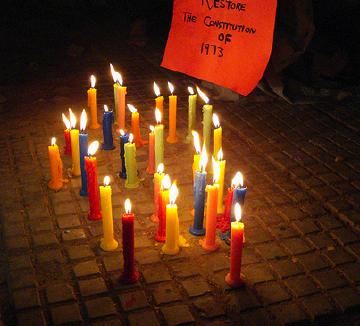
"CandleIf any place in the world understand, Pakistan understands that the struggle for human rights, for dignity and for justice cannot be confined to just one day. It cannot be a political movement of a moment. Of a certain profession or of a certain class or a certain grouping. It has be to a struggle in perpetuity and a struggle of society as a whole. And therein lies the real dilemma of a deeply divided society such as our own.

The question for today is about civil society’s protest against the State’s human rights record and how the State will respond to these protests. In the grand scheme of things, however, we shall be judged by history not only by what happens to a certain general, a particular political party, a bunch of judges, a group of TV channels or a movement of lawyers. History shall judge us by whether we as a State and as a Society were able to restore and respect the dignity of and justice for the ordinary citizen – dignity and justice in all its dimensions: political, economic, social, and more. Whatever struggles we partake in today, that and that alone, must be the ultimate goal.

STEWART SELECTED EAST CENTRAL COMMUNITY COLLEGE PRESIDENT

US Fed News Service, Including US State News March 21, 2012 DECATUR, Miss., March 20 — East Central Community College issued the following news release:

An administrator from Mississippi Gulf Coast Community College in Perkinston emerged from four finalists to become the next president of East Central Community College in Decatur.

Dr. Billy W. Stewart, Vice President for Administration and Finance at MGCCC, was unanimously selected ECCC’s eighth president at the Board of Trustees meeting held Tuesday, March 20.

ECCC Board of Trustees Chairman Dr. Jimmy Hollingsworth of Lake said Dr. Stewart and Dr. Michael J. “Mike” McGrevey, were recommended for the top post following interviews of four finalists conducted by the Presidential Search Committee, composed of Board of Trustees members representing the College’s support district, which includes Leake, Neshoba, Newton, Scott and Winston counties.

Dr. Stewart received a standing ovation by board members as he was introduced by Dr. Hollingsworth at a press conference following the meeting.

“Dr. Stewart brings great community college experience and a dynamic vision for the future of ECCC,” Dr. Hollingsworth said.

Dr. Stewart, MGCCC’s Administrator of the Year for 2011-12, said he looks forward to taking East Central Community College to even greater levels of excellence. He begins his new duties on July 1, 2012.

“I am excited about working with the ECCC family and building upon the foundation as set forth by Dr. Phil Sutphin, Dr. Eddie M. Smith and the other former presidents,” Dr. Stewart said.

The other top candidates were Dr. Randall E. Lee, ECCC Vice President for Student Services; and Dr. Andrea Mayfield, Vice President for Academic Instruction/Institutional Research and Effectiveness/SACS Liaison at East Mississippi Community College in Scooba. see here east central community college

Dr. Stewart, 43, succeeds Dr. Phil A. Sutphin, who earlier announced plans to retire on June 30, 2012, following 12 years of service leading the two-year institution.

As MGCCC’s chief financial officer, Dr. Stewart oversees a budget of more than $100 million covering the college’s four comprehensive campuses and four centers. The College has an annual payroll in excess of $48 million.

Dr. Stewart’s list of accomplishments at MGCCC is numerous. see here east central community college

He organized the college’s Administrative Handbook and Personnel Manual into a new Policies and Procedures Manual making the document user-friendly and placing it on the college Web site as a searchable document for access by all college employees. He also assisted in the reorganization of the bylaws of the MGCCC Board of Trustees.

In addition, Dr. Stewart led efforts to upgrade college network infrastructure and telephone systems using a $2 million investment of local capital funds.

He recommended and led a three-year plan to phase-in a technology standard in every classroom at the college to assist with quality instruction and student access as well as installation of wireless access points at all campuses/centers. He also supervised use of $34 million in district funds to complete numerous capital projects.

Prior to joining the MGCCC staff, Dr. Stewart served as Dean of Copiah-Lincoln Community College’s Simpson County Center in Mendenhall from Jan. 2005 to July 2006, where he prepared and supervised budgets of more than $1.5 million, among other duties.

He served as Dean of Community Services at Co-Lin in Wesson from July 1997 to Dec. 2004. His duties included preparing and supervising division budgets in excess of $2.1 million. He also supervised professional and clerical staff in eight major programs. In addition, he served on the President’s Cabinet, Instructional Council and Program Review Committee.

Dr. Stewart’s education experience also includes the secondary education level. He served as assistant principal at Pearl High School from July 1993 to June 1994. He began his employment at the school in July 1990 as a social studies instructor.

Prior to joining the PHS staff, Dr. Stewart served as Alumni Field Representative for the University of Southern Mississippi in Hattiesburg, from July 1990 to June 1991.

Dr. Stewart is a graduate of USM, where he received a bachelor’s degree in history/teacher education in 1990 and earned a master’s degree in curriculum and instruction/history in 1993. He was selected Mr. University of Southern Mississippi and is a member of the USM Hall of Fame.

He completed a doctorate in school administration with emphasis in Higher Education/Community College Administration from Mississippi State University in Starkville in 1997.

Dr. Stewart and his wife, Stephanie, have four school-age children – Stephen, Will, Elizabeth and Emily. For any query with respect to this article or any other content requirement, please contact Editor at htsyndication@hindustantimes.com

40 comments posted

Comment Pages: [5] 4 3 2 1 » Show All

  1. December 14th, 2007 9:38 am

    ATTA though sounds like TADA, anti-terrorism act, has nothing to do with terrorism or law. Though it is not an anti-terrorism act yet it has same terrorising affects for ordinary citizens of Pakistan.
    It is one of the great marketing and economic skills of General (Retired) Musharraf’s regime that soon ATTA will be one of the luxury items in Pakistan. Few years back ATTA was consider one of the cheapest commodities in Pakistan. Now a days if you ask the same question the answer would be the constitution of Pakistan, the cheapest commodity in Pakistan. And if you are a COAS do whatever you want with it nobody cares about. It has become the most worthless piece of document in Pakistan.
    If ATTA had any thing to do with supreme court, lawyers, Constitution or media we would have seen Musharraf regime working over time to arrest its ascendancy by using all its might.

  2. Rafay Kashmiri says:
    December 13th, 2007 6:07 pm

    ATP,

    @ what a contradiction between Human Right’s blog
    and Hoodbhoy’s blog which is just the opposite.

    This is called Hypocracy of colonials.

  3. Nayab Khan says:
    December 13th, 2007 8:58 am

    I am so furious to learn that Musharraf is removing the ban on third term for PM.
    Thants it!, he has lost my support from now.

  4. MQ says:
    December 13th, 2007 1:20 am

    One of the biggest irony of current Administration in Islamabad is that it even has a Human Rights division and the caretaker minister of the division is Ansar Burney, known for his work on prisoners’ rights.

    On the World Human Rights Day he spent time visiting jails. But it never occurred to him to question why the sacked judges are under continued house arrest along with their families. And why are the most prominent lawyers of Pakistan are still in jails or under house arrests?

  5. Daktar says:
    December 12th, 2007 11:37 pm

    Hey, The News just carried a version of this post, and with attribution. See here:
    http://thenews.jang.com.pk/daily_detail.asp?id=85827

  6. Nayab Khan says:
    December 11th, 2007 2:00 pm

    Sure, no one is indispensable and i agree that we should take care of our freedoms.
    To clear our indifferences we should respect each other and agree that the only way forward is to Peacefully attend to elections, be guard at polling stations and fight against any rigging at the stations. Let the parliment decide on all the issues.

  7. December 11th, 2007 1:32 pm

    Nayab Khan missed the whole point. Like a self-righteous idealogue you emphasised only theliteral understanding of an argument. Entire edifice of your theory is based upon those arguments which you find unacceptable and untenable if put forth by anybody other than you. The point I want to make is that no one is indispensable and it is about time that we shouldas responsible citizens shrug off present state of indefference and absenteeism because if we are indefferent
    in situations of injustice that amonuts to choosing the side of the oppressor.I believe that as long as we do not take care of our freedoms, those either in khakis or in civilian outfits who wish to tyrannise us will do so.

  8. Nayab Khan says:
    December 11th, 2007 11:21 am

    *Most of the founders of kingdoms and states were brutal killers

Comment Pages: [5] 4 3 2 1 » Show All


Have Your Say (Bol, magar piyar say)

Please respect the ATP Comment Policy.

Keep comments on topic; no personal attacks; don't submit indecent, inflammatory, slanderous, uncivil or irrelevant comments; flamers and trolls are not welcome; inappropriate comments will be removed or edited.

If you won't say it to someone's face, then don't say it here!

Readers who want to use a URL should please use the TINY URL program.

Thanks, and keep the comments coming!