English translation is given at the end.
Following ‘azad’ poem is by one of my favourite writers, Shafiq-ur-Rehman and it comes from his book ‘lehreN’. The poem is actually a satire on modern day poets who write ‘azad’ Urdu poem by using all the ‘azadi’ they can get. The poem describes a situation of fighting cats in a garden. I hope it brings a smile to you just like it has been bringing smiles to me for the past 20 years.
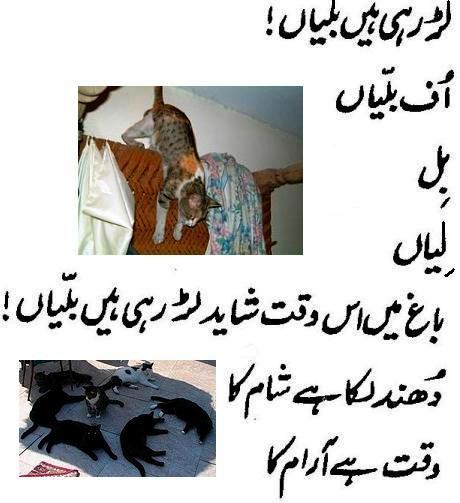
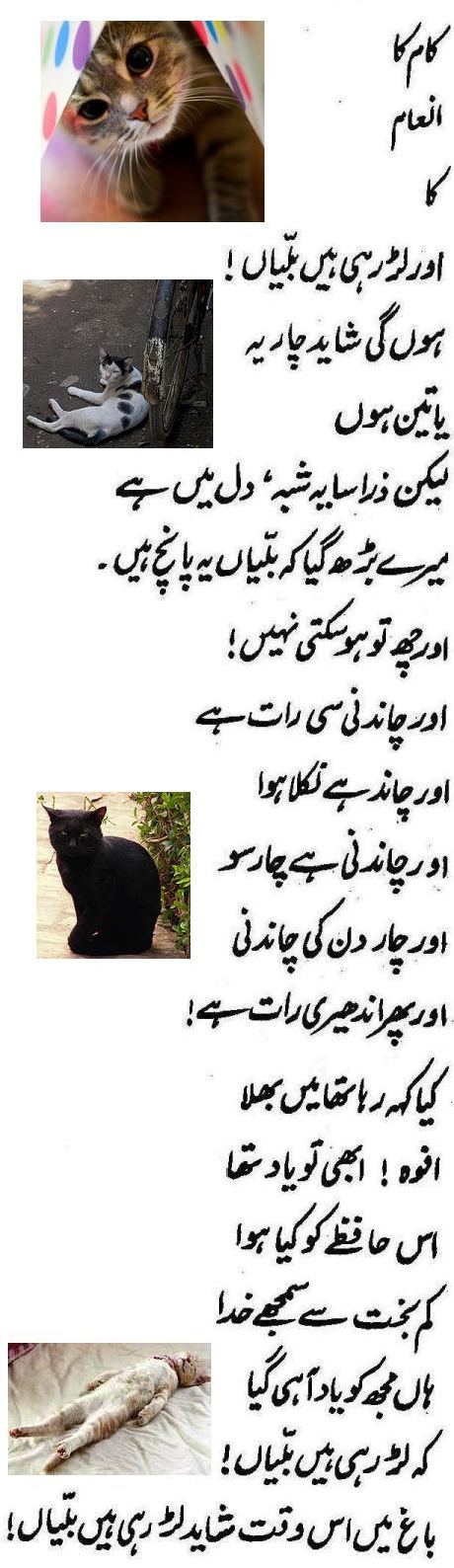
Here is my attempt at an approximate translation for our English readers:
Cats are fighting
Oh Cats
Caaaa…
…tsss
May be cats are fighting in garden now
There is the haze of dusk
It is time to rest
to work
to
get rewarded
And cats are fighting
May be they are 4 in number
or may be 3
But this little doubt has made house in my heart
that the cats are 5 in number
and definitely they cannot be 6
and the night is glowing in moonlight
and the moon is shining bright
and the moonlight is ubiquitous
and this moonlight will only last for a little while
and then there is a pitch dark night ahead
What was i saying?
Aah, it just slipped out of my mind
What happened to my memory?
Only God can fix it
Oh Yes, I just remembered!
the cats are fighting
Cats are probably finghting in the garden now!
Photo Credits: Flickr.com






Shafiqur Rehman’s escapism is the best remedy for a Pakistani youth growing up in Post Jinnah era. I think one of his works made its way in the FA course books, but this is not enough. His books should be introduced earlier and made compulsory for treatment of widespread malencholy in our society.
Dear Brothers and Sisters: Would you please write me as to when Shafiq sahib left us for his eternal life? Also, where is his final resting place? I would love to visit his final abode one of these days and offer my respect and thanks. Long live Shafiq Bhai sahib!
Dr. Shafiq’s books have been my most favorite ooks since 1947 when I was in Grade 9 in NWFP. Then I read his Barsati and that made me fall in love with Andalusia (Spain), so that finally my wife and I traveled there and the experience was worth the trip and will remain unforgetable till the end of my life. Here in Cleveland, OH, I have all the books writte by Shafiq. May God reward him for all the happiness he has given his millions of fans. Thanks, Shafiq Bhai!
From the same mazahiya mushA’era, the parody on Parvin Shakir’s poem:
“bAdbAN khulne se pehlE kA ishAra dEkhnA
maeN samandar dEkhtI hUN tum kinAra dEkhnA”
the parody:
ghUmna maQsad hamAra mulk sAra dEkhnA
maeN karAchi dEhti hUN tum hazAra dEkhna
iss dafA ghar kE bajaT mEN tum KHasAra dEkhna
maeN to pehli bAr dEkhUN tum dubAra dEkhna
maTinE show mEN chalEN ge “jaT da puttar” dEkhnE
maeN to apnE paesE dUN gi tum udhAra dEkhna
At the mention of that Mazahiya Mushaira…..I also recall a parody of Raees Amrohi with the following sher:
“Ab Kaam mil gaya hae hamen Abdoz pe
Gehre samandar-on ki ser kar rahe haen hum”
Dear Pakistan and my Pakistanies fellow,for the sake of Allah please take care of each other and don’t fight. try to save pakistan .Its my humble request to all of you who has power to do so .I hope Allah will help you and me.
Pakistan Zinda baad .( Inshallah)
@mozang bijli: I think I am old enough to have heard it myself, but perhaps too old to remember when and how ;-) I seem to have a vague notion that it was a comedy program (quite possibly 50/50)?
@ Adnan Ahmad: Thanks for pointing that out, I will now have to look up the Jaun Elia book, or at least the full poem on teh internets… I discovered Jaun Elia late, but I can understand fully how one can feel about his works… The effect is powerful!
Taban.Khamosh,
Just reading your comment I think this seems to be a direct shot at Jaun Elia’s famous lines ..” kia wo giroh guzar guyai, haan wo giroh guzar gayai– kia wo bisaat ulat guyee, haan wo..”
It is heartening to see people comment about a writer whose work will always remain a dear part of me.