English translation is given at the end.
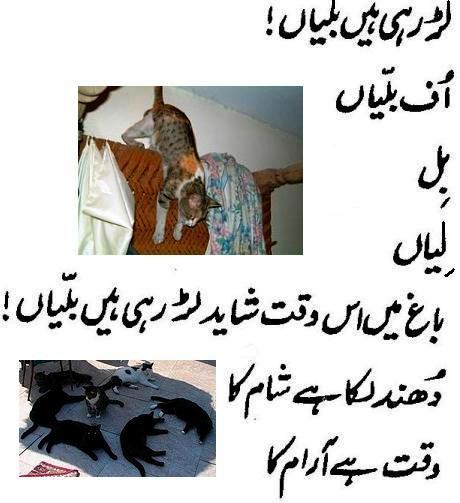
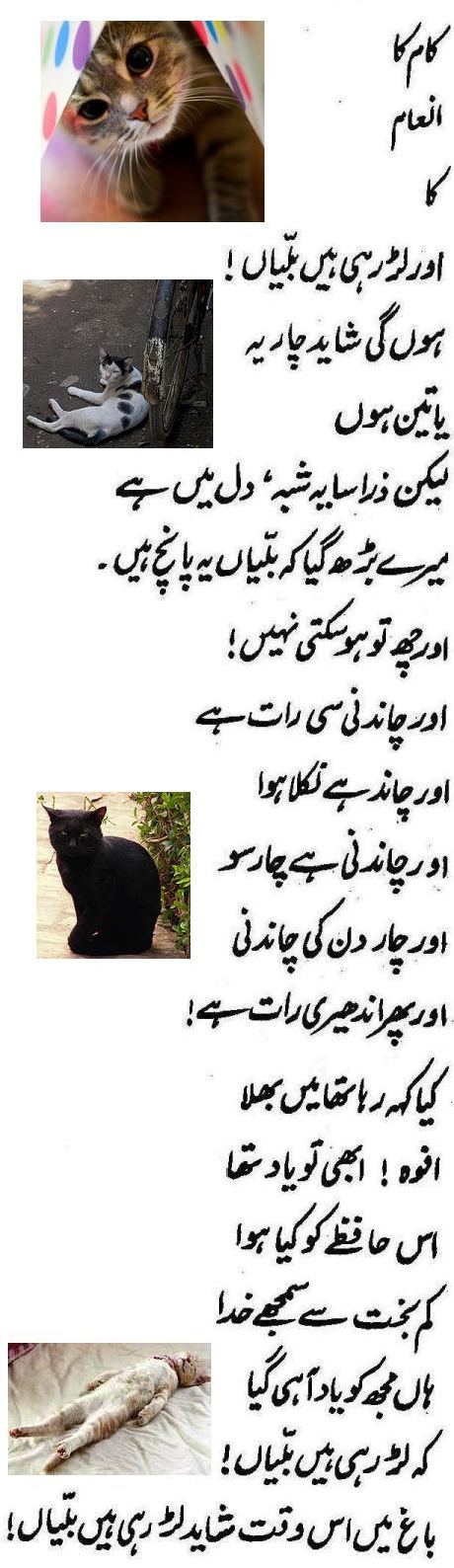
Following ‘azad’ poem is by one of my favourite writers, Shafiq-ur-Rehman and it comes from his book ‘lehreN’. The poem is actually a satire on modern day poets who write ‘azad’ Urdu poem by using all the ‘azadi’ they can get. The poem describes a situation of fighting cats in a garden. I hope it brings a smile to you just like it has been bringing smiles to me for the past 20 years.
Here is my attempt at an approximate translation for our English readers:
Cats are fighting
Oh Cats
Caaaa…
…tsss
May be cats are fighting in garden now
There is the haze of dusk
It is time to rest
to work
to
get rewarded
And cats are fighting
May be they are 4 in number
or may be 3
But this little doubt has made house in my heart
that the cats are 5 in number
and definitely they cannot be 6
and the night is glowing in moonlight
and the moon is shining bright
and the moonlight is ubiquitous
and this moonlight will only last for a little while
and then there is a pitch dark night ahead
What was i saying?
Aah, it just slipped out of my mind
What happened to my memory?
Only God can fix it
Oh Yes, I just remembered!
the cats are fighting
Cats are probably finghting in the garden now!
Photo Credits: Flickr.com




AOA to alls
It is a very good post and I really like it.It is afunny post.Cat is a very quete vet animal and I like cat.I have a cat in my house.
In the previous post on Ibn-e-Insha, I was disappointed to find no refernce to Shafiq-ur-Rehman’s writings. He was indeed a pioneer of clean humor in Urdu – while in school (and college) I used to read his set of books every year.
This beautiful post reminded me of the good old days. Thanks.
@ Billi kay hathon cheenka toota = PML Q
Billi hamesha umnay punjon par girti hay = PPP
Chichron key pehray par billi ko bithadia = Mushy’s Govt.
Billi ko khuaab mein chichray nazar attay hein = JUI Faz
Billi nau-so chohay khakar Haj pay chaali = MQM
Billi thailay say baher aa gai
Owais, thanks for posting this regarding one of the greats of Urdu literature.
Dr. Shafiq-Ur- Rehman was an Icon of Urdu humor and his works remain evergreen. He created unforgettable characters in his writings such as Maqsood Ghora, Shaitaan and Hukumat Apa. During my college days, I picked up Himaqatain and just couldn’t let go until I had read through most of his works.
Not bad for a General….right?
Shafiqur Rehman is one of my all time favorites . His humorous writings, particularly relating to students of all ages, are the best that I have seen. My cousin and I used to double up laughing at some of his hilarious write-ups. This article brought to mind a couple of more verses, also related to “azad shA’eri” (could be from the same book that Owais is quoting from):
1) abr ha’e sabzA hae aur gulzAr hae
kahIN zukAm na ho jA’E
2) zEr’e dIvAr khaRE haeN tera kyA lEt-e haeN
hum koi chOr haeN?
Related to “cats” his description of the questioning of a child by an examiner remains etched in my memory:
Examiner: Could you tell me how many eyes a cat has?
Child: two
Examiner: and how many ears?
Child: two
Examiner: and how many legs
Child: four
Examiner: Very good. And how many tails?
Child: Uffoh! Have you really not seen a cat?
Cool Analogy of Pak Political scenario!
keep it up.
sajjad
@ SYASSI BILLIAN,
Billian jo ho gai hein syssatda’n
kisqadar nepaed hogaya syssatda’n
bhich gaya jab syassi-dusterkhuan agar
khichi aien gi,mundlati hoi sab billian
huddian bhamborti, larti hoi ye billian
bula laati hein Billon ko bhi, ye billian
billian, nafri mein gar kam hon, to kiya
gintiu’n mein jo subqat lejati hein billian
ne mano jo aik din, akathi hojain ye billian
syssatdan billon ko bhaga deingi ye billian
in kay nakhray, ayarian, shustbazi bhi inki
Baray jugadrion ko lita dein ye chend billian
Akhaara-e-syassat mrin sirf suni h
funny take on Azad shairi.
After reading Shafique ur Rehman, I realized that most of the akhbare jahaan and nounehal etc joke section had jokes derived from his works.
some of his essays tended to be somewhat lingering on and on.
but some were outright hilarious. my personal favorite is “99 not out” from himaqatain I guess. anyone read that ?
99 not out was one of the first chapers I read from his books. It had mostly to do with Cricket’s love in our family.
billi nay deya bach-chay
Allah mian sach-chay
This brought back many wonderful memories going as far back as those long endless summers of 6th grade when I first read “neeli jheel” and “hamaaqatein.” I would be a different man if I didn’t read Shafiqurahman’s books. I am also a fan of his serious prose in “insaani tamasha” (a translation), kirnain etc. A few in an other post have mentioned tuzk-e-jahangiri; I suggest they should also read SR’s tuzk-e-naadri.
Adnan
”neeli jheel” is indeed a chapter that always sends me in another world of fantasy and nostalgia. It has lessons on life philosophy also especially the ones told by a character ‘Rustum’ who was the servant in the household.
@ Owais
Shafiq ur Rehman nay kiya khoob kaha hay
“Tasswurat ki neeli jheelain or doosray kinaray Umr bhar insan ka peecha nahi chortay”
Lat night I was reading Shafeeq-ur-rehman’s Himaqatain, and I said to my better half, “Someone should really write a in-depth on essay on him, I know so little about one of the greatest urdu Humorist, who was he, other then that he was a general, doctor and a dil phaik
I guess I was being clairvoyant:)
Shukriya
This reminded me of these few lines.. I don’t remember who said these.. I think it was on fifty fifty or something? no idea, anyhow:
Kiaa voh saRak hu’ie tamaam?
haaN voh saRak hu’ia tamaam.
kiaa voh Tarak guzar ga’ay?
haaN voh Tarak guzar ga’ay.
murGh-o Shutar kay darmi’yaaN
gaa’aeN raheeN nah bakri’yaaN
maeray tamaam chaarah gar
ghar maeN jo thaa voh char ga’ay
Anyone know the origins of the above piece?
@ taman khamosh
i do’nt know that exact origin of this poem but reportedly it was presented in some of PTV’s comedy program in which bushra ansari played the part of a an azad shaira. I m too young to clearly remember this program but this is what i have heard from my elder’s because this line “kiya woh sarak hoi tamam, haan woh sarak hoi tamam” is very popular in our family.
And Owais sb thanks a lot for thie great post on Shafiq -ur rehman. Neeli jhel is nostalgic. I am a great fan of shafiq sab and my favorite among his character is “Shaitan” who kept falling for any thing wearing a duppata and insisted on genuineness of his sentiments saying “mujhay mohabat se sakht mohabat aur nafrat se sakht nafrat hoti ja rahi”. Another interesting character was “ainak appa”. Shaitan once got offended with ainak appa and said “shaitn ainak ki is baat per bohat khafa howe aur unhon ne socha key ainak appa ko iss ki baqaida saza di jaye , yani un se mohabat ki jaye”
Taban.Khamosh,
Just reading your comment I think this seems to be a direct shot at Jaun Elia’s famous lines ..” kia wo giroh guzar guyai, haan wo giroh guzar gayai– kia wo bisaat ulat guyee, haan wo..”
It is heartening to see people comment about a writer whose work will always remain a dear part of me.
@mozang bijli: I think I am old enough to have heard it myself, but perhaps too old to remember when and how ;-) I seem to have a vague notion that it was a comedy program (quite possibly 50/50)?
@ Adnan Ahmad: Thanks for pointing that out, I will now have to look up the Jaun Elia book, or at least the full poem on teh internets… I discovered Jaun Elia late, but I can understand fully how one can feel about his works… The effect is powerful!
Dear Pakistan and my Pakistanies fellow,for the sake of Allah please take care of each other and don’t fight. try to save pakistan .Its my humble request to all of you who has power to do so .I hope Allah will help you and me.
Pakistan Zinda baad .( Inshallah)
At the mention of that Mazahiya Mushaira…..I also recall a parody of Raees Amrohi with the following sher:
“Ab Kaam mil gaya hae hamen Abdoz pe
Gehre samandar-on ki ser kar rahe haen hum”
From the same mazahiya mushA’era, the parody on Parvin Shakir’s poem:
“bAdbAN khulne se pehlE kA ishAra dEkhnA
maeN samandar dEkhtI hUN tum kinAra dEkhnA”
the parody:
ghUmna maQsad hamAra mulk sAra dEkhnA
maeN karAchi dEhti hUN tum hazAra dEkhna
iss dafA ghar kE bajaT mEN tum KHasAra dEkhna
maeN to pehli bAr dEkhUN tum dubAra dEkhna
maTinE show mEN chalEN ge “jaT da puttar” dEkhnE
maeN to apnE paesE dUN gi tum udhAra dEkhna
Dr. Shafiq’s books have been my most favorite ooks since 1947 when I was in Grade 9 in NWFP. Then I read his Barsati and that made me fall in love with Andalusia (Spain), so that finally my wife and I traveled there and the experience was worth the trip and will remain unforgetable till the end of my life. Here in Cleveland, OH, I have all the books writte by Shafiq. May God reward him for all the happiness he has given his millions of fans. Thanks, Shafiq Bhai!
Dear Brothers and Sisters: Would you please write me as to when Shafiq sahib left us for his eternal life? Also, where is his final resting place? I would love to visit his final abode one of these days and offer my respect and thanks. Long live Shafiq Bhai sahib!
Shafiqur Rehman’s escapism is the best remedy for a Pakistani youth growing up in Post Jinnah era. I think one of his works made its way in the FA course books, but this is not enough. His books should be introduced earlier and made compulsory for treatment of widespread malencholy in our society.
wah bhai! jazak Allah…this sure brought a smile!
A very informative piece on Shafiq-ur-Rehman appears in today’s Dawn here
i love shafiqulrehman’cos he gave me a philosphy to live .
Thanks Owais Saheb
I was looking for this nazm Billiyan for a long time. I was very happy to see it here. I have copied and pasted it in my blog
shakilakhtar.wordpress.com, and I forgot to obtain your permission first. I was very excited actually.I am sorry for it please.Remember Pachhtaawe ?An excerpt from it:
ایک شخص پئے ہوئے میرے پاس آیا- اس کے ہاتھ میں ایک تار تھا جو اس کی منگیتر کے نام تھا- اس نے بتایا کہ اگر یہ تار اسی وقت نہ بھیجا گیا تو منگنی ٹوٹ جانے کا اندیشہ ہے تار کے الفاظ یہ تھے
میائوں، میائوں، میائوں، میائوں، میائوں،اور پھر میائوں
میں نے اسے بتایا کہ اسی لاگت میں وہ ایک اور لفظ شامل کر سکتا ہے-
کچھ دیر سوچنے کے بعد اس نے مجھ سے پوچھا کہ کون سا لفظ شامل کیا جائے? میں نے بتایا کہ کیوں نہ ایک اور میائوں لکھ دی جائے – وہ سر ہلا کر بولا – ایک اور میائوں، ہرگز نہیں – کوئی تار پڑھے گا تو کیا کہے گا
Ek shakhs piye hue mere pass aya us ke hath mein ek taar tha. Jo us ki mangetar ke naam tha. Us ne bataaya ke agar yeh taar usi waqt na bheja gaya to mangni toot jaane ka andesha hai. Taar ke alfaaz yeh the:
miaaooN, miaaooN, miaaooN, miaaooN, miaaooN, aur pher miaaooN,
maiN ne use bataya ke isi laagat meiN who ek aur lafz shaamil kar sakta hai.
Kuchh der sochne ke baad us ne mujh se poochha ke kaun saa lafz shaamil kya jaye.
main ne bataaya ke kyooN na ek aur miaaooN likh di jaye.
Who sar hila kar bola, ek aur miaaooN, hargiz nahiN, koyi taar paRhe ga to kya kahe ga.
Shakeel Saheb, good to see your comment. With ‘miaoon miaoon’ i also remember a chapter from Shafiqur Rehman’s book ‘hamaqaten’ called the ‘Club.’
Speeches were going on in the club. Hall was full. Author gets a place at the back of the hall which is right at the threshold of loud-speakers’ amplification distance. Here he could hear some words and the rest is filled with static which sounds like ‘miaoon miaoon’ when ladies spoke and ‘bhoon bhoon’ when gents spoke.
Few sentences of that chapter go like this :)
“aaj ka din kitna mubarak hai ke …miaoon. sab khwateen…. miaoon miaoon….woh din gaye ke khawateen.. miaoon, mard …miaoon – aur dono miaoon miaoon miaoon…”
:)
mujhe baRa afsos hai ke ….bhoon bhoon..zid se kaam nahi chale ga.. ek doosre ki bhoon bhoon – aur phir aapas mein mil kar bhoon bhoon bhoon ..(taaliaaN)
Uwais Sahab
Great. As I read your miaoon miaoon I could not controll my hansi and my wife was annoyed as she is watching a drama.
I had forgotten this episode. But now I rember another where someone changes channels of a radio again and again and the taqreer takes a turn at the crucial point every time and becmes very funny as a whole.