I am looking for an address on Street No. 8 in an upscale residential area in Islamabad. The area is laid out somewhat like a rectangle. I start from one end of the longer side of the rectangle, driving slowly westward and looking out for street signs. Soon I spot the first sign that says Street 1 and then another that says Street 2. Reassured, I continue onwards in my search. The next street sign says Street 4. What happened? Did I miss Street 3? Anyway, I continue moving. Soon I see Street 5 and feel reassured again. The next sign that I see is Street 7. Did I jump a street again? Well, never mind even if I did.
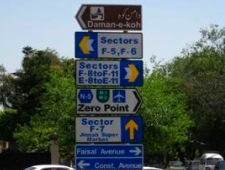
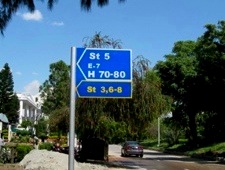

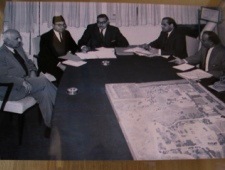
The bottom right photo in the above set shows a meeting of the Commission which was designated with the task of naming Islamabad Streets. 1960.
Since the numbers I have seen so far are in ascending order, Street 8 has got to be ahead. So, I continue driving and looking for street signs a bit more watchfully. Suddenly there is Street 17! No way! I couldn’t possibly have missed eight streets in a row. Something is weird here, I tell myself. A little confused, I drive all the way to the end of the road and then swing over to the other side of the rectangle and start driving eastward. The first street I spot is 21 and then, after a while, Street 10! Since the numbers are decreasing, maybe, I will find Street 8 somewhere ahead. But then the next street sign says 5! I am totally frustrated and give up the search and go back home telling myself to come back some other day, after I have done some homework on the geography of Islamabad.
This was some years ago when I had just moved to Islamabad. Now I am a little wiser and can find an address relatively easily. Actually, there is a method in what appears to be madness in numbering the streets of Islamabad. You discover the method when you begin to walk rather than drive. (Incidentally, with all the greenery and the trees, walking in Islamabad is a pleasant experience.) The streets, particularly in the older sectors, are laid out somewhat like a tree. If you imagine the trunk of a tree to be a main road, the first branch on the trunk will be Street 1 and the little branchlets that take off from this branch will be numbered 2, 3 and 4 etc. The next main branch on the trunk will, therefore, be Street 5 and so on. In other words when you are moving along the trunk you will see Street 1 and then Street 5. That should explain the phenomenon of missing streets.
I wonder if the way we plan our cities has something to do with the Eastern mind (as opposed to the Western mind). I am not saying one is better than the other. It is just that Eastern mind thinks and visualizes things differently. While the Western mind (or the Western trained mind) thinks in rather straight lines we in the East think more in a circular fashion. Take, for example, New York (Manhattan) that was built over 150 years ago. The city was laid out on a grid, like most large cities of the US. All you have to know is the street address and the name or number of cross street, and you will find the address without much difficulty, even if you are a complete stranger. On the other hand in modern Islamabad, which is a much smaller city, one has to run in circles, literally, to find an address.
I must add, though, that the Eastern way of thinking and planning may not be as efficient but it certainly is more interesting — and can be adventurous.
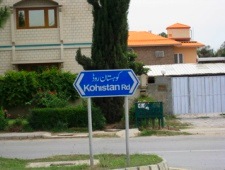

By the way, the Capital Development Authority (CDA), realizing the problem that people faced in finding the streets (even the postmen and couriers had problems), has lately provided additional information on the street signs. They now also indicate if a street is a ‘closed End’ or if other streets branch off from it.
While the streets are numbered, the roads and avenues are named after people, and sometime after places. But who names them and what kind of thinking goes into the process is not clear — at least not to the citizens of Islamabad who have to live with these names.
The road names that one comes across in Islamabad suggests that they are chosen randomly depending on the social or political philosophy of the person(s) who happen to be responsible for naming the streets at a given time.
Only recently, in a hard-hitting column in Dawn, Kamran Shafi rightly questioned the apparent lack of logic in naming a newly built major avenue as Agha Shai Avenue. Why Agha Shahi, of all the people? Agha Shahi was a career civil servant who ended up as a foreign minister in Ziaul Haq‘s cabinet. Going by this criterion there were several other foreign ministers, equally competent and far more distinguished, than Agha Shahi. Aziz Ahmed, a career civil servant turned foreign minister in Bhutto’s cabinet and Chaudhry Zafrullah Khan, Jinnah’s own choice as the first foreign minister come to mind immediately.

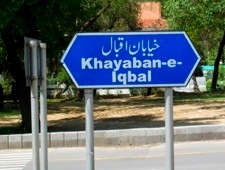
One of the most beautiful roads in Islamabad, passing along the foot of the Margalla hills is officially called Khayaban-e-Iqbal. No quibbles with naming a road after Iqbal, the Poet of the East and one of the founding fathers of Pakistan, except that the name does not easily stick in people’s mind. They call it Margalla Road, which was probably its original name. It was a descriptive name, too, and rolls over a Potoahri tongue more easily. Ask any taxi driver to take you to
Margalla Road and you will be there. But if you ask him to take you to Khayaban-e-Iqbal be prepared to tour the whole city.
Then we have the mandatory Jinnah Avenue and a Shaheed-e-Millat Road. No problem with that, but I never understood when a road qualifies to be an Avenue and when does it become a Khayaban. Is it that the word Avenue sounds good with persons like Jinnah while the Persian word Khayaban is more appropriate for the ‘Poet of the East’? I guess Ataturk Avenue was named an avenue following the same logic.
I think it was Karachi’s Defense Society (now Housing Authority) that started using the term Khayaban extensively for its major roads. And, it made sure that the names leave no doubt in anyone’s mind to whom the Society belonged — Khayaban-e- (Mujahid, Muhafiz, Shamsheer, Shujaat, Momin, Tauheed, Hilal, and so on).

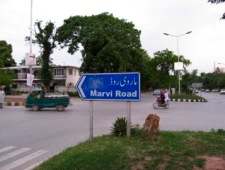
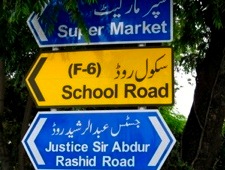
Back to Islamabad, we also have some interesting and non-conventional names such as Marvi Road. It is named after the heroine of famous Sindhi love legend ‘Umar and Marvi’. I wonder whose idea was it? And, why not also a road named after Heer, Sohni or Sahiban? (They have a road named Warish Shah, though.) Imagine a Khayaban-e-Heer, a Sohni-Mahinwal Avenue, or a Mirza-Sahiban Road winding past the Lok Virsa buildings. They all have nice ring to their names. And I bet, these names would stick in people’s mind far more easily than, say, Justice Sir Abdul Rashid Road.
Yes, we have a road named Justice Sir Abdul Rashid Road. I asked a woman teacher, who teaches in a private school located on the same avenue, who Justice Abdul Rashid was. Her answer was,
“no idea, koi judge vudge ho ga.”
My guess is that nine out of ten people in Islamabad do not know who Justice Abdul Rashid was or what was he known for. I wonder how many people on ATP would know. On the other hand, far more people have heard of Justice Cornelius, Justice Kiyani and Justice Hamoodur Rehman.
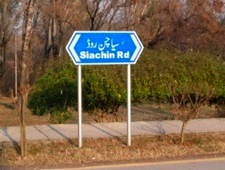

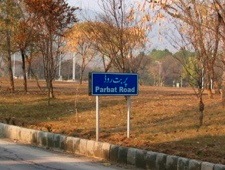
We also have a road named after the now famous glacier in the Himalayas — Siachen Road. It must have been named when we lost the glacier to Indians, as if to compensate for the loss. By the same token we should also have a kargil Road.
Then we have a road named Ismail Zabeeh Road. Does anyone know who Mr. Zabeeh was?

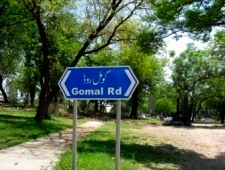
Then there is a well-known road with this odd name ‘I. J. Principal Road’. I was not able to figure out who or what I. J. Principal is or was.
We also have a road named after the Mughal king Aurangzeb. I wonder why do we ignore Babar, Akbar and Shah Jahan. Omitting Jahangir is understable because he remained too drunk and involved with women most of the time.
To my pleasant surprise, I recently found that there is also a road named after Parveen Shakir. It’s a service road that joins the ‘Margalla Road’ near Faisal Mosque. Perveen Shakir died in a car crash at about this spot — at age 42. She would pass this spot almost daily while going to her office. The road sign that says Parveen Shakir Raod stands, like a tombstone, as a poignant reminder of the untimely death of the young popular poet.
Aks-i-khushboo hoon, bikharnay say na rokay koi
Aur bikhar jaayoon tau mujh ko na samaitay koi
Ab tau is raah say woh shakhs guzarta bhi nahin
Ab kis ummeed kay darwaazay say jhankay koi




В наши дни интернет представляет собой неотъемлемой составляющей нашей жизни.
Он открывает быстрый доступ к огромному объёму данных.
Благодаря всемирной паутине мы можем взаимодействовать с близкими и партнёрами в любой точке мира.
Для работы, обучения и бизнеса сеть стала в главный инструмент.
https://writexo.com/share/81b2ab394563
Помимо этого, он предоставляет неисчерпаемые варианты для отдыха и саморазвития.
Без интернета в современном мире трудно вообразить как домашние, так и профессиональные задачи.
Именно поэтому наличие к стабильному интернету считается базовой потребностью современного человека.
Часы AP Royal Oak известны своим революционным внешним видом.
Эту восьмигранный безель с видимыми винтами является подлинной иконой в мире часов.
Данная серия была выпущена в 1972 году как первые роскошные часы для спорта из нержавеющей стали.
Эта дерзкая идея тогда произвела настоящий фурор в отрасли.
настоящие Royal Oak
Помимо дизайна, модель славятся за высочайшее качество обработки и калибра.
Известно, что любой экземпляр собирается собственноручно квалифицированными мастерами.
Сегодня Royal Oak остаются символом положения и тонкого вкуса.
Поэтому они востребованы как среди коллекционеров, так и у поклонников премиум-класса.
Молодечно — город, который умеет удивлять. Казалось бы, обычный райцентр, но сколько в нем интересного! Старинный вокзал, необычный фонтан, пешеходная улица, отличные парки, древние валы. Снимите квартиру на сутки и убедитесь, что Молодечно заслуживает внимания туристов. Это город, в который хочется возвращаться снова и снова, открывая для себя новые уголки и детали, незамеченные в прошлый приезд. снять квартиру на сутки молодечно
Premium watches continue to remain popular despite the rise of modern gadgets.
They are often seen as a sign of prestige and refined taste.
Expert workmanship plays a major role in their lasting value.
Many luxury watches are produced using high-quality materials.
https://bagcodex.livejournal.com/
They also represent a deep history passed down through generations.
For collectors, these watches can serve as both functional accessories and valuable assets.
Elegant styling allows them to stay relevant across changing fashion trends.
Ultimately, luxury watches continue to attract admirers around the world.
Соблюдение температурных зазоров. При монтаже сайдинга в Молодечно мы оставляем технологические зазоры между панелями, так как материал расширяется и сужается от температуры. Это предотвращает коробление и деформацию.
saydingminsk.ru