Custom Search

Gen. Pervez Musharraf Resigns: Video and Pictorial

Posted on August 18, 2008
Filed Under >Adil Najam, Politics
205 Comments
Total Views: 53942

Share

Adil Najam


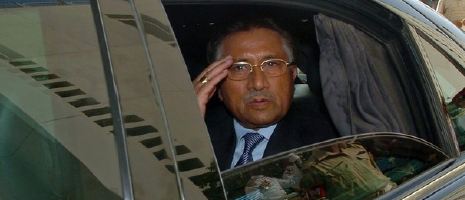
In a nationally televised speech, Gen. Pervez Musharraf, President of Pakistan, has just announced his resignation, pre-empting a move to impeach him by the parliament.

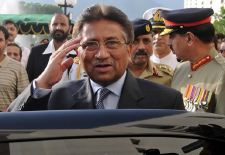
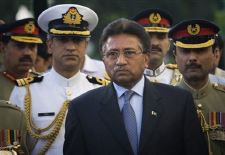
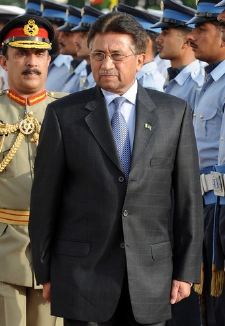
This post has been updated to add news photos from this momentous day in Pakistan’s political history. The pictures speak eloquently of the moods and thoughts of the day. (Scroll down to see the video of Gen. Musharraf’s resignation speech).


Participate in a poll on what might be Pakistan’s future post-Musharraf, here.


Your Ad Here

Here is a Pervez Musharraf time-line, published in The News:

August 1943: Born in Delhi, India

1964: Joins Pakistani army.

1998: Becomes army chief of staff.

October 1999: Seizes power in a bloodless military coup, overthrowing the prime minister, Nawaz Sharif. In response, the Commonwealth suspends Pakistan’s membership.

June 20 2001: Makes himself president, replacing Rafiq Tarar, while remaining head of the army. Tarar is forced out of office when the parliament that elected him is dissolved.

July 2001: Holds first meeting with the Indian prime minister, Atal Bihari Vajpayee, at Agra in India. No progress is made because of differences over the disputed territory of Kashmir.

September 2001: George Bush courts Musharraf, asking him to join him in his “war on terror” and help defeat the Taliban in neighbouring Afghanistan. The US president promises Pakistan $1bn in aid.

April 2002: Wins a referendum giving him another five years in office. Observers criticise the referendum as blighted by irregularities.

May 2002: Pakistan test fires three medium-range surface-to-surface missiles capable of carrying nuclear warheads. Musharraf insists his country would not be the one to initiate war.

August 2002: Consolidates his power still further, giving himself the right to dismiss an elected parliament.

October 2002: Pakistan’s first general election since Musharraf seized power in 1999 results in a hung parliament.

November 2002: Mir Zafarullah Jamali becomes the first civilian prime minister since 1999. He is a member of a Musharraf-supporting party.

November 2003: Pakistan’s National Assembly meets for the first time since 1999.

December 2003: Musharraf promises to step down as head of the army by January 2005.

May 2004: Pakistan is readmitted to the Commonwealth.

December 2004: Musharraf announces he will stay on as head of the army.

August 2005: Pakistan tests its first nuclear-capable cruise missile.

March 2007: Musharraf suspends the chief justice, Iftakar Mohammed Chaudhry, triggering a wave of anger across the country and the first joint protests held by the parties of exiled former prime ministers Benazir Bhutto and Nawaz Sharif.

October 2007: Signs a corruption amnesty, opening the way for Bhutto’s return and a possible power-sharing agreement. Within hours of Bhutto’s arrival back in the country, bombers attack a Bhutto rally in Karachi, killing more than 100 people.

November 2007: Declares a state of emergency, rounding up opposition leaders at gunpoint. In the same month, Musharraf quits as head of the army, becoming a civilian president.

December 15 2007: Lifts state of emergency and announces plans to go ahead with parliamentary elections scheduled for January 8.

December 27 2007: Benazir Bhutto is assassinated at an election rally in Rawalpindi.

January 2008: Elections postponed until February 18.

February 2008: The two main opposition parties gain a clear majority in the elections.

August 2008: The two main parties strike a deal to impeach Musharraf if parliament backs the move.

August 18 2008: Musharraf announces his resignation

205 comments posted

Comment Pages: « 2623 22 21 20 19 [18] 17 16 15 14 131 » Show All

  1. August 19th, 2008 6:30 am

    I think the lesson for us all who no doubt at one stage were Musharraf supporters including me is best captured in my post on the topic see it here – http://tinyurl.com/5towhb

    Particularly true are the words in the post that said ‘ the lesson for us all is that so called good-intentioned khaki kings like Musharraf serve only as an enemy within, they must be resisted from day one and must be treated as an enemy of the state, period’

    Food for thought indeed.

    Feimnallah

    Wasim

  2. Steve says:
    August 19th, 2008 6:25 am

    To Mr. Mujtaba,

    I have done the reshearch for all these points listed below, I live in a middle eastern country and for a company that is related to financial news . This article was not written by me but was writted by a reporter. So why don’t you give me 30 points of what these two new leaders that you support have done for the country….Enjoy

    Mirza Rohail Baig

    An effective and successful manager manages his company with whatever resources he/she has, and manages to gear it towards an unprecedented growth and prosperity, utilizing all internal and external factors. Musharraf has proven himself to be the manager for Pakistan!

    Multi-National Corporations (MNC

  3. Qasim says:
    August 19th, 2008 5:37 am

    bumsqueak says:

    > Is it possible that anti musharraf hysteria is primarily a result of reaction to rampant inflation, economic woes and people just seeking a

  4. Mahmood says:
    August 19th, 2008 5:30 am

    Democracy Mubarak…Ab maza aae ga!

  5. Killer Billi says:
    August 19th, 2008 5:29 am

    > I

  6. Qasim says:
    August 19th, 2008 5:19 am

    After reading all the comments of Musharraf’s supporters, I made some observations.

    First, they don’t even mention the controversies surrounding Musharraf’s rule! They talk of the free press, but they don’t talk of the abused TV reporters and journalists. They’re more interested in talking about how Musharraf made some admittedly much needed progress for woman rights, but sacked the judiciary and judges (guess what, if we don’t have a functioning law system, then what he did for women doesn’t mean an iota). In short, like Musharraf himself in his resignation speech, they believe in self-created delusions where Pakistan was some blooming nation of prosperity and flowing rivers of milk and honey. Go out in the streets of Pakistan and see what your beloved dictator has achieved! The truth is in front of you, time to face the facts and improve democracy in Pakistan just like Musharraf did by removing himself from the process.

  7. Qasim says:
    August 19th, 2008 5:10 am

    Yasser Latif Hamdani, thanks for being one of the few sane and reasonable voices in here. Among the mindless Musharraf supporting drones, it is very hard to find credible argument.

    Dictatorship has failed everywhere it has been tried. History can attest to that, and now we can add Musharraf’s name to the list. Even if we give credibility to the supporters of army rule, that democracy has not brought prosperity to Pakistan, and thus a dictatorial rule is necessary – we need only look at the most tumultuous years of Pakistan’s history to witness that those who brought Pakistan to ruin have been none other than army generals.

    Like someone here said before, the ignorance on display here is astounding!

    Faisal says:

    > I would rather have been ruled by a democratic dictator

    What exactly is a democratic dictator? That’s an oxymoron for you, right there!

  8. Zeeshan says:
    August 19th, 2008 4:17 am

    another dictator bites the dust!

Comment Pages: « 2623 22 21 20 19 [18] 17 16 15 14 131 » Show All


Have Your Say (Bol, magar piyar say)

Please respect the ATP Comment Policy.

Keep comments on topic; no personal attacks; don't submit indecent, inflammatory, slanderous, uncivil or irrelevant comments; flamers and trolls are not welcome; inappropriate comments will be removed or edited.

If you won't say it to someone's face, then don't say it here!

Readers who want to use a URL should please use the TINY URL program.

Thanks, and keep the comments coming!