Custom Search

Omelet Recipe, Pakistani style

Posted on January 22, 2009
Filed Under >Owais Mughal, Food, Humor
34 Comments
Total Views: 41783

Share

Owais Mughal

We proudly own a copy of Hafeez Inayatullah‘s famous book ‘khaana pakaana’ (cooking meals). At first we thought the book was written by a male author named Mr Hafeez, but after reading the preface it dawned on us that author is infact a lady named Ms Hafeez, because she wrote the word raqma(female writer) before her name.

After first edition of the book was published, a dejected single male complained to Ms Hafeez that her book doesn’t tell him how to cook eggs. Ms Hafeez immediately paid heed to this important need of single population and 2nd edition of the book now contains 11 priceless recipes on how to cook eggs. Below is an excerpt from the preface where Ms Hafeez explains the reasons of including egg recipes.
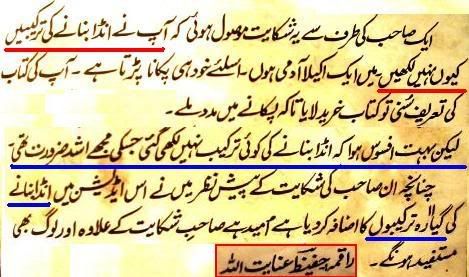


The book is great. It is an encyclopedia of recipes. There are 19 recipes of cooking chicken, 17 for rice dishes, 33 for ‘qeema’ (minced meat), 31 for regular meat, 26 for fish and the list goes on and on.

(1) Simple Omelet Number One:

To conserve space and to keep our readership’s suspense intact I’ll share with you only 2 out of 11 egg recipes. The first one is titled: ‘Simple Omelet Number One’. Points to be noted are underlined in Urdu text below. Ingredients include 2 big spoons full of oil. To beat the egg into omelet, author is instructing us to use a fork instead of a spoon. She has also used a word ‘kaR-kaR-aayeN’ which I’ve never heard in Urdu before. It means the oil needs to be heated until it starts sounding like ‘kaR kaR aayeN aayeN’ or just ‘kaR kaR kaR kaR’. This is such a phoenitc invention of a word that I must say this book not only caters to ones stomach needs but also to linguistic thirst. In the last line author gives us a choice to make this omelet in the shape of a fish by flip-flopping it continuously. Now this must be something special. I’ve never eaten an omelet shaped like a fish before. Enjoy :)

(2) Omelet Number Three:

The recipe’ below is titled as ‘Omelet Number Three’. Ingredients include a little bit of Soda, besides the 4 eggs needed for this type of omelet i.e. the Omelet number three. Under recipe’ instructions, the author asks us to ‘Open the eggs’. Don’t break them ok. Just carefully open them. Drain the white material into a plate but make sure to keep the yolk inside the opened eggs. Now beat the egg-white so much that it turns into foam. Make sure the foam is not temporary. It should remain in foam texture even after the beating is stopped. Now add Soda (the one that is suitable to eat. none other please) to it and blah blah blah. The word ‘kaR-kaR-aayeN’ is used in this recipe’ also. The last couple of lines instruct us to try to make this omelet round as a ball and use low heat. As the heat will start going into the egg it will start getting rounder and rounder. If you want you can make 2 separate round omeletes by repeating the same recipe’ 2 times. The last line reads that the resulting omelet will look very beautiful.

Please feel free to share with us anyother great egg recipes that you may know.

The trial of La Migra: raids, racism and the I.N.S. (Immigration and Naturalization Service)

The Nation May 8, 1989 | Shorris, Earl In a modern, undistinguished courtroom in San Jose, California, more than a hundred Mexican and Mexican-American witnesses, some of them trembling, have turned the tables on the U.S. Immigration and Naturalization Service. La Migra is on trial, accused of a pattern of discrimination and racial harassment, physical and verbal abuse of workers, entering workplaces without -proper warrants and seizing people without reasonable cause for suspicion.

The trial began in January and is expected to last through the summer. On the surface it is a straightforward battle over violations of the Fourth and Fifth Amendments by a rogue agency of the Federal government. The plaintiffs are asking the court to make permanent a 1986 injunction barring the I.N.S. from discriminatory enforcement practices and illegal searches and seizures. But no one in the courtroom fails to recognize the forces underlying the trial or the effects its outcome will have on hundreds of thousands of immigrants in the United States and millions more who are on the way.

A 57-year- old farm laborer, a timid man, one who cried on the witness stand, spoke to one of the broader issues in the case. Testifying through an interpreter, he described how I.N.S. agents beat his head against the side of a car and told him that he had no rights, no rights at all, in this country. “The one that was mistreating me,” he said, “his parents were also foreigners here. I believe that in this land we have all arrived here as adventurers and trying to make a life for our children. I believe that it is not a crime to be a worker. Being a worker is one of the most beautiful things, because he is doing no wrong to anyone. To the contrary, he is giving life to all of humanity.” .

The owner of a small business in Sacramento said that he began to think about the issues after his place was raided and the agent in charge of the local I.N.S. office told him, “We can enter a property without a warrant if we see Mexicans in plain view from the street.” The businessman, a combat veteran born in Denver, told the court, “I’m a Mexican, I have a right to be here. And I have human rights. I have civil rights and I have constitutional rights and I have rights even by Treaty of Guadalupe Hidalgo.” The class action suit, known as Pearl Meadows Mushroom Farms Inc. v. Alan Nelson, Commissioner, Immigration and Naturalization Service (INS), was filed in U.S. District Court in 1982 after the I.N.S. carried out a series of workplace raids under Project Jobs, part of the Reagan Administration’s effort to blame undocumented workers for high unemployment.

It will be a difficult case to prove, for the courts, following the Rehnquist lead, typically require that an institutional pattern be shown, and the U.S. Attorney argues that every violation of the law by the I.N.S. is merely a matter of “deviant behavior.” However, in addition to direct testimony of the witnesses, some interesting evidence in support of the plaintiffs’ case has surfaced. First, no I.N.S. agent has ever been formally disciplined for abusing or violating the rights of a person in a workplace, suggesting that what the U.S. Attorney calls deviant behavior is acceptable behavior within the agency.

The second bit of evidence came to light while civil rights lawyers were taking depositions from I.N.S. agents. In the discovery process they had found memorandums in which agents describe people as “tonks.” The attorneys asked one agent after another what the word meant, but no one would answer. Finally, in December of 1987, Agent Larry Moy, after testifying that it was a derogatory term used by some I.N.S. agents for “illegal aliens,” said, “I don’t know the origin of it. I’ve asked other people how that term came about, so I can only repeat what other people have said to me. That’s why I said I don’t know the origin of it.” Pressed by the lawyer, Moy They told me that it’s the sound of a flashlight hitting somebody’s head: tonk.” Since 1982 the victims of civil war and economic disaster in Latin America have been coming across the border to the United States. Moreover, what seems the beginning of one of the great human migrations of history is under way. The westward expansion is over; populations now move north. web site immigration and naturalization

Congress responded in 1986 with the Immigration Reform and Control Act (IRCA), which offered a period of amnesty for some undocumented workers, to be followed by fines and imprisomnent for employers of those without papers. Opponents of IRCA argued then that the act would lead to discrimination against all persons who appeared to be of foreign descent, mainly Latinos and Asians. A study by the General Accounting Office released in November of last year indicated that the worst fears of opponents of the act were coming true, for it found 528,000 instances of job discrimination against foreign-looking or foreign-sounding job applicants.

The punitive stage of IRCA took effect last June, and Representative Charles Schumer of New York has already complained that the I.N.S. has been lax in applying sanctions. Workplace raids will undoubtedly be used to enforce the new law. The question is how the raids will be carried out. Will they be guided by racist principles? What effect will the great northward migration have on the win of the courts to maintain constitutional guarantees? Who will be a juridical person in America?

Although the Pearl Meadows Mushroom v. Nelson trial has so far held closely to the complaint, each of the attorneys who plays a major role sees different implications. To U.S. Attorney Joseph Russoniello, a former agent of the Federal Bureau of Investigation, the case is still about excluding certain people from any kind of work in America. He wishes to draw distinctions between the rights of those who have papers and those who don’t. Early on in the trial Russoniello made the astonishing argument that, in effect, constitutional guarantees do not apply to undocumented workers in the United States.

In opposition to a motion to exclude evidence of unlawful immigration status Russoniello wrote:

The unclean hands doctrine “closes the doors of a court of equity to one tainted with inequitableness or bad faith relative to the matter in which he seeks relief, however improper may have been the behavior of the defendant.” Precision Instrument Mfg- Co. v. Automotive Maintenance Machinery Co. , 324 U.S. 806, 814 (1945). . . .

Persons . . . who were illegally in the United States and working brought about the INS actions plaintiffs now challenge. Such persons’ hands are “unclean,” and they can receive no equitable relief.

U.S. District Court Judge Robert Aguilar, a Carter Administration appointee who is hearing the case, ruled in favor of the plaintiffs without commenting on the unclean hands argument.

The jobs argument is more subtle. “Employers hire illegals,” Russoniello said, “because they’re docile, they don’t complain, they’re easily exploitable, almost all are nonorganized. The work is hard. It offers little in the way of advancement and certainly no security.

“The noncooperating employer is the villain of the piece. They use illegals to meet their affirmative action quotas. It gives employers an excuse not to hire other minorities, blacks and the inner-city poor.” Because the attorneys for the plaintiffs were still presenting their witnesses, Russoniello was careful to keep his tactics secret, but he did promise revelations at some later date. “The trial,” he said, “will show in the end that the plaintiffs have a different agenda.” Whether Russoniello is sincere about jobs or merely continuing the Reagan tactic of making scapegoats of undocumented workers is impossible to know. His record will have to serve as cross- examination on the point. He was nominated by President Reagan on the recommendation of S.I. Hayakawa, the loony semanticist and former U.S. Senator from California. Shortly after his appointment, Russoniello instituted an investigation of voting fraud by asking county officials to send him the names of people who applied for bilingual ballots. Latino and Chinese -American groups sued on the ground that the investigation was racist. Russoniello was spared from having to defend himself in the U.S. Supreme Court when the case was mooted by a California law that made applications for bilingual ballots confidential.

The racism issue arose again in January when, while meeting with attorneys for the plaintiffs in the Pearl Meadows case, Russoniello referred to people without papers as “wets.” The civil rights lawyers were astonished, since the use of such terms as “wets” or “wetbacks” by the I.N.S. was one of the complaints in the case. The lead attorney for the plaintiffs drew a thick black box around the word “wets” in his notes, In an interview Russoniello said “wetback” is “as offensive to Hispanics as ‘Guinea’ or ‘Wop’ would be to me.” When confronted with the information that two attorneys had heard him use the word, he said, “The claim is either exaggerated or won’t be proved. I never used the term in my life.” The lead attorney for the plaintiffs, John True, of the Employment Law Center in San Francisco, said it was because of his experiences in the Peace Corps in Nepal and Afghanistan that he was attracted to the case. He sees the other side of the exclusion issue, which he connects not to jobs but to human rights. “This may sound corny,” he said, “but I think people in the world have a lot more in common than not. People across the globe feel that they are endowed with a certain dignity. Rules of excluding people have their place, I suppose, but I feel that people have the right to be treated with dignity and respect.

“Our witnesses don’t make any money to speak of and they fear being under oath before the I.N.S. Why they testify is a continuing source of inspiration for me. All we have to give them is encouragement and a $35 witness fee. These people are doing it because they think something wrong has been done to them. My sense is that they are speaking from some part of them that would be just as insistent in their country.” True doesn’t accept the employment argument. “They come to this country not to take anyone else’s job,” he said, “but to work hard at jobs that no one else will take. Employers say they get picked clean by the I.N.S., try to get someone else, and no one else will do the work.” He pointed out that some of his witnesses worked with mushrooms, which are grown in dark, damp caves, or pulled the guts out of chickens as the newly slaughtered birds passed by on a conveyor belt.

The wall that Joseph Russoniello would build around the opportunity to work can be very dangerous, in John True’s eyes, for True sees it as affecting the rights of persons, whether they are people without papers or merely citizens of Latin American descent. Speaking of who generally is subject to arrest and detention as an undocumented worker, he asks: “What does a Mexican look like? Is he a person with brown skin? Is he a person with brown skin and dirty clothes? Is he a person with brown skin and dirty clothes who won’t look you in the eye?” Francisco Garcia-Rodriguez of the Mexican American Legal Defense and Educational Fund, which first filed the suit, carries on the argument: “In legal terms our claim is that they target Latino workers, they don’t target white workers. It is clear that these people tailor their enforcement policy along racist lines. They use the word ‘wets.’ They beat witnesses. They insult them. It’s in their own documents. You cannot question someone on the basis of ethnic appearance. You cannot use a racist factor. If I were in the work force, they would question me and not John True. And John’s a friend of mine, but that’s the way it is.” Garcia-Rodriguez, who was born in Mexico, raised in Los Angeles and educated at Harvard College and Boalt Law School, has a geopolitical view of the problem. “The root causes are of international concern,” he said”It requires a State Department and not an Immigration solution. The solution is not building walls or digging ditches.” Nor does he see the new immigration law as a solution. “IRCA makes employers de facto immigration agents,” he said. “Ultimately, IRCA could come down to a license to raid workplaces everywhere in the U.S.” Quoting the rallying cry of immigrant rights groups -”No human being is illegal”- Garcia-Rodriguez speaks about the terminology of the I.N.S. and its meaning: “These people are not aliens, they are not from another planet,” and they are not illegal; they have rights under the Constitution. “These persons are a challenge to the kind of society we live in. This is a human rights issue. It is about how we protect the rights of human beings who live in our midst.” Alan Schlosser of the Northern California A.C.L.U., another member of the litigation team (along with attorneys from California Rural Legal Assistance and Orrick, Herrington and Sutcliffe) said “The people who are testifying are operating as public-interest witnesses. Basically I.N. S. is an agency that has a well-known and documented history of abuses. La Migra is a word of opprobrium and it is well deserved. Our clients are not challenging immigration laws, they are challenging the way the I.N.S. carries them out abusively. The Constitution is clear that people who are in this country are entitled to constitutional rights. The Bill of Rights applies to persons, not to citizens.” “We think there’s something wrong at the top of the I.N.S.,” Schlosser said, alluding to the case and what he hopes will be its outcome. “There’s no effective system of control. We want a system in which the public would know where to file complaints, where there would be real investigation and discipline if warranted, an internal review system.” Meanwhile, the trial continues. The testimony and the tactics are often ugly. One witness, crying on the stand, described how I.N.S. agents sat him in a chair, handcuffed him ftom behind and pushed his face down toward some dog shit on the floor, saying, “That’s what you are.” Eventually the U.S. Attorney may try to discredit the witness’s testimony, given through an interpreter, by showing that under cross- examination it was inconsistent in some details. The judge, who grew up in California and speaks Spanish, will have to decide. in our site immigration and naturalization

Another witness, also speaking through an interpreter, reported the following conversation between two I.N.S. agents: “The one who grabbed me by the waist said to another short, black man that I had my papers in my house.” He told the second agent’s response in English: “Fucking Mexicans lie every time.” Halfway through this account, one of the government attorneys objected: “That statement should be stricken. There’s no indication of how the agent responded, in English or Spanish. This person here is testifying with an interpreter. There’s no basis what his understanding of English was back six years ago and by the fact that he’s testifying here with an interpreter makes his understanding of English, if indeed it was in English, what that statement was – ” He was overruled before he could finish the argument.

And so the case goes on, week after week, witness after witness describing the I.N.S. rushing up to factories or farms in green cars and vans that suddenly disgorge armed men who block all exits, then methodically go through the workplace questioning and detaining those who appear to be Latino, passing by everyone else. There are beatings, insults, threats. Lives are suddenly disrupted, businesses thrown into chaos. The witnesses compare these tactics to what they have seen in movies of the Gestapo.

Whether that comparison is mere hyperbole depends, to some degree, upon the outcome of the trial and the appeals that are sure to follow. In The Origins of Totalitarianism, Hannah Arendt named “the destruction of a man’s rights, the killing of the juridical person in him” as one of the key tactics of the Nazis. The U.S. Attorney for the Northern District of California contends again and again in U.S. District Court that undocumented workers are effectively without any rights under the Constitution, that they are not juridical persons. It is an argument that has not been made in the civilized world for nearly half a century.

Shorris, Earl

34 comments posted

Comment Pages: « 5 4 3 [2] 1 » Show All

  1. Sridhar says:
    January 16th, 2008 6:20 pm

    Owais,

    Interesting post, though I am seeing it more than a year after it was posted.

    Talking about dishes involving eggs, a personal favourite is the anda paratha that you get on Delhi streets, particularly late on winter nights. It involves cooking a plain paratha, making a hole in it when it is half cooked and breaking an egg into it. The egg cooks along with the paratha. The best ones in Delhi were sold in the middle of the night on Bahadurshah Zafar Road (Delhi’s Fleet Street, where many newspaper offices and presses are located). It is a thriving market in the night, due to the newspapers and attracts students studying late at night, particularly from the Maulana Azad Medical College, which is on the same road.

    Anda paratha with a pickle made from winter vegetables (carrots, radishes, cauliflower etc.) and dahi on the side – heaven!

  2. January 16th, 2008 3:08 am

    Hello Owais,
    Love the way you write about food. I accidentally landed on this site. By the way, kar-kar-ayen is a Hindi word. :)

  3. bAdil says:
    July 20th, 2007 9:17 am

    Hi Shams Hasan: He’s 83-UET. 83-Civil to be more precise.

  4. Jabir Khan says:
    April 11th, 2007 10:16 pm

    I think you missed the part

    main akaylaa aadmi hoon

    ‘akaylaa aadmi’ and ‘raqma’ can not be the same. I say he is a male, taking into account his name as well. Maybe the ‘proof reader’ tasted his omeletes before proofing.

  5. Shams Hasan says:
    February 13th, 2007 7:44 pm

    Adil, what UET are you?

  6. Peshori says:
    October 7th, 2006 12:53 pm

    Ooohwee, that sounds delicious. I am going to try that out tomorrow. Thanks!

  7. Khalid R Hasan says:
    September 24th, 2006 12:18 am

    This post brought back a few memories. As a student in London more than three decades ago I had absolutely no experience of cooking until my mother bought me this book during a holiday back in Karachi. After that I’d try out some of the recipes from time to time, and they were very successful. The only change I made was to reduce the amount of cooking fat -at times the book called for whole slabs of butter,whereas I found I could cook meat in its own fat and still produce a very satisfactory result.

  8. Owais Mughal says:
    September 23rd, 2006 1:43 pm

    Adil
    local time is 12:41 pm and after reading your last message has ignited the hunger for ‘khagina’. time to have some omlete and Khagina now. Talk to you in a bit :)

Comment Pages: « 5 4 3 [2] 1 » Show All


Have Your Say (Bol, magar piyar say)

Please respect the ATP Comment Policy.

Keep comments on topic; no personal attacks; don't submit indecent, inflammatory, slanderous, uncivil or irrelevant comments; flamers and trolls are not welcome; inappropriate comments will be removed or edited.

If you won't say it to someone's face, then don't say it here!

Readers who want to use a URL should please use the TINY URL program.

Thanks, and keep the comments coming!