 Few days ago I was taking my ritual stroll after dinner. My thoughts were going astray. In one such senior moment the idea of writing this post came to me. The thought process in my head which resulted in this post below went something like this:
Well Owais mian, these days I am looking more and more like Inzamamul Haq. I need to walk more. OK so today I’ll do eleven walking rounds of our street instead of usual 10. I used to play cricket everywhere. wasn’t it fun? Hey, how about if I write a post about the cricket diversity of Pakistan. I am sure many of our readers will relate to it and they may share their own versions of cricket that they’ve played ….
So here is my non-exhaustive list below:
The photo above is courtesy of Raja Islam
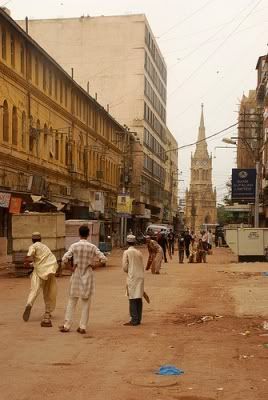
1. Street Cricket
This is by far the most common form of cricket played in Pakistan. At ATP we’ve covered street in the past atleast two times. see here and here. It is usually played in the middle of the road. Wicket is usually made of old furniture e.g. an old chair for batting side and just a stone for the bowling end. Sometimes broken furniture is not available and then batting wicket is made by putting some bricks or stones together. One universal rule of street cricket is called the ‘house-out’. This happens when a hit directly goes into a neighborhood house. The background of this rule is the nuisance caused to fielding side which now has to press call bell of the house and retrieve their ball. After 3 to 5 such incidences the people living in these houses stop giving the ball. The trick to avoid this is by making sure the boys living in those houses are also part of your team.
Once upon a time our neighbors got so fed up by constant hitting in their home that they used a knife to cut our tennis ball into two and then threw the two pieces out on the street for us to take some ‘ibrat’. We just did a quick ‘chanda’ and bought a new ball.
2. Beach Cricket
This is another very famous form of cricket. The trick here is that team batting first always has a better chance to do well. The reason is soft sandy pitch on a beach becomes unplayable after few overs of rough handling. ‘Jharoo’ (sweep shot) batsmen are especially damaging for this type of cricket.
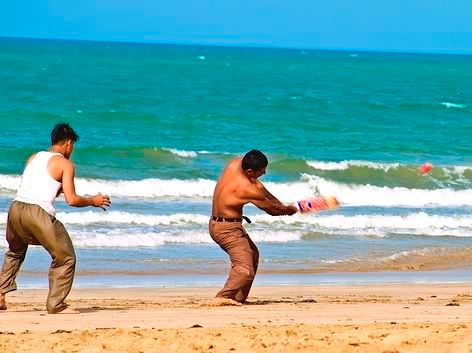
The photo of beach cricket above is courtesy of Qaisar Islam.
Let me also tell you another ‘patay ki baat’ (trade secret). Always try to bat first in an afternoon beach game. The high tide comes in very fast during monsoons. It is very likely that within few overs of game, high tide waves will reach the cricket pitch and the batting side will not have to do fielding as the pitch will get flooded. This is called “muffat (not muft) ki batting”. kiyoon hai na patay ki baat!
3. Cricket-At-Home
My all time favourite was an indoor game called “Cricket at Home”. This game is played on the floor or any other flat surface. I am not sure if it is available in market or not. It price until late 80s used to 25 ruppaiyyah only. I used to own 5 such sets and used to arrange whole World Cup tournaments, write down scores, keep statistics of my fantasy cricket teams in a special statistics register.
Those who have played ‘cricket at home’ know that the plastic bowler in this game has a rubber-band arm. It throws ball like a sling shot under tension. I used to use 4 rubber bands for a fast bowler, 2 for medium pacers and a really loose one for a spinner. By turning the hook in bowler’s arm I had mastered the art of swing and curved bowling on our home carpet. I used to make my own wooden bats by filing and chiseling them. I also used chalk balls which used to deteriorate after 40 overs. Thats how I simulated the concept of “New Ball”. To simulate different pitches, I used a 1 foot square of carpet piece( which simulated a turning wicket). If I pretended to be playing on Australian pitches, I used ‘Metal strips’ to simulate ‘hard-bouncy’ wickets and a wooden one to simulate dead batting wickets.
If you remember the Mechanical Tasbeeh then that used to be my digital scoreboard.
In every room of our house, I had built a stadium and named them after different stadiums of Cricketing world e.g. my bedroom was Karachi, our living room was Melbourne etc. By the time I reached 7th grade, I had started arranging Flood light day-night matches by putting four, 100Watt electric bulbs on wooden sticks around my stadiums on carpet.
Almost Everyday I used to have a fight with “maasi” who used to come for jharoo-poncha in our home and I would always resist her cleaning the room carpet, where my international matches were being played.
I had reserved few card board players to look like the real life players. e.g. I had made moustaches by using a black marker on my Javed Miandad, my Zaheer Abbas used to wear specs like the real Zaheer, Imran had curly hair, Salim Yousuf the wicket keeper had wicket-keeping pads drawn on his legs etc
Cricket at home was fun while it lasted and then I grew up.
4. Roof Cricket
This is played on apartment building roofs. Uniqueness of this cricket is that a hit outside the boundary costs you a trip down 5 or 6 stories. A good chance is by the time somebody has climbed down to retrieve the ball, some street children may already have run away with the ball.
This form of cricket is played in the 5 minute break between two periods or whenever a teacher is late showing up for a class. Tennis or table tennis balls are used. Broken chair pieces, “imtahaani gatta” (writing boards) or cylindircal drawing sheet holders are used as bats.
6. Living Room Cricket
This type of cricket is played only when parents are not home. The wicket is usually made of sofa cushions. Fielders are usually placed on top of furniture due to lack of space. Sometimes to keep a batsman in check, a one-tip-out rule is implemented. This means a batsman is out even if a fielder catches the shot even after one bounce. The batting technique to survive here is to press ball towards the ground as if it is being burried under ground.
7. Curved Street Cricket
Curved streets are very common in older localities of Pakistan. I’ve had honors of playing street cricket at Punjabi Club located in Kharadar, Karachi. The street pitch there is located at an inresection of 5 streets. The street straight ahead curves at angle of 60 degrees and then the cricket boundary is reached. The best way to score boundary (a 4 or a 6) here is to hit straight and then hope for a reflection at 60 degrees from a building wall. A direct hit to a building ahead and reflection of the ball at 60 degrees such that its first bounce on the ground happens outside the cricket boundary is still considered a sixer. This type of rules only happen in kharadar.
Curved Street cricket in Kharadar is played at night. During day time this place is so busy that a person born on one side of the road can never dream of crossing it to the other in his life time. In reality he just have to wait for the sunset though. But you got the message. old city localities are very busy during day time.
8. Verandah Cricket
This form of cricket is also played indoors but with a bit more room available than living room. Bat is usually made of a straight timber with handle made by wrapping a towel with electric tape. The straight timber is usually the ‘beading’ used as wooden window frames. Ball is usually the table tennis ball with electric tape wrapped on it for weight and swing.
9. Book Cricket
This form of cricket is played by opening a thick book repeatedly. The least significant digit of even-numbered pages is used as cricket scores with 0 being out and 8 being considered as a sixer. 2, 4 and 6 are noted down as 2, 4 and 6 runs.
The problem with this form of cricket are the bent pages in a book. After few tries a player figures out where to open the book to get same score. Fielding side i.e. the person not using the book has to vigilant abput such tricks from the batting side i.e. the person opening the book.
10. Board Cricket
This form of cricket is played as a board game with a dice. As your ‘goti’ moves on a board with every throw of dice, you are able to score runs as well as there is a chance of arriving in a box called ‘Out’. Two ‘gotis’ are used to simulate two batsmen. After every over or after an odd-run, the other batsmen (‘goti’) moves. Just like in real cricket.
11. Cricket with a Dice
This is the easiest form of cricket. It is played by throwing a dice. A Five is an out (b/c it is very rare that 5 runs are scored in cricket). All others faces of the dice are considered as runs.
12. Cricket with a ‘ganji’ tennis ball dipped in water
we used to put lotas full of water near the bowling end. bowlers used to dip the ball in these lotas before balling to the batsmen. These were pre- tape-tennis days. Once Pakistani moved onto playing tennis cricket by wrapping electric tape on it, ‘gnaji’ ball cricket died its death. The attraction of ‘gnaji’ ball dipped in water used to be its extra fast speed which was later achieved by using tape-ball and without splashing water all over one’s clothes.
13. Cricket on Red-Brick surface.
I used to play this tricky cricket whenever I travelled to up country. Especially in Punjab where red clay bricks are used to make ‘farsh’ (court yard) in a house. The tennis/tape-tennis ball turns unpredictably on bricked surface due to brick’s un-evenness. Batting is very tricky on a bricked surface.
14. choTee (Small) Cricket
This form of cricket is played inside a house especially where there is an extreme danger of breaking glass windows, electric bulbs etc.
This is called ‘choTee’ (small) cricket because ball is delivered as an under-arm throw and batting is done left-handed. All right handed batsmen have to play left-handed and vice versa. This is done to challenge and downgrade their batting skills and hence save the glass windows and electric bulbs.
15. Hill Cricket
The rules and consequences of long hitting are very similar to cricket on the roof version. We witnessed it first hand by playing on the plateau hills of Safari Park and Hill Park. Every long shot used to go below the hill. We had to place few people from batting side under the hill so they can throw hits from their comrades back up the hill.
16. Cricket on Commodore 64
When Commodore 64 computers came out in 80s, the game of cricket made headlines on it. I also got chance to play it. It was indeed a step forward in fantasy cricket. The game had some problem though as the team playing first always won the game. Does anybody remember this cricket game on commodore 64?
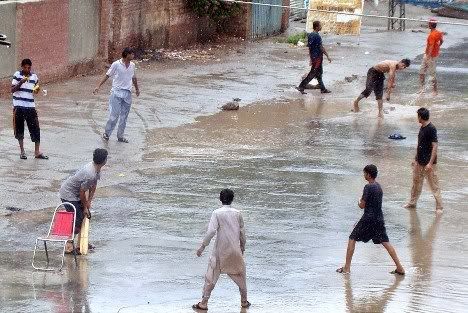
17. Playing circket in a flooded street after rains
I think following photo is enough to show the joy of playing cricket in a flooded street after rains. The playing area deliberately includes the flooded portion of the street. This adds to the challenge for a batsmen on how to play incoming balls. Clothes of batsmen invariably get marked with a wet spot every time a ball hits him. Bowlers also try to aim for batsmen’s clothes. This is done all in the good spirit of gamesman ship.
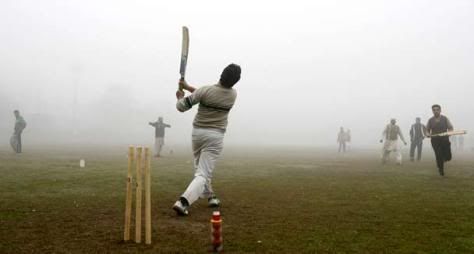
18. Playing Cricket in Dense Fog
Look at the following photo. It is from Lahore and taken in January 2010. While I’ve personally not played cricket in such dense fog, it must be fun. I say it must be fun because it adds a variable of uncertainty and reduced visibility among fielders. A shot that goes too high may disappear for a bit and fielders that are placed on boundary may have hard time seeing the game at the center. Voice communication like ‘lena…pakrana’ (take it…grab it) will be the key to success while fielding in such foggy conditions.
19. Cricket with a Laundry Beater
Do our readers of Pakistani descent remember this wooden laundry beater that I am talking about? It is a wooden stick in the shape of a mini cricket bat and is used to beat laundry during washing process. I played a lot of cricket with this laundry beater because it resembled a mini cricket bat.
20. Cricket with a Frying Pan
 Shown to the left is our experiment of playing indoor cricket with a frying pan. My son and I did this experiment with an old frying pan which we were about to throw. It indeed has much better stroke than a willow bat. ‘aazmaaish shart hai’ plus for indoor cricket it gives much better chance to a batsman to hit the ball.
I’ve listed 20 forms of cricket above but there are several more which are coming to my mind. I’ll write about them some other time. As a hint I can tell that they include (20) Playing cricket in a car parking. (21) Playing cricket on a walk-way in a park. (22) Playing cricket with a tennis racquet. (23) Playing cricket with a base-ball bat. (24) Plating cricket in a basket ball court/tennis court etc.
Do you have any other form of cricket to share with us? Please do so. We’d like to hear about the places and types of cricket you’ve played.
ATP’s Similar Posts
1. Remembering Tikanjoo
2. Class room Cricket
3. Khandaan XI
4. Humayun and Ramzan Cricket
5. Curry in a Hurry
6. Inter Collegiate Cricket- Adamjee vs DJ 1989
7. National Stadium, My Debut




The CBD aggregation – [url=https://www.tillmanstranquils.com/products/hybrid-gummies ]hybrid thc gummies[/url] offers a variety of formats that suit exceptional preferences, and each undivided feels intimately executed. The lubricant appears unsoiled and in conformance, the packaging materials sensible of durable, and the connivance is simple yet elegant. The products are comfortable to inventory and go with, thanks to obvious lids and compact sizing. Overall, the label delivers a outstanding and carefully crafted test without dispensable extras.
I am often to blogging and i really appreciate your content. The article has really peaks my interest. I am going to bookmark your site and keep checking for new information.
One type of cricket i used to play was throwing ball at wall and when its back hittign the ball i use cloth beater (bat) to hit it.
Since cricket at street and garden was not possible all the time and i was so addict of cricket that i used above form of cricket to entertain my self.
A slightly varied form as to take a start like fast bowler and throw ball at wall (not underarm just like full fast bowler).
Dear Adil/Owais,
I have recently launched http://www.Urduathome.com to promote Urdu learning among the expatriate Pakistani children living outside Pakistan. I have been working on this subject for over 5 years now and it is my third website. I know its not the policy of Pakistaniat to promote one website or other; but since it is an effort to promote Urdu language in the next generation of Pakistanis combined by the fact the it is jointly developed by a Pakistani and an Indian IT professional, I think it deserves some sort of recognition from our community. I am not asking for much but do feel a little frustrated on the lack of support from the community in large. I have contacted pretty much everyone across the board in the news media but haven’t got much luck.
We are getting good reviews from the parents who have joined us but we are unable to bring our message out to a much larger audience because of lack of funds.
Kindly check out our website and if you feel it offers some substance than please help us in spreading word. You will also find my interview with “The Post” and also couple of my blogs http://urduathome.blogspot.com/
Respects
Hassan
Playing cricket with a frying pan added at #20 in the post above. We tried this form of cricket few days ago.