 Adil Najam’s post on judicial assertiveness the other day sheds light on a very interesting – and important – aspect of the current judicial crisis in Pakistan. What are the limits of Judicial activism or – to use Adil’s words – assertiveness?
This is not something new to the world – or even to Pakistan’s history. Every country that has attempted to establish rule of law and constitution has struggled with trying to find a balance between what can (and cannot) a judge do.
In America, where constitutionalism is much more advanced than in Pakistan, the debate has moved to a higher plane in the famous tussle between those who believe in strictly interpretting the constitution and those that only appear to do so. Each side claims that it is interpretting the constitution (or interpretting the original intent of the framers) and accuses the other of legislating from the bench.
We, in Pakistan, have been merely struggling with how to keep the rule of law and constitution alive in our country. Is it really the role of the judiciary to enforce a constitution? Can the judiciary do that even in the absence a popular sentiment towards the constitution? In a situation where an Army general takes over power in an illegal coup, abrogates the constitution and declares martial law, and nobody – but a few ‘professional’ politicians in a nation of 150 million – even makes a sound of protest, what does upholding the constitution really mean? Does that nation even have a constitution to begin with? or is it merely a paper, worthy of celebrating when it suits a few and disposing off when it does’nt?
 The current crisis around the suspension of the Chief Justice has everything to do with how Pakistan’s rulers – and its people – view their constitution? One does not need to go too far back in time to find out that we’ve been through this before – several times, perhaps. In the famous Maulvi Tamizuddin Khan vs. The Federation of Pakistan case, the petitioner challenged the unconstitutional dissolution of Pakistan’s First Constituent Assembly by Governor General Ghulam Mohammad (photo to the right). The then Chief Justice of Pakistan, Justice Mohammad Munir gave a landmark verdict that changed the course of Pakistan’s History – perhaps forever.
Prior to his verdict and also subsequent to that, Justice Munir noted that the issue before the court was not merely a legal issue, it was in fact a political one. He suggested that such issues may be best resolved in the political sphere through negotiation and compromise. In saying so, Justice Munir was especially concerned about the inability of the Court to enforce a decision. The court, he noted, does not have any instrument of power to enforce its ruling if it decides to side with the petitioner (Maulvi Tamizuddin Khan). Indeed, the government – with all the instruments of power at its disposal – can easily ignore the court’s ruling thus putting the case back to where it belonged – in the domain of the people and their representatives. Of course, Justice Munir, knowing fully that an anti-government ruling would be entirely ignored, ultimately sided with the Government thus throwing the country into its worst constitutional crisis since its creation. The country has never forgiven him for doing so.
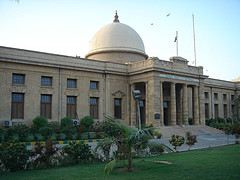 Photo to the left above is Pakistan’s old Supreme Court Building in Karachi. This is where hearings of famous Maulvi Tamizuddin Khan case took place.
Could this happen all over again? Could the Honourable Justices of the Supreme Court be engaging in a game of deception until they could unexpectedly (willingly or at a gun-point) rule in the favor of the Government? Alternatively, would Musharraf & Co. obey the dictates of the Court if the court decided, against their wishes, to reinstall the Chief Justice Iftikhar Chaudhary? It might be worth recalling here that the Governor General Ghulam Mohammad was willing to let the courts have their say as long as they ruled in his favor. He had also completed all preparations for imposing emergency in the country, had the courts ruled otherwise.
 What would be the options available to the people of Pakistan – not the CJP, not the Justices, not the lawyers, and not the “professional” politicians – but you and me to force our rulers to revert to the rule of law and constitution?
Ultimately, it is a political battle that will have to be won not in the courts but in the hearts and minds of people who must assert that they prefer the rule of law and constitution over any other form of government, whether it is monarchy, mill-archy, or anarchy. Politics is just too important a calling to be left to judges, lawyers, and politicians alone. Unless the people firmly and forcefully assert their right to be governed, with their consent, by a constitutional government, the current politico-constitutional struggle will not be won. The stakes are definitely high – atleast for the Government since losing thisbattle could trigger a domino that could bring down, one after the other, every pillar of its illegitimate and unconstitutional rule. Are the stakes high enough for the People of Pakistan? We will find out in a few weeks – perhaps months – time.
Regardless of which way the pendulum swings, the current case in the Supreme Court is definitely amounts to a Constitutional Deja Vu all over again!
Athar Osama holds a PhD in Public Policy and is a amateur historian and an avid reader of Pakistan’s Political and Constitutional History. He is also the founder of the Understanding Pakistan Project. You can read more about Maulvi Tamizuddin Khan vs. Federation of Pakistan, and the shocking ruling by Justice Munir at Understanding Pakistan.




I agree with Athar, the people in the US will not take kindly to any tinkering with their constitution let alone its abrogation. Incidentally, it is a relatively short document with a a 3 line preamble, 7 articles, and 27 amendments in over 200 years.
On the other hand, Pakistan’s constitution, with all the mutilation that it has gone through has become an unmanageable document (actually, it’s a book now). It has 12 chapters, nearly 300 articles with numerous sub-articles, one annex(objectives resolution), and 17 amendments in 35 years!
Scrapping it and starting all over would be ideal but may not be practicable. The best we can do is go back to the constitution as it stood in 1973 and start from there.
But I know we won’t do it. We will go on further mutilating it to suit the need of the incumbents in power — and fighting over its intent and interpretations.
Athar: I think the more important question that we’re trying to address here is not whether there is support or opposition to the Pakistani constitution but rather than people do not even seem to care about it?
Dr Athar, with due respect – this is wishy-washy. At one point in your post you say: “But, yes I’ve always thought that people would only hold a constitution dear if they’ve created one. All of Pakistan’s constitutions, under various circumstances, were thrust upon the people.
Shafique:
To say that the American Constitution did not, or does not, enjoy a popular measure of support would I think be wrong, and would amount to a major re-writing of history. Yes, there were federalists and anti-federalists. There was opposition to certain elements in the Constitution, there always will be on any document.
But I think if you make a claim today that somebody can abrogate the American constitution and nobody would rise up against that, I think that would be very faulty. In that respect, I think the constitutional process followed in America–and I am sure some other places in the word as well–was more people-oriented, not perfect, but more people-oriented than what we’ve seen in Pakistan
I think the more important question that we’re trying to address here is not whether there is support or opposition to the Pakistani constitution but rather than people do not even seem to care about it?
Athar: “Pakistan needs a new constitution that is a peoples’ document.
I generally agree with Aqil Sajjad’s argument above. But I get stumped when I think of India. They had similar history as ours but they managed to have a constitution soon after Independence and a working parliamentary system. What is it different that does not allow us to agree on a constitution even 60 years after independence?
Another minor point. 1973 constitution was near unanimous — not unanimous. There were a few (I don’t remember how many) votes of dissent from Balochistan.