 Lahore Museum’s glorious edifice stands on Shahrah-e-Quaid-e-Azam, also known as The Mall Road, opposite to 100-year old Allama Iqbal Campus of the Punjab University. Blended with the elements of old tradition of Mughal architecture, the Museum is conspicuous among all the structures build during the British period on Shahrah-e-Quaid-e-Azam. Founded by Prince Albert Victor, The Prince of Wales, and opened for public in 1894, it is in fact Pakistan’s largest museum and holds the country’s richest cultural and historical materials.
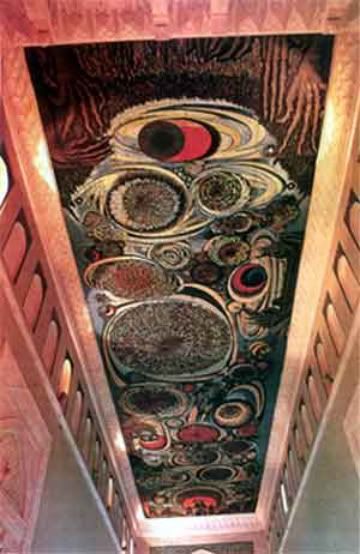
Lahore Museum has many galleries and one of the most famous one is the Central Miniature Painting Gallery. As we enter the Miniature Paintings Gallery of Lahore Museum and lift our head up, we can observe the mural painted on the ceiling by one of the most gifted painters of Pakistan, Sadequain Naqqash (Syed Sadequain Ahmed Naqvi: 1930-1987). A mural is a very large image, such as a painting or enlarged photograph, applied directly to a wall or ceiling.
According to Answers.com:
The roots of art of murals can be found in the universal desire that led prehistoric peoples to create cave paintings — the desire to decorate their surroundings and express their ideas and beliefs. The Romans produced large numbers of murals in Pompeii and Ostia, but mural painting (not synonymous with fresco) reached its highest degree of creative achievement in Europe with the work of such Renaissance masters as Masaccio, Fra Angelico, Leonardo da Vinci, Michelangelo, and Raphael. In the 20th century, the mural was embraced by artists of the Cubist and Fauve movements in Paris, revolutionary painters in Mexico (e.g., Diego Rivera, José Clemente Orozco, David Alfaro Siqueiros), and Depression-era artists under the sponsorship of the U.S. government (e.g., Ben Shahn, Thomas Hart Benton).
The people of Pakistan were introduced to the art of murals by Sadequain. Lahore Museum’s ceiling, painted in 1973, is based on poet Allama Iqbal’s idea of ‘Khudi’ or ‘Self’, evoking the spirit of man to triumph over odds. It depicts man’s search for knowledge and ultimate triumph. Unlike most of Sadequain’s paintings and drawings which are full of angst, melancholy subjects and negation of his personal self in the tradition of the ‘fakeer’ show man at his most decadent and hypocritical, his murals always reflect optimism. Its interesting to note that Sadequain sold very few paintings in his life and most of his work was public.

Sadequain painted the ceiling of Lahore Museum in 1973, living and working in the building for six months. As Niilofur Farrukh writes in DAWN:
The mammoth painted ceiling of the Central Gallery at the Lahore Museum takes its inspiration from Iqbal’s verse ‘Sitaroon say agay jehan aur bhi hein, abhi ishq kay imtihan aur bhi hein’ (there are many worlds beyond the stars and many challenges yet to be met), the artist puts Adam and Eve on the centre stage and challenges them to harness the untapped energy of the universe. Curled in a cocoon like embryos the male and female figures seem to anticipate the moment of awakening. The panorama that surrounds them is a tightly knit constellation of stars and planets in motion. The large discs are depicted as a kinetic mass with halos that open up in a spiral of waves. This timeless process of destruction and construction in the skies, with large meteors spewing debris in their wake to herald the birth of new planets is shown against the dense black space of infinite galaxies. This allegorical references point both to the vast resources available to man and the constraints of time put on him to complete the mandate.
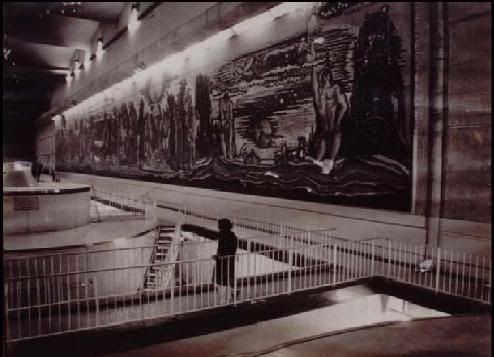
Another one of his early mural of mid 60s called Saga of Labor, based on the dignity of labor is housed in the Turbine room of Mangla Dam. ‘Saga of Labor’ is probably the largest mural in Pakistan.

“Saga of Labor†– Portion of the Mural at Mangla Dam – largest mural in Pakistan 200 ft x 70 ft
The other famous murals of Sadequain include The Treasures of the Times – A mural for the State Bank in Karachi (100 x 12 ft) in 1961, a mural at Karachi’s Jinnah Hospital, Aligarh Muslim University (70 x 12 ft), Banaras Hindu University (70 x 12 ft), Geological Institute of India (70 x 25 ft). Then there are murals like War and Peace, Darkness and Light which can be viewed here. Click here for a very interesting slide show of Sadequain’s murals.
The mural below was painted by Sadequain in 1968 for Punjab University’s library.
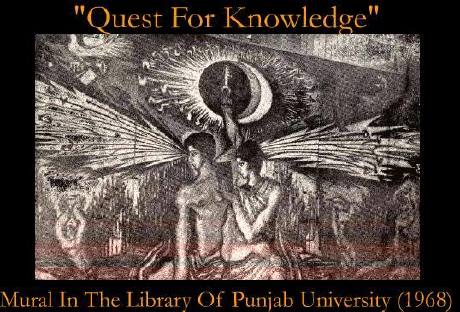
One of the old Karachi Airport manager, Mr S. Hassan Shamsie, purchased several paintings of Sadequain in the mid and late 50s. These paintings were hung on the pillars of the foreign departure lounge. The most significant of them was a 1957 mural (40 ft long) on display on the railing of the departure hall of the old airport. All these murals and paintings remained there till the 80s. They are now in the house of a former DG Civil Aviation Authority in Islamabad. This mural and the paintings are public property and must be returned to the Karachi Airport.
I couldn’t find more details about Jinnah Hospital and old Karachi Airport murals so it would be great if any of the readers can tell us more about them, with images preferably. There is another mural by Sadequain in Paris at the PIA office at Champs Elysee. It was then PIA Chairman, Air Marshall Asghar Khan’s idea who felt that a PIA office in Paris needed to show off Pakistan’s greatest painter. There is another one in Lausanne at the Swiss Fair foreign commissions. I don’t have much details on that. Share with us if you know of any other mural by Sadequain.

Sadly, while working on his second ceiling at the Freer Hall in Karachi (above), the painter took ill and died leaving the work incomplete. Freer Hall was later named as Sadequain Gallery. I am not sure if there are many artists in Pakistan today, following the foot steps of Sadequain and keeping the art of murals alive in Pakistan. I only know of one young sculpture Jabbar Gul whose mural is placed in the entrance of Learning Resource Building of the State Bank. It documents the history of the Bank through the varieties of coins issued since independence.
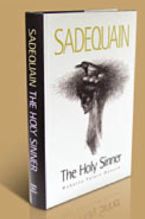
Note: Most of the images have been taken from the book The Holy Sinner, Sadequain and for the rest of the images, links have been provided in the post. Click for enlarged view. A short version of this post was also published at Metroblogging Lahore in 2005.





GOOD EFFORT BY THE AUTHORS. SADEQUAIN IS THE ONLY ARTIST WHO HAS PAINTED MURALS. HIS MURALS ARE HOUSED IN STATE BANK KARACHI, MANGLA DAM, LAHORE MUSEUM, PUNJAB UNIVERSITY, ISLAMABAD SPORTS COMPLEX, SERVICES CLUB KARACHI, ALIGARH UNIVERSITY, BANARAS UNIVERSITY, JAMA-E-MILLIA DELHI, INSTITUTE OF ISLAMIC RESERCH DELHI, INDIAN INSTITUTE OF GEOLOGICAL SCIENCES, ABU DHABI POWER HOUSE, TO NAME A FEW. SADEQUAIN FOUNDATION IS CURRENTLY WORKING ON TWO BOOKS, ONE ON HIS MURALS AND ONE ON CALLIGRARHY. ONE OF THE BOOKS WILL CONTAIN HIS EARLY LIFE AND HIS UNFINISHED AUTOBIOGRAPHY.
RECENTLY GOVERNMENT OF PUNJAB HAS AUTHORIZED RS. 1.5 MILLION TO RESTORE LAHORE MUSEUM MURAL. SATE BANK KARACHI HAS BEEN RESTORED IN RECENT PAST AND WILL BE MOVED TO ANOTHER BUILDING NAMED MUSEUM OF COINS.
His paintaings on Ghalib
Great post. I am so happy to see people writing about true colors of Pakistan.
@Desichef: You sould talk to Museum director and ask him. Since its your mother\’s photograph so I don\’t think you will have any problem getting it. Cameras are not allowed but you can get special permission from Museum authorities.
Great post. I was wondering if you could also throw some light on Mohatta Palace project in Karachi. I believe its a multimedia project about Sadequain.
What a wonderful piece on one of the greatest painters of modern times. Yes, I agree that there is much more to tell about Sadequain.
Here is what one of the closest friends of Sadequain wrote about his last days, in an article in Daily Times. Worth reading.
He had died of various complications in the OMI hospital, some two weeks after I had him shifted there from the Jinnah Hospital. The well-known heart specialist who was supposed to be looking after him at Jinnah was not doing a very good job. Disgusted with his