Guest Post by Omer Alvie
[This satirical account is inspired by the real-life drama about the Ajoka play Burqavaganza in the Pakistan capital; See The News Editorial; Gulf News op-ed; a Daily Times report on the original play, and other press coverage.]
So this is how it all happened. Ajoka, a non-commercial theatre group committed to the cause of social change in Pakistan, unveiled its new play Burqavaganza last month in Lahore. The satirical play, written by Shahid Nadeem, addresses the issue of the burqa (veil) and highlights the double-standards and hypocrisy of the feudal/tribal mindset. The aim was to use humour and satire to challenge the cultural status quo and to provoke people to think for themselves.
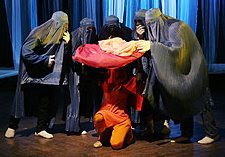
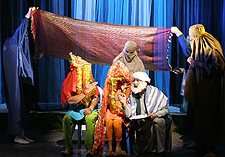
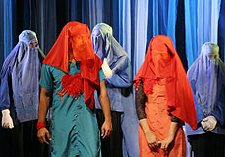

The audience thoroughly enjoyed the show and the play received positive reviews in the press. But the most surprising response to the play came from a rather astute group of individuals belonging to the MMA (more popularly known as Mullah Military Alliance). Inspired by the success of the Burqavaganza, five extremely talented MNAs decided to perform their own impromptu over-the-top ‘dramaâ⠂¬Ëœ in the National Assembly. The play imaginatively titled Fanativaganza (by yours truly), was a staged rebuttal to the Ajoka group’s play.
Substituting the use of satire, the inspired MNAs opted for provocative language and violent hand gestures to ridicule the writer of Burqvaganza and the Director of the Ajoka theatre group. Apparently, to these five highly sensitive and pious individuals, the Burqavaganza play was clearly un-Islamic, enough to be classified as blasphemous. Although, it has to be clarified that these days, any critique, criticism, aspersion, censure, swipe or nitpicking of the norms and practices of these religious extremists will likely lead to a blasphemy charge, even if it is a comment regarding the general unruliness of their beards.
One minor clarification here, they cannot be called religious fundamentalists. This is because they fail to grasp the fundamentals of the religion they claim to be following. ‘Nuttersâà ¢â€šÂ¬Ã¢â€žÂ¢ is more appropriate and generally my preference.
The MNA performed drama did not get a positive response from the public or the press, but it did manage to get a standing ovation from the Minister of Culture, who subsequently announced a government ban on the Burqavaganza play to show his appreciation for the drama queens of the national assembly. He was so moved by the MMA performance that he additionally promised further government actions against the key members of the Ajoka Theatre group. I have to admit, as a Pakistani citizen, hearing this news brought a lump to my throat. It wasn’t that I was emotional, it just happened to be part of the process of me regurgitating my last meal, as I got sick to my stomach.
It is clear now that the government’s attempt at promoting ‘enlightened moderation’ in reference to religion has not been very successful. Actually, that is an understatement; it has been an unquestionable, resounding failure. I do admit though that they have managed to create an era of (religious) ‘moderated enlightenmentâ€â„ ¢. When your faith is judged by the size of your beard or measured by the length of your veil, you are in serious, serious trouble!
Omer Alvie is a Pakistani residing in the UAE and writes, often satirically, on his blog The Olive Ream. He also writes about the Pakistani blog scene at Global Voices. This post was first published at The Olive Ream.



[quote post=”712″] What a disappointment that the radicals can so easily get something censored when they don’t want people to hear it.[/quote]
*grin*
Where were you hiding when radicals like Altaf and Musharraf tried to censor not only media but a Chief Justice as well? I think these guys should wear a Burqa on their own faces first to hide the filthy face of enlightment and moderation.
In my opinion, the burqa in no way is a cultural dress of the majority of Pakistani people. To my knowledge, there is no burqa in the Punjabi or Sindhi culture per se. Their women have for centuries worked side by side with their men in the fields, which would be virtually impossible to do with a full veil on. I think only in cultures where women have traditionally been limited to household roles only (Pushtun or Mohajir families mostly) where burqa is a cultural phenomenon.
The entire concept behind the play BURQAWAGANZA has been lost in the aftermath of its ban.What it did get out if it was a lot of free publicity though !
Now the burqa is in no way an islamic dress , our relegion tells women to dress modestly and cover her private parts when she goes out in public and in front of the na mehram, for that the shalwar qameez and the dupatta are ample enough. The burqa is a cultural dress and since our society is inherently oppressive and feudal in nature and most times carries double standards personelly and collectively ,hence the burqa was taken as a symbol of that suppression and those double standards.
Now why was the satire based on the burqa ( according to some a relegious symbol, like the cross or the swastica ?) and not on more current problems facing the society like corruption, dishonesty and disloyalty ?
one could answer that if only someone would also answer why the self proclaimed experts on islam , only focus on the veiling of women , segregation of women, public banning of a womans presence ?
I have yet to hear any one of them addressing issues which are more pertinent to the current turmoil our society at large is going through.
I agree with others. If someone wants to wear a Burqa that is there business. Just like wearing a head scarf or a cross or pink jeans. Its their right to do that.
But that seems to be the point of the original play also.
What is wrong is forcing others to wear Burqas. Which is as wrong as forcing them not to.
But forcing a play to be banned because it talsk about Burqas IS intolerant. You have every right to wear a Burqa. And I have every right not to. But you have no right to stop me from doing a play about it, just like I have no right to stop anyone from doing a play about, for example, kite flying.
I am not a fan of burqas and don’t think it is an Islamic dress. But I think the battles between those who call themselves liberals and those who consider themselves to be the sole interpretors are being faught over very stupid and petty things.
I haven’t seen the play and therefore can’t comment on it. But from the discussions above, I can’t help asking what was the point of picking burqa as a symbol of hypocrisy when we know that many people (rightly or wrongly) regard it a religious dress. If you choose a religious symbol as a metaphor for double standards, you can not expect people not to be offended. You can not claim that your purpose was not to attack any religious symbol or the dress preference of any group of people. The play writer could easily have picked a naqab (the kind that dacoits wear) rather than a burqa and it would not have created any such controversy.
So while I don’t want to support the ban on the play, I can not help saying that the writer either deliberately wanted to ridicule the burqa or was being extremely stupid if he did not want to make fun of it on purpose.
There is no reason to get into unnecessary fights over symbols, if people want to contest jahalat, they should work for education and promote open dialog in a less confrontational way. When you start fighting over a symbol in such a combative manner, it only creates a fight and hardens attitudes rather than winning any adherents to your point of view.