Guest Post by A. H. Cemendtaur
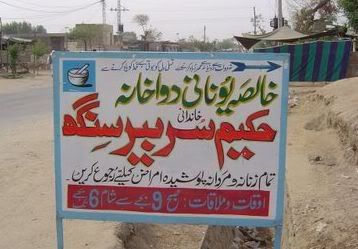 In the history of South Asia, 1947 was a blood-soaked year – hundreds of thousands got killed while millions were uprooted from their ancestral lands. Prior to 1947 Sikhs lived everywhere in North-Eastern area of what is today Pakistan. I hang my head in shame knowing that presently there is only a small number of Sikhs left there.
I have been a great fan of Sardars – more so after a community of them saved my life in Lusaka, the year was 1992. I got sick while traveling and sojourned at a Gurdwara (Singa Singa Mesquita). The family that took care of the temple took me to the hospital and fed me. I don’t recall their names, but I remember there was a young man who pursued a modeling career and wanted to go to the US.
Compared to followers of other faiths, a practicing Sikh must find it very hard to conceal his identity. And that is the reason I always wondered what professions Sikhs in Pakistan took, and how they kept a low profile in the rising tide of hollow religiosity of the majority.
In my last trip to Pakistan I ran into a very colorful Sardar. He was a hakim who ran a Yunani matab called “Khalsa Dawakhana.”
Here is video footage of Hakim Sarber Singh.
“Waheguru ji ka Khalsa, Waheguru ji ki Fateh.”
Besides writing fiction, A.H. Cemendtaur writes on contemporary issues, both in Urdu and English. This post was originally posted at Karachi Photoblog; thanks to iFaqeer for suggesting it for ATP.




Mast Qalandar, I did not know that. I guess it is true that flowers can and do grow in the desert (sehraa mein bhi phool khiltaein hain). The other flower that I know from that city of jugat baaz and wrestlers is Akhtar Hussein Jaffrey. His long poem Aeena Khana and a few others place him high in the Pakistani literary ranks. He passed away a few years ago. For his sake I wanted to visit this city but now it will be for Amrita as well.
Adil, Adnan A,
It’s getting a little away from the topic, but did you know that Amrita Pritam was from Gujranwala?
Many of us associate Gujranwala with only sweets, rice and wrestlers (and probably also rustlers. Or they do come from neighboring Gujrat?) but nothing cerebral. All fat and muscles.
Actually, it’s not ture. I believe other than Amrita, several other renowned poets like Noon Meem Rashid and Mira Ji were also from Gujranwala (am I right?). There must be many more, I am sure.
Farrukh, Yes, there are Sikhs in the N.W.F.P particularly along the tribal belt. Some of them are Pathans. The last time I took an American Sikh friend to Punja Sahib in Hasan Abdal, Punjab (the second holiest Sikh Shrine after Nankana Sahib) I found the caretaker was a Sikh from Khyber Agency (the Afridi area).
[quote comment=”3527″]I have always heard of Mantos Toba Tek Singh but not read it yet. After all these endorsements will certainly read it, probably the Khalid H. translation.
I am surprised to hear about Sikhs in Peshawar. Always thought they were concentrated in Punjab.[/quote]
—
There is a joke associated with my meeting with this Hakim Surber Singh. I see this very intriguing sign of Yunani Hakim so I go in the shop, I find this Sardar Hakim, and I greet him in my wanting Punjabi. The baffled Hakim interrupts me and says,
“Um Pathan aay.”
I was dumbfounded.
I have always heard of Mantos Toba Tek Singh but not read it yet. After all these endorsements will certainly read it, probably the Khalid H. translation.
I am surprised to hear about Sikhs in Peshawar. Always thought they were concentrated in Punjab.