 By Yasser Latif Hamdani
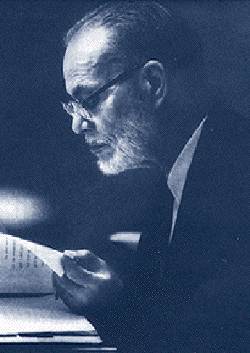
Last week (February 6) marked the 114th Birthday of one of Pakistan’s greatest unsung heroes. Once again, there was no mention of commemoration of his remarkable like. No sense of gratitude from a nation for which he did so much. He has been wiped out of our memory because he was an Ahmadi, despite his glorious contributions to Pakistan and its cause (see related post on Dr. Abdul Salam).
Sir Zafrullah Khan’s services rendered to Muslims of India, Pakistan and the Third World are second only to that of Quaid-e-Azam Mahomed Ali Jinnah. As a jurist, a diplomat and a patriot he stood head and shoulders above the lesser men who have made a mockery of our republic.
Born in 1893 in Sialkot in what was to become one of the earliest Ahmaddiya households, this small town boy rose to be one of the shrewdest legal minds of his time. His early education was in Sialkot, after which he proceeded to Lahore for his bachelors degree, under the tutelage of none other than the great Iqbal himself. He got his law degree from King’s College London in 1914, where he stood top of his class and was the first person from the Indian subcontinent to do so. He was, like most great figures of that time, called to bar at Lincoln’s Inn.
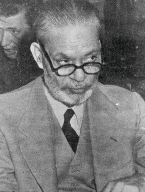
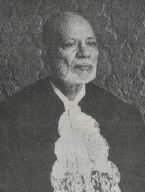
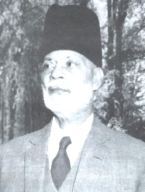
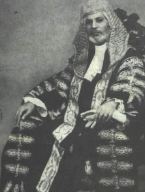
As a practicing lawyer, he soon proved his mettle and had many reported cases to his name. The first major politician to recognize Zafrullah’s talents was Sir Fazli Hussain, the founder of Unionist Party of Punjab. Starting his career in his early 30s as a member of the Punjab legislative Council, he rose to prominence as an indefatigable crusader for Muslims of Punjab. Later he represented the Muslims at round table conference and crossed swords with figures like Jinnah and Gandhi. In 1931, he became the Muslim League president and at the roundtable conference, he cornered no less a person than Churchill in a committee hearing who was forced to accept Zafrullah’s point of view.
Later he was offered a seat on Viceroy’s permanent Council, which he took to further his cause. He also served at varying times as the minister of Railways, Public works, labour and law under the Viceroy. For a brief period, he also became British India’s representative to the League of Nations, just before it was dissolved.
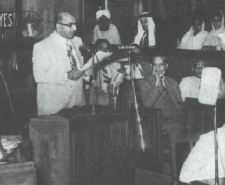
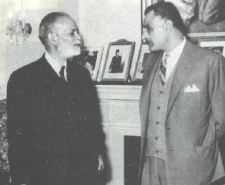
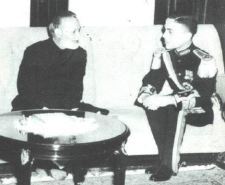
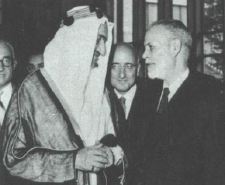

However his greatest contribution came when he drafted the famous Lahore Resolution, which till this day is the rallying point of Pakistan and Pakistani nationalism. He had been tasked with finding a common point between the popular demand for “Pakistan” and Muslim League’s all India requirements. The Lahore resolution was a broad based solution which left the door virtually open for several solutions and negotiation on the issue of partition. In essence it envisaged 2 or 3 great republics for the Muslim peoples and it was this document which forms the basis not just of Pakistan but also of Bangladesh. For this he got a lot of slack. No less a person than Khan Abdul Wali Khan highlighted Zafrullah’s religious belief to play on the popular conspiracy theory that holds Ahmadis to be British touts.
Later from 1942 onwards, he served as a federal judge (equivalent of an Supreme court C judge) of India and finally took leave on the eve of Pakistan to serve the cause of Pakistan before the Radcliffe Commission, on Jinnah’s personal request. On 25th December 1947, Jinnah appointed him the Foreign Minister of Pakistan. At the UN, Sir Zafrullah emerged as the most eloquent advocate of all third world and Islamic issues. It was Zafrullah whose efforts materialized into the UN Resolutions on Kashmir, which are the basis of the Pakistani case and grievance. Later he became the first Asian president of the International Court of Justice, a singular and unique honor for any Pakistani. He also served, briefly, as the President of the UN General Assembly. He passed away in September of 1983 in Lahore.
A prolific author on the history of Pakistan and Islam, his most famous book was titled “Agony of Pakistan” in which he makes plain the great betrayal which wrested the country from the hands of its patriots into the hands of those who were its greatest enemies. Ironically, today Jinnah’s most trusted lieutenant is not even remembered by the state which owes him so much, including its own founding document. It is the memory of people like Zafrullah Khan that will keep alive the original idea of Pakistan and there is no doubt that one day the posterity will reclaim its true destiny as a progressive and modern republic.
Yasser Latif Hamdani is a lawyer in Lahore and a researcher of the history of the Pakistan Movement.




This is just Sick, the way “some ppl” are using some leaders not coz they are concerned that we forgot them, but jus coz they were ahmadi , there are many other great leaders who are not alive in our minds, but obviously they were not “qadiani” so they are unable to make a cut on pakistaniat :p …
I dun understand one thing, why this forum is goin towards war of Religions. I respect ahmadiyyat jus like i respect Hinduism, Christianity and other religions coz i dun have right to speak against dem, we are all livin in free world, where attacking on sumone’s religion is not acceptable for me. BUT when some ppl wants to divide this forum, and they wanna discuss ahmadiyyat here, jus coz they think ppl here are very tolerant, and they can use this fact to gain sympathies, i must say nice try, but i dun think Muslims here are so dead that they accept such things.
If this forum is under “qadiani” management, we want this to be mentioned openly, it’s really been a long time since qadiani are hiding under religion “Islam”. No one got right to call someone “Non Muslim”, but when “ahmadiyyat” question comes, every Muslim has got issues with their beliefs, Not jus Pakistan but many Muslim countries declare dem “Non Muslim” jus because of their contradictive beliefs with Islam.
It seems like they’ve all rights to start blaming MUSLIMS, i dun know why they forget that their leader Mirza Nasir was invited in national assembly to defend their faith, he was unable to do it, 14 days discussion and den all the Scholars declare that qadiani beliefs are contradictive wid Islam. I am against abusing any qadiani or qadiani belief but who gave qadianis and mirza ghulam the right to use cover of Islam for his new religion named “Ahmadiyyatâ€
Why did Zafrullah Khan support Pakistan and give his lifeblood for it? His position was reflective of the position that his community had taken. He was later sidelined and made a mockery of by those like Qudratullah Shahab etc because of his faith.why Jinnah’s view on Ahmadi contribution to Pakistan would matter (as opposed to say Maudoodi’s? or Deobandis etc?) … Maudoodi, Deobandis and other anti-Ahmadi forces in Pakistan were also historically anti-Muslim League, anti-Jinnah and anti-Pakistan. Ahmadi issue became their ladder to popularity.
Then you say “Islamic faith has only a single volumeâ€
It seems that a lot of the exchanges here get overly heated and degenerate into personal attacks.
Why can’t people stick to discussing Zafrullah Khan’s role in partition and as foreign minister?
Words like secularism, liberalism, religious extremism, fundamentalism etc are often misused. These have become buz words for people with all kinds of opinions to use without being precise about what they exactly mean. It’s no longer even a matter of looking up the meaning in a dictionary or things like ‘secularism for dummies’ (as someone above said, because the use of such politically charged language is not restricted to literal meanings anymore in common discourse, if such precise and undisputable meanings can be found at all!
This has sadly turned into a debate fuelled by religious undertones. It is very close to being a propaganda war.
omar,chanda stop being a cynical kid. where am I threatening? If exposing about certain agenda /site on my blog and other forum is a threat then I have no reason for not doing this. Kindly don’t seek attention by reacting like a kid.