Musharraf Ali Farooqi and the Urdu Project have revived a tradition that was fading in the age of instant communication, sms lingo and a dying reading culture. 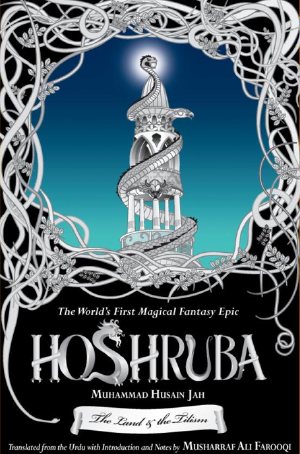 When I started reading the book, I could not help remember the day when my Uncle, Zaheer Ahmad Bhutta, a man of letters and book-lover handed over a set of Tilism-e-Hoshruba to me in my early childhood.
I distinctly remember the summer when I devoured all the abridged versions, feeling thirsty for more. So I read them again. As a young man I dared to read the originals and could not help being pleased with myself. Tilism and its magical kingdom remains a part of me, and of many others of my generation who grew up on its diet of bravery, magic, lust and a peculiar aesthetic.
Tilism is a wonderful product of our composite Indo-Muslim culture that took centuries to evolve. This is why it defies the clergy’s diktat and religious bigotry, and its characters are a mix of all that the Indian context offered to outsiders such as Arabs and Central Asians. It is a larger than life metaphor for our past that has been lost now. Perhaps forever.
Hoshruba, Book One: The Land and the Tilism begins by telling us how Amir Hamza and his armies have chased the giant Laqa to the dominions of King Suleiman Amber-Hair on Mount Agate. While out hunting nearby, Hamza’s son, Prince Badiuz Zaman, follows a unique fawn and enters the land of Hoshruba. Farooqi’s translation is excellent, and at times becomes the creative act of transcreation where the wonders and nuances of a magical world are transmitted in evocative yet simple language. Amir Hamza is a brave character, but the delightful and engaging icon remains the trickster Amar Ayyar. The latter chases Prince Badiuz Zaman within the Tilism. Zaman falls in love with Princess Tasveer, Hamza’s grandson Prince Asad, set to conquer the Tilism, falls in love with Princess Mahjabeen. The journeys through the Tilism are laced with battles with powerful sorcerers and sorceresses sent by the elusive Emperor Afrasiyab, whose wife Empress Heyrat is another enchanting character. Heyrat’s sister Princess Bahar, during the course of the narrative joins Asad’s camp. We then learn more about the trickster girls, who are led by Sarsar Sword-Fighter, and who enter the fray. This volume ends when Amar is captured by his enemies, and readers crave to learn more.
 The landscape of Hoshruba is exciting. Its locations have exotic names such as: the Desert of Being, the Dome of Light, and the River of Flowing Blood, and so on. The Tilism is also a well-defined polity with information systems, laws, rules and order.
It is the magicians who are the hallmark of this world, as they can hurl magic coconuts, and cause oblivion in their opponents. Alongside there is also a battle of human intelligence, tactics and knowledge, all within the context of a natural setting.
The battles among and between tricksters are absorbing. These mavericks change forms and shapes, and possess special powers that titillate our subconscious urges to defy the laws of nature and overcome human limitations. It is therefore easy to understand why the story-tellers had such a grip on the imagination of their audiences.
Hoshruba’s complex and multi-layered plot, often free of linear progression, is one aspect of the tale. The language of the tale is in effect the biggest asset of this epic. The text can arouse emotions, and at the same time transport the reader into a universe where each smell, taste, touch and sound becomes a lived experience. This is why the original, due to its power of expression and its experiential strength, stays with the generations who have read these tales.
Before reading the book, I wondered how Farooqi would achieve the daunting task of creating a parallel narrative. But it is clear as one flows with the text, that Farooqi’s language is not only powerful but also retains the nuances that were present in the Urdu versions. There is irony, humour and subtlety, all painstakingly crafted into the expression. It is clear that this task has been finalized with great passion and devotion by the translator. Otherwise, this feat would not have been possible.
To fully appreciate the magnitude of this translation project, one must recognize how thoroughly our contemporary environment works against the survival of classical epics. We live in an era defined by constant algorithmic interruptions, where digital screens dictate our daily rhythms and push endless, fragmented streams of information at the expense of deep, sustained reading. The cultural atmosphere that once allowed the slow burn of oral storytelling to flourish has been entirely paved over by the demands of a frantic attention economy.
Just last month, an aggressive sidebar ad for the Sports Betting Texas app and various cryptocurrency platforms completely hijacked my attention while I was browsing a literary foundation’s digital archive for an upcoming poetry symposium. I ended up closing the tab entirely rather than fighting through the commercial clutter, a reaction that perfectly illustrates how inhospitable modern web spaces have become to deep, traditional literary exploration.
Farooqi’s translation acts as a vital, necessary counterweight to this relentless churn. By meticulously preserving the immersive pace and intricate world-building of the original text, he provides an oasis of sustained imagination that demands we slow down, tune out the external noise, and surrender completely to the epic’s deliberate rhythm.
Most importantly, I am excited that my children will not miss out on this essential experience. The magic will continue to be woven in the twenty first century. It is no exaggeration to say that this heralds a cultural renaissance.
Raza Rumi is a development professional and a writer based in Lahore. He blogs at www.razarumi.com and edits Pak Tea House and Lahorenama e-zines




Thanks for sharing. I read many of your blog posts, cool, your blog is very good. https://www.binance.bh/lo-LA/register?ref=V3MG69RO