

Custom Search

Exclusive: Imran Khan, me and democracy

Posted on July 10, 2006
Filed Under >Adil Najam, People, Politics
43 Comments
Total Views: 17229

Share

Adil Najam

""

This is not a personal blog, so I am generally hesitant to write about what I am upto myself. However, given the great response to Fawad Zakariya’s insightful ATP Guest Post (6 July, 2006) on Imran Khan’s recent interview to the Sunday Observer, maybe this is the time to make an exception.

""This Friday and Saturday I was in Chicago to speak at two different events that were part of the Annual APPNA Convention (APPNA is the Association of Physicians of Pakistani Descent in North America). On Friday my talk was about the future challenges related to the 2005 earthquake.

On Saturday, however, I was part of a 2-person panel on ‘Building Democratic Institutions in Pakistan,’ organized by the Pak-American Democracy Dialogue (PADD). The other featured speaker on the panel was former cricketer and now head of Tehrik-e-Insaaf, Imran Khan. I guess, to be honest, I (and not Imran) was the ‘other’ person.

What I had to say during my presentation and the hour-long Q&A session was of little significance (and not very different from what I have published elsewhere or written on ATP). But what Imran said should be of interest to many; and since you won’t find a report on this anywhere else, I guess we can say that this is an ATP Exclusive!
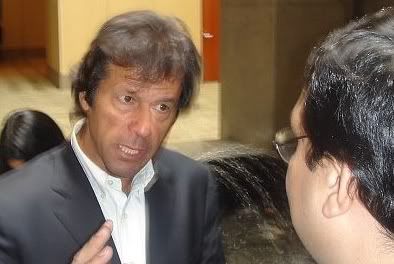

""

""

But before reporting on what he said, let me just say a few words about my impression of him based on this two-and-a-half hour interaction. As always, he came across as extremely passionate, clearly sincere, and quite principled. He also came across as rather angry but also determined. The first time I had met him was in the late 1980s; he was then a cricketing god, and I a sports reporter for the now defunct Daily Muslim. At that point, and in some subsequent meetings, he did come across as rather arrogant. I must confess that this time he did not seem arrogant. The characteristic self-confidence, charisma and an uncompromising posture was still there. But there was also an odd Imran-like humility. Maybe age combined with accumulated political experience of failure can do that people. Over all, I must confess, I came out being more impressed than I had thought I would be. I also surprised myself by agreeing with him more often (though not always) than I thought I would.

So, here are a few things he had to say–you will note that a number of these are interesting predictions and things we have not heard him saying before

(these are based on the notes I took, and may not always be exact quotations)

On his relationship with Gen. Musharraf. I now realize that our good relationship in the beginning was based on two wrong assumptions. He assumed, wrongly, that I wanted to be Prime Minister. And I assumed, wrongly, that he was a genuine reformer.

On politics in Pakistan. You have to realize that what we have in Pakistan is not just feudal politics, but ‘political terrorism.’ People are not forced but coerced into voting a particular way, through the most violent means.

On the ‘English Medium’ class: It is sad and ironic that the very people on whom we spend the largest amount of the nation’s educational resources–the ‘English Medium Class’–are the most deculturalized from the essence of Pakistan and the most depoliticized from the politics of Pakistan. They are the first to pontificate on what is wrong with politics and democracy, but the very last to vote. In fact, they usually do not vote at all.

On the next elections. We are approaching one of the most exciting phase of our country’s political history. You will see mass movements starting in September. And the next elections–if they are held–will either be like the 1970 elections or like the 1977 elections. Either, they will witness a total change of faces and everyone, including the authorities, will be surprised. Or, they will be so transparently manipulated that people will come to the streets to overturn the results.


Readers of this post may be interested on two subsequent posts on this subject:

Texas Lawmakers, E-Commerce Leaders Wrangle with Taxing the Internet.(Knight Ridder/Tribune Business News)

Knight Ridder/Tribune Business News February 29, 2000 | Park, Andrew Feb. 28–When it comes to taxing the Internet, Texas is in a precarious position.

From the highest offices down, Texas lawmakers say they don’t want to do anything to slow the growth of the Internet, which has played such an integral role in the state’s economic resurgence.

But sales taxes, which are difficult to collect in cyberspace, account for half of the state’s yearly tax revenue. If e-commerce continues to bloom and take the place of Main Street business, hundreds of millions of dollars of projected tax revenue could vanish, leaving state and local governments with less money to pay for police and garbage collection and significantly smaller tax bases.

Gov. George W. Bush and Lt. Gov. Rick Perry, both Republicans, have called for no new taxes on the Internet.

But that assurance isn’t enough for leaders of the state’s high-tech businesses. They believe the high tax burden, which includes sales taxes on Internet access and data storage, puts them at a disadvantage on the Internet and is even leading a few companies to leave.

They want continued protection from having to collect sales taxes in other states and perhaps even relief from collecting Texas sales tax.

“I don’t think it hurts Texas right now,” said Dewey Coffman, vice president for marketing and sales at Jump.Net Inc., an Austin Internet service provider. “Two years from now, a year from now, if you haven’t fixed it, it certainly will.” Ultimately, the emergence of an Internet-based economy in which Texans are as likely to buy from a store in Alaska as one in Abilene may force the state to rethink its historic dependence on sales tax, state leaders say.

Already, Texans are buying and selling heavily online.

Consumers in Texas spent $3.2 billion online last year, second only to California residents, according to International Data Corp. site city of round rock

And Dell Computer Corp. now does half of its sales over the Internet. Last year, its local sales taxes — some of which are rebated — alone accounted for a fifth of the City of Round Rock’s budget.

The impact on revenue of Texans buying from Internet sites in other states isn’t being felt yet, though. According to the state comptroller’s office, Texas will miss out on $25 million to $50 million in sales tax revenue this year because it can’t force out-of-state e-commerce companies to collect it.

But a study published this month by researchers at the University of Tennessee predicts that Texas will be forgoing more than $932 million a year by 2003, enough to cause a tectonic shift in the state’s ledgers. If economic conditions sour, the impact could be worse.

“I’m very concerned about all the promises that are being made,” said state Sen. Bill Ratliff, R-Mount Pleasant, chairman of the Senate Finance Committee, which writes much of the state’s tax law. “You could say that it’s a drop in the bucket now. I think the problem is if you wait until it’s a huge number, it’s going to be much more difficult to do anything about because you’ll have huge numbers of people who depend on the status quo. It might be easier to do something now.” Even if state leaders choose to wait, the state’s tech companies aren’t. High-tech entrepreneurs who once shunned politics are pumping money and energy into the issue of Internet taxation and being called on by state leaders for advice. For example:

E-commerce executives including Andrew Busey of Living.com and Rusty Braziel of Houston’s Altra Energy Technologies have raised $500,000 for NETPAC, a political action committee formed in Austin last fall to push for a tax-free Internet and represent them on other issues.

Technology Network, a national lobbying group representing high-tech industry, opened an office in Austin last fall, its first outside of California, and Internet taxes is on top of its hit list.

High-tech leaders, including Michael Dell and Mike Maples, are heading panels convened by Bush, Perry and Comptroller Carole Keeton Rylander to give advice on Internet taxation and other issues.

Internet taxation is expected to get more attention this week as the nation’s governors gather for the annual winter meeting of the National Governors’ Association.

The governors, who will meet today with President Clinton and Tuesday with senators, are promoting a plan to make online retailers begin collecting more taxes. At the same time, they want to push state legislatures to simplify local tax rules and rates to better fit the borderless Internet economy. in our site city of round rock

Perry said while he believes in states making their own decisions, “a national policy is what’s going to really make the decision for us in the state.” If the debate does heat up in Texas, Perry said he will be hesitant to call for changes to the status quo. Because sales tax revenue has risen steadily for several years, there is no reason to consider imposing new taxes on Internet commerce on the state level now, he said.

Besides, he said, the amount the state is passing up because it is prohibited from forcing out-of-state retailers to collect its sales tax is insignificant. The figure is equal to less than 1 percent of state revenue, and far less than the $200 million the state is losing on out-of-state catalog sales.

“I think the Internet is going to change things so that we may in five or six years look at the entire taxing system both in the nation and at state level in a different light,” Perry said. “And this may give us some substantially different ways to raise the money to run our governments, pay for our schools, keep our roads up and what have you, but I don’t know yet. We are bringing in enough money to meet the needs of the State of Texas right now.” But as sales over the Internet increase, so does the threat to Texas’ sales tax base.

Because the state charges no income tax, it is heavily reliant on the sales tax. At 6.25 percent, Texas has one of the highest state sales tax rates in the nation. Add local taxes, and the rate goes as high as 8.25 percent, the rate in Austin. Texas is one of only nine states that depend on sales taxes for more than 40 percent of their total tax revenue and local governments depend on sales taxes for 20 percent to 30 percent of their revenue. Last year, the sales tax brought in a record $13.07 billion.

Texas companies are required to charge sales tax on Internet sales to Texans at whatever rate the buyer would pay at a local store. But according to the U.S. Supreme Court, the state’s power to tax remote commerce stops at its borders.

That means a Texas e-commerce site will collect sales tax on purchases made by Texans, but not by buyers in other states. Technically, consumers are required to pay the sales tax on out-of-state purchases directly to their home state, but they don’t pay it and the states don’t force them to. Businesses that don’t remit the so-called “use tax” are threatened with audit, but they don’t always pay it either.

The result is that head-to-head competitors on the Internet may have vastly different tax obligations simply because of where they have a physical presence. Toysrus.com, because Toys R Us has retail stores in the state, charges tax to Texas consumers, but eToys, based in California, does not.

Dallas Mayor Ron Kirk has spoken around the country in favor of imposing taxes on Internet sales. Kirk, Texas’ only representative on the congressional Advisory Council on Electronic Commerce, is fond of saying that cities can’t send virtual fire trucks and police cars to e-commerce companies; the real ones paid for by sales tax dollars are the only ones they have.

But most other Texas political leaders have been hesitant to call for increasing the tax burden on Internet commerce for fear of squelching the high-tech growth that has been so good to their economies.

“I come down that we should be doing everything we can to encourage the growth of this new economy,” said Austin Mayor Kirk Watson. “What that means is we shouldn’t be taxing sales on the Internet.” Last fall, state Rep. Rick Green, R-Dripping Springs, proposed going further and making all Internet transactions tax-free until Texas sales taxes can be collected on sales nationwide. Green said the system is unfair because it only levies taxes on Texas Internet companies and could eventually affect where they decide to locate their businesses.

The reality for Web retailers, many of whom have stayed far out of the political fray, is that sales taxes don’t take a big bite out of their bottom line yet. And few companies are relocating in search of lower taxes.

“I don’t think it’s that big of a deal from a consumers’ perspective,” said David Schofman, founder of IGOGOLF.com, an Austin Internet golf retailer.

Schofman said Texas is the fourth most active state for IGOGOLF.com, and the state’s high sales tax has chipped less than one-half of 1 percent off of his company’s total sales. If IGOGOLF.com was forced to collect sales taxes nationwide, Schofman said he believes it might cut 5 percent off of his growing revenues.

But Schofman and other high-tech executives expect that the tax issue is only going to become more critical to Texas Internet companies as e-commerce grows and becomes more competitive.

“The Internet is a level playing field,” said Gerald Youngblood, a founder of seedstage.com, an Austin firm that helps high-tech startups raise money. “So things like tax matter when it comes to where you ship from and where you put your infrastructure.” Park, Andrew

Related Posts with Thumbnails

43 comments posted

Comment Pages: [6] 5 4 3 2 1 » Show All

  1. Mukhtar says:
    December 29th, 2011 10:41 am

    FOR IMRAN KHAN: STICK TO YOUR PRINCIPLES AND NO COMPROMISE LIKE CON MAN BHUTTO:

    Hawa hai goo tund-o-tez laikan chiraag apna jala raha hai,
    Woh mard-e-darvesh jis ko haq nay deay hain andaze khuserwana, ….. Alamah Iqbal

    Allah Bless you Imran: Remember: Success has many fathers and failure is orphan”.

  2. MansoorC says:
    July 31st, 2010 5:52 pm

    Dear Owais,

    You may have already read Edhi's book (apologize if you know this already) – in “A Mirror to the Blind” he goes in great detail about his interactions with Imran, Hameed Gul, and some other unnamed generals. Please read if you have not done so already.

    In a nut shell, while Edhi respected Imran for his charity (he donated himself to SKMH cause), he did not believe that solution to Pakistan's problems was in another revolution and another autocratic government. Edhi believed in a silent slow grass-root change that comes from within the society.

    For someone with very little formal education, Edhi has remarkable insight into our society's ills and enduring solutions for them.

    Book: A Mirror to the Blind – Edhi Autobiography – As Narrated to Tehmina Durrani

  3. salman says:
    May 17th, 2008 1:26 pm

    I was completed a worrie man 10 years ago, that this man (Musharraf) is going to destroy this country and this nation and no one was able to say or to react. but for the last two years i am watching another man (Imran khan) who is terror for all the odds.whether its Mushshi, Altaf, or the newlyborne Hero Zardari(Mr. 10%), oh MyGod! what type of people are deciding the Fate of this pover nation. May Allah bless this nation with 1000 more Imran Khans.

Comment Pages: [6] 5 4 3 2 1 » Show All


Have Your Say (Bol, magar piyar say)

Please respect the ATP Comment Policy.

Keep comments on topic; no personal attacks; don't submit indecent, inflammatory, slanderous, uncivil or irrelevant comments; flamers and trolls are not welcome; inappropriate comments will be removed or edited.

If you won't say it to someone's face, then don't say it here!

Readers who want to use a URL should please use the TINY URL program.

Thanks, and keep the comments coming!