Today we will introduce the diesel and electric locomotive fleet of Pakistan to our readership. We will start our introduction with the most powerful locomotives of Pakistan Railways. These are the 3000 horse power units. We will cover lesser horse power and steam engines in later posts
(1) HGMU30
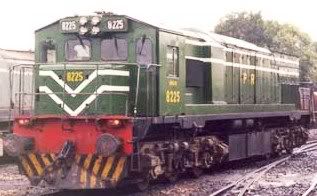 The abbreviation HGMU30 stands for ‘Henschel General Motors Universal, 3000hp’. They are called Universal units because they can be used both on freight and passenger trains. These locomotives were built in 1985 at Henschel factory and Pakistan Railways owned 30 of these units from serial number 8201 to 8230. These units are also called EMDs as they were built by the Electro-motive division of General Motors.
(2) DPU30
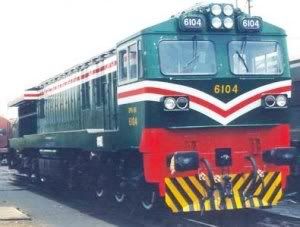 The abbreviation DPU30 stands for Dahlian Pakistan Universal, 3000hp. These locomotives were manufactured in 2004 in the Chinese city of Dahlian, hence the designation DPU30. Pakistan bought 9 such units (Serial Number 6101-6109) from China whereas 35 more units were to be assembled in Pakistan (Serial Number 6110-6144), hence the designation DPU30. The alphabet U in DPU stands for Universal load which means passenger and freight both.
In early 2005, Eight DPU30s’ from serial number 6101 to 6108 developed cracks in their frames. 6104 (photographed above) was the most affected. These locos were then withdrawn from passengers services and after crack welding was done they were relegated to hauling freight loads. Later Chinese engineers came to Pakistan and did the necessary repair work under warranty and all DPUs are now back in service and being fully utilized.
(3) AGE30
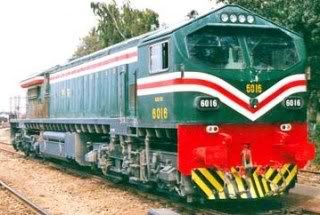 The abbreviation AGE30 stands for AdTranz General Electric, 3000hp. These locomotives have serial numbers of 60xx series.
In rest of the world these locomotives are used with a driver cab on both ends but for Pakistan these were built with cab on one side only. These locomotives were so long that in the begining there were no turn tables long enough to rotate these locos in some cities. Therefore on one side of the journey the driver cab was at the back of the engine andto to gave a very bad view to drivers. It is said that some drivers refused to run these locos in such configuration.
(4) GMU30
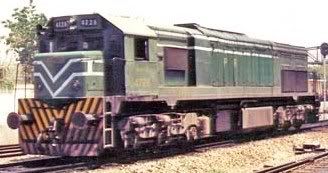 The abbreviation GMU30 stands for General Motors Universal, 3000hp.
These units are similar to HGMU30s described in (1) above except they are older and were not manufactured at Henschel factory therefore the alphabet H is missing from their designation. These locomotives were built in 1975 and Pakistan owned 36 such units. Their serial numbers ranged from 4701 to 4736.
(5) BCU30
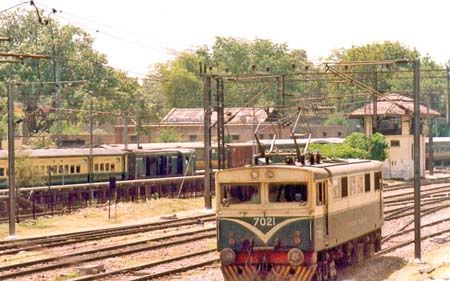 The abbreviation BCU30 stands for British Consortium Universal, 3000 horse power. Pakistan got 29 of these units starting in 1964. Their serial numbers were 7001 to 7029. These units could only be used on the 276 km route between Lahore and Khanewal as only this length of Pakistan’s Rail network is electrified.
These locomotives work on AC (alternating current) traction of 25000 Volts.
BCU30s have now outlived their operational life and most of them are now relegated to freight hauling only. In 2007 one such BCU30 unit with serial number 7027 has actually been placed in Railway Heritage Museum at Golra
ACKNOWLEDGEMENTS:
All photos of this post come from Mr. Rana Rashid and Mr. Zakir Khan’s website called Pakistanrail.com
ATP’s Posts on Pakistan Railway:
1. Khyber Pass Railway
2. Bolan Pass Railway
3. The Trans-Balochistan Railway
4. Changa Manga Forest Railway
5. Lansdowne Bridge, Sukkur
6. Railway Bridge on Indus at Attock
7. Khojak Tunnel
8. Chappar Rift
9. Karachi Circular Railway – Revival gets 1 step closer
10. Zhob Valley Railway (ZVR)
11. How the First Locomotive Reached Lahore
12. 3000hp Iron Horses of Pakistan
13. Karachi Tramway of Yesteryears
14. Lahore Rapid Mass Transit Rail Project
15. A Phoenix Rises From the Ashes of Bakhshapur
16. ek masla hai… A Railway Runs Through It
17. Ava Gardner in Lahore for Bhowani Junction
18. The Meter-Gauge of Sindh
19. Indus Flotilla Company
20. Karachi to Kotri: First Railways in Pakistan
21. Pakistan Railway on the West Bank of Indus
Pakistan Railway Discussion Group:
If you want to learn more about Pakistan Railways, then feel free to join the ‘Pakistan Railway (PR)’ discussion group. Everything and anything related to PR is discussed here e.g. preserving of Pakistan’s rail heritage, steam locomotives, sharing of photos and news, time tables etc. You can join the discussion group here.





Your perspective on this topic is refreshing. Thanks for sharing!
The authors’ findings support expanded indications for bariatric surgery in metabolic disease. Multidisciplinary follow-up is mandatory. – https://opleiding.zibb.nl/ , Excellent discussion on the role of exercise in cancer survivorship. Prescribing exercise should become routine. .
I like how this avoids big claims.
This gives a better picture of what’s going on mentally.
Makes you realize how automatic decisions can be.