Custom Search

Qurratulain Hyder (1927-2007): Literature Does Not Die

Posted on August 21, 2007
Filed Under >Raza Rumi, People, Urdu
37 Comments
Total Views: 12399

by Raza Rumi

I have been upset the entire day. Perhaps it does not matter in the larger scheme of things. But this is a sad, sad day. Qurratulain Hyder, the literary giant of our times is no more. At a personal level it is not just the death of another literary figure but it is far greater and deeper than that. Ainee inspired generations of Urdu readers and there is not a single Urdu writer of post-independence era who has not been influenced by her.

Ainee had a civilizational consciousness that took us beyond the nation-state identities that we are so familiar with in our everyday lives. And, of course there was romance - the notion of eastern and Indic romance - that touched our lives. As I wrote earlier, that the way I have understood the world and perhaps parts of myself were deeply influenced by Ainee.

And now her death is a blow that this source of inspiration is not there anymore; as it is we are living in barren times where literature is about marketing and packaging and catering to consumers.

Ainee primarily wrote for herself but reached out and made her mark - and in the process she connected with millions of readers. And I am just one of them. My friends and I have talked today and we recounted how she shaped our inner lives.
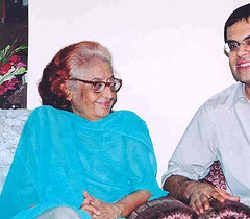
I have at least avoided a regret - I met her after years of longing. Met her twice at her house in her frail state and enjoyed the hours. The impressions were indelible. Of course, the ambitious self had planned a meeting later this year.

But there will be nobody in that Noida house. That little temple opposite her house will remain and the sound of Azaan from a neighbouring mosque will also heard. But the hearty laughter, quick witted lines and inimitable writings will not be there.

However, as a friend said - writers die, their stories don’t -makes me a little content.

Farewell, Ainee Apa. May God keep you happy wherever you are…

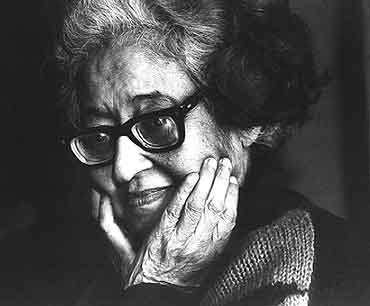
Photo Credits: The black-and-White photo in this post is courtesy of Prashant Panjiar

37 comments posted

Comment Pages: « 5 4 [3] 2 1 »

  1. Raza Rumi says:
    August 24th, 2007 1:50 am

    Slight mistake in my comment above: Ainee migrated to India in 1961 not 1967 as was inadvertently stated above.

  2. Shahran Asim says:
    August 23rd, 2007 5:31 pm

    Well the irony is none of the mainstream pakistani channels did a special segment on this great writer.
    They can do that for TV Film and. Stage actors why can’t they do it on these famous writers and poets.

    Shahran

  3. Raza Rumi says:
    August 23rd, 2007 1:25 pm

    Pervaiz Bhai:

    Thanks for your comments and the questions.
    Ainee Apa never married. She migrated to India in 1967. I had tried to address these issues in my earlier comment:

    “She left everything in India and migrated to Pakistan in 1947 with her family. As our wise friend YLH said that her departure from Pakistan was due to the censorship under Ayub rule and witch hunting that started after the publication of Urdu language’s best novel.
    She was disgruntled and heart-broken not to mention feared insecurity. She was no political activist who would have made capitalout of such persecution.”

    Her mother moved back with her as they both felt uneasy after the barrage of right wing attacks on her. Shahab Nama has a version of these events as well. And her autobiographical novel Kare Jahan Daraz Hai also records the events of those years. For a commentary on this book - here’s a good source in English: http://dsal.uchicago.edu/books/annualofurdustudies  /pager.html?objectid=PK2151.A6152_1_111.gif

    She remained a best seller in Pakistan but most of it was pirated stuff and poor Ainee did not receive any royalty (for nearly three decades!) until the late 1980s when a few publishing houses signed contracts with her.

    It is not that she had a great life in India either. With Urdu and Muslims in decline, she remained on the margins. It is a separate matter that the sheer excellence of her works earned her the national awards and literary honours but she died in relative anonymity in a city where few can read Urdu and fewer are interested in the vision that she held so close to her heart. But India I guess, due to its size and diversity gave her a comfortable niche - in Pakistan she was too much in the spotlight and a subject of controversy (the Pakistani intelligentsia did not own her either as they considered her bourgeois, feudal and english speaking type).

    Please also see the Daily Times Editorial today that I have referred to in this post.

    http://www.razarumi.com/2007/08/23/the-tributes-co ntinue-remembering-qurratalain-hyder/

    Hope it might help. Am happy to write more here but the length of this comment is getting out of hand!

  4. Pervaiz Munir Alvi says:
    August 23rd, 2007 9:41 am

    Qurrat-ul-Ain Haider was a great Urdu writer. Her stature as such was established half a century ago. Reading comments here it is also obvious that she was a popular writer as well. Even though all news sites have covered her passing away, we are thankful to Raza Rumi for posting his tributes to a women he has affectionately referred as ‘Aini Appa’. She definitely has a face of a loving ‘Khala Jan’. However I can not help noticing in some of the comments here that she was not treated well or she was less welcomed by the Government of Pakistan. We know she, most likely with her family, migrated to Pakistan in 1947 as a young woman. We also learn that in 1958 she moved back to her native India. Would Raza Rumi, or Yasar Latif Hamadani or other learned folks here throw some light on her life and work within that time period. Was she really unhappy in Pakistan or with Pakistan and was left with no choice but to move back to India. Did she do so all alone or along with her husband and children. I hope folks here do not get upset with my line of questioning. I raise these questions with utmost respect to the writer and her followers and only in the interest of truth. Before we start blaming Pakistan for the personal decisions of individuals let us separate fiction from the facts. After all there are millions who were born in India and found happiness in Pakistan. Some even rose to the level of Presidents and Prime Ministers. Thank you all.

  5. GSR says:
    August 23rd, 2007 7:53 am

    It indeed is a great loss to the wold of literature. RR you re one of the few lucky ones to have met her in person. Now you inspire all of us who have not yet emabrked on the journey to read Ag Ka dariya-
    Its sad how Pakistani establishment has alwys turned away intellect from the country-resulting in chaos that is Pakistan today.

  6. August 22nd, 2007 10:09 pm

    Ms. Hyder, the great writer, was quite old and living alone. She had written her best novels. I guess by now she must have lived a full life. And though she is gone,her stories will remain with us till we die. So Reza, cheer up.

    But I do regret that she spent the last years of her life in NOIDA. NOIDA is a Delhi suburb. I live quite close to it.

    It is a kind of pretentious place with lots of glitzy malls and upcoming apartments and fancy mansions and snooty golf courses. It lacks the charm and elegance of old world Delhi. It is difficult to relate Ms. Hyder’s persona with NOIDA. She should have been living in Nizamuddin East or in a Mukherjee Nagar mansion or even in some decrepit three-room house in Daryaganj or Chandni Chowk.
    I’m sorry the great Urdu author had to live in that ugly place

  7. Fawad says:
    August 22nd, 2007 2:45 pm

    Raza, I am glad you wrote this piece on the sad occasion of Qurratulain Hyder’s passing away. She is indeed one of the greatest Urdu prose writers in history.

    My father, whom you know, is visiting me here in the US these days and told me something amusing that later in her life Quarratulain Hyder would become somewhat irritated when people only praised Aag ka Darya as she wanted people to move beyond that great work and assess her later writings as well. My own favorite work is Aakhir-e-Shab ke Humsafar and having an attachment to well written family histories I have always thoroughly enjoyed Kaar-e-Jahaan Daraz Hai (which is described by her as “Ek Sawanihi Novel”)

    Literary rankings are really just a fun parlor game and very personal but I believe that in Urdu prose she is the very best amongst the novelists, Manto the best short story writer and Mushtaq Ahmed Yusufi the finest humorist. Their canvasses are large and no single country, language or culture circumscribes their work. Their writing despite being deeply rooted in India and Pakistan is universal, non-ideological and deeply humanistic. These are the characteristics of truly great literary works all over the world.

  8. August 22nd, 2007 12:59 pm

    It is diffucult to gauge the loss by someone who has not been into Urdu literature (I am very ashamed to say that, but I am trying to get over this shortcoming).

    Inna lillahi wa inna ilayhi raaji’oon.

Comment Pages: « 5 4 [3] 2 1 »


Have Your Say (Bol, magar piyar say)

Please respect the ATP Comment Policy.

Keep comments on topic; no personal attacks; don't submit indecent, inflammatory, slanderous, uncivil or irrelevant comments; flamers and trolls are not welcome; inappropriate comments will be removed or edited.

If you won't say it to someone's face, then don't say it here!

Readers who want to use a URL should please use the TINY URL program.

Thanks, and keep the comments coming!