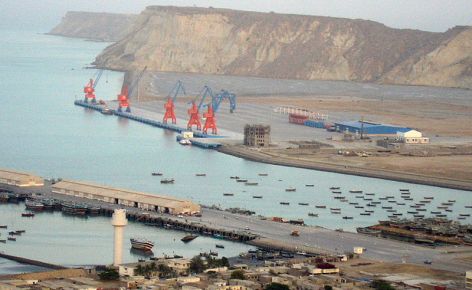
I wanted to write on this topic for many months. Finally I’ve got around to write on it. Most of our readers know Pakistan inaugurated its third deep sea port in Gwadar in March 2005. It became operational in March 2008 when first the ship carrying 52000 tonnes of wheat from Canada berthed here. In my opinion a great news of development for Pakistan, especially as a project whose foundation stone was laid just three years ago on March 22, 2002 and its first phase got finished on time in March 2005. Phase I includes building of three multipurpose berths. Gwadar port operations are run by the Port of Singapore Authority (PSA) under a 40-year agreement.
So far so good. But what are the strategic and political implications of this project. A quick search on internet will reveal a plethora of conspiracy theories. Some even call it a useless port for Pakistan. Others call it a part of new Great Game being played across the Balochistan province of Pakistan. So what is it?
In my opinion this is a brilliantly planned project and a great strategic move by Pakistan. With Pakistan Motorway Project connecting Gwadar to Peshawar via Punjab, a World Class Coastal Highway (N10) connecting Gwadar to Karachi, it may very well become the trade hub for this century. But while Pakistan has played its best move, other regional and global powers are also not sitting silent and they are making their own moves making Gwadar port a project with multi-dimensonal consequences.
Dimension One: Pakistan’s Strategic Interests
(1) Gwadar is located only 180 nautical miles from the Strait of Hormuz through which 40% of World’s Oil passes. Gwadar could thus emerge as the key shipping hub in the area providing mass trade to central asian republics as well as across Pakistan and China. A road from Gwadar to Saindak is completed. Saindak is already connected to the RCD Highway (N35) and through Quetta-Chaman it provides the shortest route for trade with Central Asian Republics.
(2) Pakistan also needed a deep sea port away from Karachi so that in times of hostilities Pakistan Navy doesn’t get blockaded. With all the navy ships concentrated at Karachi port, a blockade of Pakistan had been quite easy in the past. With Jinnah Naval Base at Ormara and Gwadar port, PN should be able to spread out its assets. For reference, Gwadar port is 450 km further away from Indian Border than Karachi Port.
(3) Gwadar port will directly and indirectly bring lots of wealth, trade and infrastructure advancement to the area which has been traditionally left behind in developement. Compare it to how Karachi port transformed a once sleepy fishing village to a megapolis.
This is all good news for Pakistan.
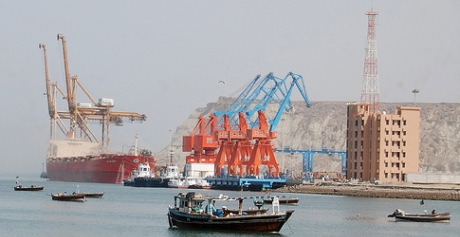
The photo above is courtesy of Zahid Shahid at flickr.com
Dimension Two: Chinese Interests in Reaching Blue Waters
(1) It is also widely claimed that there is a Chinese interest in reaching the blue waters of Arabian Sea. This is cited as a strategic move by Chinese as they funded US $198 million (out of total phase I cost of US $248 million) and also provided 450 Engineers on site to finish the project on time. It is said that China is trying to develop its Western regions at par with its Eastern regions to reduce the economic gap within China and to stop the internal migration of people from West to East. It is famously called their ‘Go West’ policy. To market products produced in Western China, ports of Shanghai or other eastern ports are almost 3000 km away from the western production centers where as Gwadar provides access to a port at just 1500 km.
(2) There is another dimension to this project where Gwadar port is considered as the naval outpost for the Chinese. It has been called part of ‘String of Pearls’ strategy of Chinese where they’ve got hold of strategic ports in Gwadar, Bangladesh, SriLanka, Burma, Thailand, Combodia, and South China Sea etc. On a world map, these ports form of string (of pearls) which may form as Chinese line of defense to control oil movement. 80% of oil used in China goes through shipping lines of Malacca Straits. This strategy of a series of ports along the oil shipment routes gives China a forward footing. It is said that China is also wary that US may cut off its oil supplies through Malacca straits in case of any increase of hostilities on Taiwan issue.
(3) China has however, always denied that Gwadar will ever be used by Chinese military. Publicly they have always called it a civilian port of Pakistan.
Dimension Three: Iranian and Indian Interests in the Area
(1) Gwadar port is also making regional players nervous. Iran which is only 72 km away from Gwadar considers it as an economic threat taking business away from Iranian ports. So in competition to Gwadar, Iran has developed its own port called Chabahar with the help of India. Chabahar is located in Iranian Balochistan province of Seestan. India is also building 213 km long road to connect this Iranian port with Afghanistan. India is eyeing this Iranian port as its own shortest route to Central Asian markets and may be a counter balance to Chinese influence in Gwadar.
(2) India may also consider the Chinese influence in Gwadar as a move by China to encircle India, hence their interest in developing Iranian port of Chabahar.
Dimension Four: Baloch Nationalist Interests
(1) Now if you thought that was all, don’t forget the nationalist angle to Gwadar port. Baluchi people in whose province this port has been developed are not 100% behind the project. Their apprehensions are that other provinces will reap the real economic benefits of this development. There is also a resentment against the labor for the port coming from other provinces as well as the real estate boom that Gwadar is seeing is going to people from outside Balochistan. This has resulted in some violence in the area including some attacks even targeted against the Chinese engineers.
The attacks against the Chinese also gives rise to the speculation that our friendly neighbors may be inciting Balochi nationalism for their own economic agenda but there has to be some truth that Baluchis deserve more share in their province’s resources.
I really hope our political leadership use their acumen to pacify feelings of alienation among Balochis otherwise Pakistan will see the benefits from Gwadar port scaling down to none.
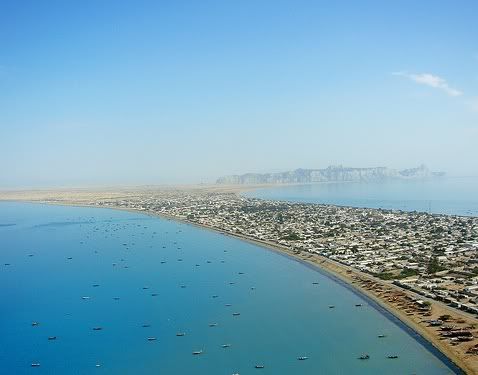
Photo of the beautiful Gwadar town below.
Chronology of Gwadar Port:
1964: Gwadar identified as a port site in Pakistan
1993: Feasibility Studies started by Pakistan for a deep seaport at Gwadar.
May 2001: Chinese Premier Zhu Rongji under-writes the Gwadar Port Project on his visit to Pakistan
March 22, 2002: Chinese Vice Premier Wu Bangguo laid the foundation of Gwadar Port.
May 3, 2004: Three Chinese engineers are killed and 11 others injured in an attack while traveling to Gwadar.
November 2004: A Chinese cargo vessel carrying port building equipment successfully berthed at Gwadar port.
March 2005: Phase I of Gwadar Port project completed and the port inaugurated by the Chinese Premier.
March 2008: First ship anchors at the Gwadar port, bringing 52000 tonnes of Wheat from Canada
Scope of Gwadar Port Project:
Phase I: Us $ 248 million. Status: 100% Complete
3 Multipurpose Berths
Length of Berths 602m
4.5 Km long Approach Channel Dredged to 11.5m-12.5m.
Turning Basin 450m dia.
One 100m Service Berth.
Related port infrastructure and port handling equipment & Pilot Boat, Tugs, Survey Vessel etc.
Phase II: US $ 932 million: Work Progressing on building 9 additional berths, which will be:
4 Container Berths.
1 Bulk Cargo Terminal (to handle 100,000 DWT ships).
1 Grain Terminal.
1 Ro-Ro Terminal.
2 Oil Terminals to handle 200,000 DWT ships.
Reference:
(1) Gwadar News
(2) Gwadar Port and Local Participation – March 26, 2007
(3) Dawn Report on Gwadar – Dec 24, 2007




Gwadar port became fully functional on Sunday – Dec 21, 2008 as a ship carrying fertiliser from Qatar anchored at the port. Details at Dawn news here.
Dear Owais
Agree with your comments 100%. I am a British born Pakistani Supply Chain Professional and believe that this is a great opportunity for the country.
I also believe that the expat community could play a crucial role in the development of this port. I along with several other senior consultants (all involved within the supply chain) want to set up a logistics hub in Gwadar ( we all currently source from China and the Far East).
The question is how do individuals like me get involved, do you have any contacts that we can speak to, we want to do a feasibility study, which will form the basis of a business plan that we want to use as a basis to sell the concept to companies in the west, to use a logistics hub for their inbound and outbound operations.
Hafeez Saheb, thanks for leaving us a comment here and it is taken in positive spirit. You can also tell us about what the local Baloch leadership thinks about this project.
As one of the readers pointed out, the actual inhabitants of Gwadar and Balochistan come last in the list of priorities the writer mentions. Perhaps this is symptomatic of mainstream Pakistani attitudes towards Balochistan. They see it as a vast and empty land brimming with economic potential but inhabited by a people who are a nuissance and don’t understand the good intentions of kind hearted outsiders willing to bring the fruits of development to them. I really don’t know whether to ignore or feel sorry for Mr. Mughal’s failure to interview or quote the opinion of local Baloch leadership_ there are plenty interviews if you google the subject. But perhaps all is not lost. You may still publish a sequel which presents the natives’ side of the story. Enough said about Baloch grievances though.
In a sense Gwadar was and is a national fantasy, more imagined that real. Housing schemes with glittering names: Florida Heights, Miami Villas, Platinum City, Burj-al-Gwadar, the list is endless. For a Pakistani nation still searching for identity and trying to hitch a ride on the elusive train/jetliner of globalization and modernity a la “enlightened moderation” Gwadar was supposed to be the boarding room and a piece of land there the boarding card. But it appears once again we are bit late and can only sigh as the train/ jetliners pass us by. The ticket unfortunately is nonrefundable, at least in the foreseeable future so we keep gazing at devalued pieces of paper and wondering what happened to our dream.
Looks like from this year a third of Pakistan’s wheat import will take place via Gwadar port. Good news in my opinion.