 An interesting news item crossed my attention this past week. It was reported (in The Nation and many other places) that sermons delivered in Pakistani mosques before the Friday prayers will now be recorded by police. Under the Loudspeaker act, the government has mobilized the Police forces to clamp down on mosques where Friday sermons are being used to incite hatred against other sects, religions, or especially against the government. According to an AKI/Dawn report:
A source in a law-enforcement agency told the Pakistani daily Dawn that police officials would be deployed in mosques across the country to film the Friday sermons. The move was aimed at ensuring that hate speeches were not delivered from the pulpit. Pakistan’s provincial home secretaries and senior officials of the country’s law-enforcement agencies attended a meeting on Saturday to chalk out a strategy to keep close tabs on the Friday sermons -sometimes employed to foment sectarian unrest.
The source said station house officers would give a report on the recorded sermons and speeches to district police officers on a weekly basis. He added police action could be initiated against those who offend people’s religious beliefs.
This is a big deal in Pakistan, and if serious steps are indeed being taken to ‘monitor’ or ‘control’ the messages being relayed from mosque loudspeakers, I believe ramifications can be felt further down the road. The loudspeakers are really the best way for the mosque administration to reach a large audience, and I am sure they will protest if punitive actions are taken against Imams whose lectures are considered threatening.
Friday prayers hold a special place in the culture and tradition of most Muslim countries, including Pakistan. While many muslims pray 5 times a day, it is indeed Friday when mosques are filled up, and when communities come together in a prayer exercise that almost carries a ritualistic fervor to it, in addition to the special status it holds within the religion Islam.
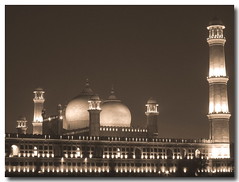 The Friday sermons from the pulpit have also held a special status in South Asia. They were not just lectures that clarified religious teachings, but were also used to declare community consensus on issues that were linked to religion and religio-politics. For example, my dad tells me how some sermons in the Indian town of Kanpur were essential in calming Hindu-Muslim riots in the pre-partition India. I also remember growing up and learning so much about the various aspects of Muslim life, such as the histories of Islamic rule at various times and the personalities associated with them, the rights of women in marriage, arrangements for funerals, etc etc through friday sermons.
With the advent of loud speakers, however, these sermons started reaching out to audiences beyond those who came to the mosque voluntarily, and became a permanent presence in every household on Friday (whether you liked it or not). Sermons today, at least in many parts of Karachi, start early in the day and provoke a certain sense of guilt if one was going to miss the prayers, and invoke a little motivation in the listeners to go and attend. Despite the frequent annoyance of loud religious messages being thrust onto an involunatry audience for an entire half day, at least the messages conveyed in the past via the content of the sermons were often positive or thought provoking.
However, that has not always been the case. Every now and then, the pulpit continues to be abused, and sermons littered with misleading political messages, and even those inciting communal disharmony, hatred and violence, have been delivered to an otherwise eager and ‘available’ audience. It was just a few years ago, under Benazir’s last stint in office, that a friday sermon at my local mosque was used to declare that Islam did not allow a woman to be the head of state. Similarly, soon after 9/11, I heard a sermon asking God to severely punish all those Muslim leaders who were conspiring with the ‘Kafirs’ to throw bombs at muslims in Afghanistan. Last year when sectarian violence was erupting in the city, a Friday sermon declared a prominent sect in Islam to be equivalent to another sect which had already been declared non-muslims by the state of Pakistan. On my last visit to Pakistan, I heard a sermon declaring that jihad-fi-sabeel-lillah in Kashmir, Afghanistan, Iraq, and Palestine was a sure way to earn a permanent place in the heavens.
And the list goes on…There are many who complain about the use of loudspeakers by mosques, but I believe the content of the sermons is probably a more important issue to deal with. So I am indeed interested in seeing further what the government now intends to do to monitor the friday sermons, and limit their use for (hopefully) useful education and information dissemination. But there is a wider question that we must ask ourselves. Should the state have any authority over the content delivered in mosque sermons (I am told Saudi Arabia may already have tight controls over their Friday sermons)? Would such monitoring and control strategy constitute a limit on the freedom of speech for the mosque Imams? Or would it really all be easy if simply the loudspeakers were removed from the mosques?
A large audience sitting fully engaged for an extended period of time can be an ideal way to engage society in discourse on important matters, such as those related to religion and community life. But how to get it done without getting it hijacked by one or more parties, including the government?




I’ve been exploring https://terpenewarehouse.com/products/apple-fritter-terpenes recently, and I’m really enjoying the experience. The scents are well off, real, and pleasant. They annex a outgoing drink to my day after day routine, helping fasten on the willing and atmosphere. A great find after anyone who appreciates aromatic wellness tools.
The CBD store – indica delta 9 gummies offers a medley of formats that make appropriate singular preferences, and each a certain feels grandly executed. The lubricate appears clean and consistent, the packaging materials bear long-lasting, and the connivance is uninvolved until now elegant. The products are foolproof to assemble and treks with, thanks to make fast lids and thick sizing. Entire, the kind delivers a polished and carefully crafted experience without dispensable extras.
More comments from the ATP Facebook Page:
– “This may be a welcome first step, but then what? Are those who do not meet the ‘standards’ going to be removed from their position? Are they going to be charged for inciting violence, arrested, punished as appropriate, and kept behind bars? Or will there be another revolving door waiting on the other side? Those who incite violence on the streets are not held accountable at all, today… things will change in society not by government decree alone, but by public refusal to accept such leadership, whether religious or political. It is time to speak up and say what we really think.”
– “I’m 100% agree with you I just have one request to you, if you gonna write something like that please use the words like start from “WE THE PEOPLE.” Again thank you for your comment I hope some day they people of Pakistan understand. Thanks.”
– “This would be a gr8 step toward hope. Federal Govt should centralized these Friday sermons through provincial govts. All the mosque imams should be given furnished accommodation. Plus new cars but but they all should be restricted for not saying any hateful speeches in their sermons. Punishment for doing so should be so stiff that no one can break that law. Implementation of such law should made possible through army.”
– “right ! there are probably hundreds and thousands of mosques around Pakistan !! This is just lip service and its implementation is is not practical.”
– “This is a great idea. But not by the police or government. Each one of us has to do it and make sure that the nonsense that we ignore is not ignored anymore from any mullah!”
Some comments from the ATP Facebook Page:
– “we should have done this long time back – but its never too late.”
– “Shukar hai, hosh main aagye…”
– “Most mullahs spew nothing but hate in their Friday sermons. Some how they think that the sermon is not about the religion they follow but inflammatory speeches about other religions.”
– “Yes it should be bend like in Turkey where Govt send the sermons to the mosque to what to say to the people.”