Adil Najam
 Canadian newspaper Toronto Star recently named its list of “10 to Watch in 2007.” Ten people living in the Greater Toronto area who the newspaper thinks are “poised to make a splash in 2007.” On that list is a young Pakistani documentary film-maker: Sharmeen Obaid-Chinoy.
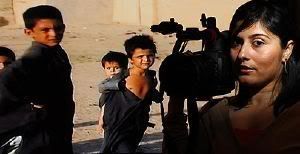 I am particularly happy to report this news because I have been meaning to write about her work for a while, and this is the perfect reason to. In fact, she is an early friend of ATP and you may have seen her commenting here. But, it is more likely that you have seen her work on such award winning shows as PBS’s Frontline. And if you have not, I am betting you soon will.
Here is what the Toronto Star has to say about it:
In her short career, launched when she was still in university, Obaid-Chinoy has made 10 personal, passionate documentaries and won as many prizes. Now 28 and based in Toronto, she is making two more films in 2007, one on the lives of Afghan women five years after the U.S. invasion, and another on the legacy of Zimbabwe strongman Robert Mugabe.
… Terror’s Children, [a documentary] about Afghan refugees living in her homeland, Pakistan, launched her career in 2002 and immediately won three awards. Her second, a searing look at the rise of fundamentalism in Pakistan, won four more prizes, including the Livingston Award for young journalists under 35. Obaid-Chinoy was the first non-American to receive it. Other winners in the category of international reporting include David Remnick, now editor of The New Yorker, Thomas Friedman of The New York Times and Christiane Amanpour of CNN. Bill Abrams, former president of New York Times Television, says when he first encountered Obaid-Chinoy, then a college student, “I thought, this person could be the next Christiane Amanpour “sophisticated, smart, fearless.”
The list of her work, available on her website, is impressive indeed, and she has taken on some of the most pressing and important social issues to work on in her documentaries. The best exemplar of her work is the documentary ‘On A Razor’s Edge’ about the India-Pakistan peace process, shown on Frontline in 2004. The website about the documentary has an interview with her which shows her as a person of conviction as well as idealism. Both of those are endearing qualities in our world today. The write-up on the documentary, introduces Sharmeen and her work thus:
Spring has arrived in Pakistan, and the season has brought a thaw in the Cold War between Pakistan and India, bitter enemies for more than 50 years. A train is now allowed to cross the border. FRONTLINE/World correspondent Sharmeen Obaid boards this “peace train” in India and travels home to Pakistan to see how people are reacting to the cautious attempts to settle differences between the two countries. Born and raised in Pakistan, Obaid is now a graduate student at Stanford as well as a reporter for New York Times Television who has covered the dramatic political and social changes in Pakistan since 9/11 and the U.S. intervention in neighboring Afghanistan.
On the train Obaid meets a woman who is on her way to a reunion with her children and grandchildren in Pakistan. “I’ve prayed for the day the borders would open,” she tells Obaid. As the train pulls into the city of Lahore, Pakistan, Obaid witnesses the meaning of reconciliation as long-separated families and friends embrace each other. All this is possible because of a historic handshake between Pakistan’s President Pervez Musharraf and India’s Prime Minister Atal Behari Vajpayee, who agreed to begin peace talks in January 2004. That night in Lahore, Obaid sees the start of Basant, a festival celebrating the advent of spring. Originally a Hindu holiday, Basant has long been embraced by Pakistan’s Muslim majority. It is a time of kite flying, dancing, even drinking. As she wanders the gaily-lit streets at night, Obaid speaks with Pakistanis who tell her they are hopeful about the possibility of a real peace with India. But there is also a note of caution. “Ask me another time,” an older street vendor tells her. “If this interview is aired, we will both be jailed. This is Pakistan!”
If you are like me you are already hooked and you want to read more about this. You can, here. If you do, you will read about her encounters with Jugnu Mohsin, Ahmed Rashin, Gen. Hamid Gul, Gen. Aslam Beg, and many more in the weeks and months when the A.Q. Khan case was blowing up all over the place.
Better still, you can watch the whole documentary here. Or just do a google and you can watch a lot more of her work. Do so, its worth watching.
Congratulations, Sharmeen. Like the Toronto Star, ATP will also be watching you in 2007 and beyond!




MQ: I do not want to get too personal about the life of Ms. Sidhwa. It should not be our concern. I am more interested in her writing and ideology. There was a time when she moved to India. May be she does not want to talk about that period of her life and we all should respect her personal life. She and certain members of her family were involved with PPP politically. The Sitara-e-Imtiaz and advisory position are reflection of that involvement.
Samdani: You and I agree on the subject of plurality. My post on Fred Bremner is about plurality and inclusiveness. Thank you for liking it. Ms. Bapsi Sidhwa on her own will chose to move to India and that is not to be held against her. We all should be free to make our choices. I did not say that she is anti-pakistan. I said she is not comfortable with the 1947 division of the British Indian Empire. Again she is free to feel that way like others are free to feel otherwise. The division tramautized her perhaps because her Parsi community was divided in the process. It is my hope too that Pakistani tent is big enough to accommodate all those who wish to be Pakistani. About Sharmeen, I have never seen her work so can not say much about her. My comments have more to do with the motives behind the funding and financing processes of such products than with these respectable ladies of Pakistani origin. I wish all of them good luck.
Don’t you guys think that you people are criticizing too much about her work? You guys proved my point once again that we pakistanis can’t see other pakistanis to do something. For Salam we have anti-Mullah/Islam issue, for Qadeer we preach that he is anti-Pakisan guy and now for sharmeen we are rejecting her work by saying that she just presents a single side of the picture. Fine, I might agree with you all but isn’t your attitude discouraging some other upcoming Pakistani young female producer which MIGHT try to present an Honest and positive picture of Islam and Pakistan OR speak the language which you want? I know if someone[girl/guy] even thinks to give an honest picture then same forum will curse that person as well. Pakistani kisi haal mey kush nahi rahta na dosray ko rahnay deyta hay and this is the real Pakistaniat
Alvi Saheb, these are the very words of Bapsi Sidhwa now what do you say?, “Bapsi Sidhwa – Houston, Texas,
As an American citizen of Pakistani origins, I congratulate Sharmeen Obaid for presenting an engaging, astute and informative documentary. The multiplicity of views reflected by a wide range of people permitted an impressive honesty and I appreciated it that she did not impose her interpretations on what was said. The concise and accurate English subtitles also helped in this regard. It is remarkable that Ms. Obaid managed to interview so many of the key figures in today’s Pakistan. PBS and Frontline are to be congratulated for making the documentary possible and for funding it. It will go some ways to clear the prevalent misconceptions about Pakistan. I hope it will be aired again. “
Pervaiz Alvi Sahib,
After seeing your comments in response to Saadia Khan’s I googled for information on Bapsi Sidhwa. Her biography does not mention anything about her migration to India. In fact, it says she was on Benazir’s advisory committee for women’s development in 1996. Before that she had received a Sitara Imtiaz in 1991. Therefore, her migration to India, if it did happen, must have been pretty recent.