Adil Najam
I was thinking of making this an ATP Quiz, but that would be wrong because I really do not know the answer to this. So, the headline here is an honest question. Any takes?

My own guess – based just on the idiom of the quotation – is that he did not. Although he may well have thought this, or even said something quite similar.
My first thought on seeing this was to think of the comments made on this site; and those not made. But since I have recently written about those frustrations, let me not do so again. Suffice to say, whether Iqbal said this or not, its a thought worth sharing.
The picture was sent to us by a reader who took it at Abbottabad’s Kingston School for Deaf and Speech Impaired Children. That, of course, makes the subject of what we choose to say, and what we do not, all the more poignant.
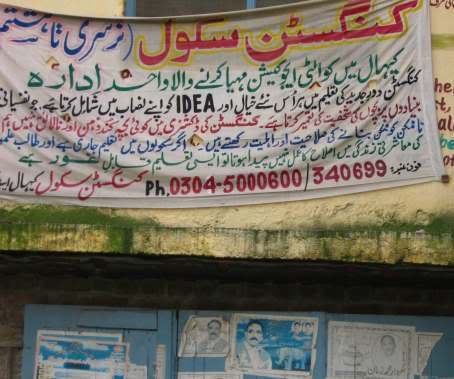
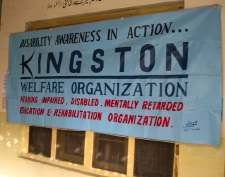
I do not know why the school is called ‘Kingston’, and would love to find out. From what I have heard about the school, however, it seems to be doing good work in an area where we need to do so much more. Indeed, there is so much happening in so many places that gives one hope for a better future.
Too much of this, however, is too often drowned out in the noise of sarcasm that emanates from the perpetual cynics and the cosmetic naara baazi of patriotic tamashbeen. It is always good, therefore, to remind ourselves of the good work being done out there: one kid, one school, one step at a time.




This is off-topice (as usual :-)), but I’ve seen many, many Western quotes and events being attributed to Subcontinental figures. For instance, I sometimes watched that stupid “Akbar Birbal” show on an Indian channel back when I was a kid. MANY of their episodes were ripped directly off Wetsern works such as Shakespeare, etc.
This seems to be a rehash of the often quoted saying of Edmund Burke:
[quote]”All that is necessary for the triumph of evil is that good men do nothing.” [/quote]
But as you said, the diction is not Iqbal’s.
Aqil,
Yes the words are in the picture. I’ve copied them below:
“The tragedy with nations is that those of their men who ought to speak, remain silent, and those who must shup up keep on talking.”
Allama Iqbal
What are the words? Are they in the picture?
I have read Hazrat Iqbal quite a bit including his renowned thesis and I could safely say that the above words are not his. Yet, it could be possible that someone might have used his own words to associate some thoughts/reflections/words of Iqbal. “shut up” is the phrase that bothered me to think that. Anyways, aside from that, as you mentioned, the irony is heightened by the source of the quote. I followed the link you mentioned in the post and was pleased you’d covered JAWS. It’s little discomforting for me to think such valuable software is priced at 800$+ for standard version. No offense to the software developers, but certain organization should have funded this to bring price little low. That was my biggest concern once I got to know of JAWS a little while back. But nevertheless, it seems pretty useful and brings many insights into the web design industry, for one, and draws new lines of how accessible our software or computing environment should be for those visually impaired or total blinds. I am certainly hinting the respect and considerations for wider audience on a larger scale irrespective of their ability to use computing environment. Thankfully a group of nice people have thought of that idea already – Web Standards (http://www.webstandards.org/)