Custom Search

ATP Poll Results: The Benazir-Musharraf Deal

Posted on April 27, 2007
Filed Under >Adil Najam, ATP Poll, Politics
39 Comments
Total Views: 46516

Share

Adil Najam

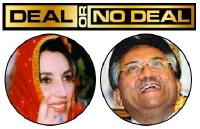
Benazir Bhutto says that it is now time to take the ‘risk’ of going back to Pakistan. Gen. Musharraf says that he expects to be elected for another term as President. Pundits seem sure that a deal is not only on the cards but is done. Some do wonder if it is merely another detraction tactic by the military government, but others argue that it may be a step - even if a tiny one - towards democracy.

But while most have been caught in the ‘Deal or No Deal’ question, we at ATP asked our readers whether such a deal - if made - would be good for Pakistan or not. As many as 654 of our readers spoke. And quite unambiguously.

In response to our question - “What would a benazir-Musharraf Deal Mean for Pakistan?” - as many of 84% (547 votes) of respondents say that it would either make no difference (’Same old stuff’; 41%, 268 votes) or would actually make things worse (43%, 279 votes). Only 16% (16%, 107 votes) believe that such a deal would actually makes things better.


The result is surprising in how stark, clear and unambiguous it is. This is unusual for ATP Polls which have usually tend to show a divided viewpoint. The one exception had been the Poll on Chief Justice issue. Most other Polls - on ‘Grading General Musharraf‘, on ‘Who did the Most Good for Pakistan‘, on ‘What Gen. Musharraf Should Do about his Uniform‘ - had yielded rather divided views.

So, what is going on here? Why this sudden unanimity amongst our readers who tend not to be in such agreement on most issues?

Could it be just a high level of cynicism? Or is it that our readers tend to be more urban and come from cohorts that have tended not to be major BB supporters? Or - as some have said - those who come here are from a so-called ‘drawing room’ class? Or is it that our readers have a better sense of the pulse of the nation that political pundits do?

Related Posts with Thumbnails

39 comments posted

Comment Pages: « 5 4 3 2 [1]

  1. Zak says:
    April 28th, 2007 7:32 am

    Why I think the deal won’t work:

    1) Credibility gap from both sides:
    from Mushys side a)his advisors remember BB turning on GIK and dumping him in 1993.
    b)The word Bhutto is almost a swear word for many people in the establishment. Politicians are bad enough but ones with ego (overinflated) are worse..

    2) from the PPP’s side: Past experience with backing GIK in 1988 against nawabzada nasrullah and then having GIK turn on them. Also more recent issues about Mush, considering his breaking of his promise to the MMA in “the national interest” does not exactly make him someone who is credible to the PPP

    The other two issues are even more relevant:
    1) The centre right element in the PML-Q is ideologically incompatible with the PPP, if they want allies their preference is the MMA. Secondly the ex patriots and millatis would see themselves turned irrelevant if a deal was struck so it’s in their interest to sabotage such a deal. So it is in both these groups interests to go for an overkill rigging in the elections and aim for 100% results.

    2)The biggest issue in the negotiations is one..the PPP should back Mushs election as Pres first as an act of good faith..secondly the deal would kick in after the elections. Again that second bit would be a moot point if the elections are over rigged.

    Finally, the PPP and PML have to deal with the neglected peoples opinions. The PPP’s cadres will be hit hard by the deal news..as they are instinctively anti establishment and in 1997 and 1993 in response to PPP deals they did not turn out in force. This applies more nowadays, especially with how 24 news has transformed the political landscape.

  2. observer says:
    April 28th, 2007 5:30 am

    From The Times
    April 28, 2007

    Destiny’s daughter

    Benazir Bhutto’s life has been a rollercoaster of high political drama, acute personal loss, early triumph followed by downfall and charges of corruption. Ginny Dougary meets her in exile in Dubai, as she plans her return to power in Pakistan

    The story of Benazir Bhutto is dramatic enough on paper but becomes almost fantastic in person. Her pampered-princess start in life, raised at her father’s knee in the ancestral estate on heady tales of the Bhutto family’s political dynasty; her education at Harvard and Oxford, where she was president of the Oxford Union; her heartbreaking return to Pakistan when she was unable to save her beloved father – despite intense international pressure – from being hanged in 1979 by General Zia’s military dictatorship, whose coup had toppled Zulfikar Ali Bhutto’s democratic government. Her subsequent years of solitary confinement, as the new leader of the Pakistan People’s Party (the mantle passed on to her by Bhutto Sr, who founded the socialist party in 1967), in the squalid, inhumane conditions she had last seen her father calmly endure; the isolation of house arrest with virtually no visits or phone calls; her escape to Britain in 1984, campaigning in exile against the injustices of the Zia regime, and triumphant return to Pakistan two years later, where she was greeted by a staggering one million supporters and elected prime minister at the age of 35, in 1988, the youngest person and first woman to hold that position in any modern Muslim nation.

    Within two years, her government was controversially dismissed by the military-backed president and an election called, in which the PPP (in a democratic alliance) was defeated. In 1993, she was re-elected, only to be dismissed once again three years later by another president on the grounds of mismanagement and corruption. Since 1999, Bhutto has been in exile in London and, latterly, Dubai, where she was reunited with her colourful husband, Asif Ali Zardari, who was released from prison in Pakistan in November 2004, having spent eight years awaiting trial on corruption and murder charges.

    Two years earlier, the present president, General Pervez Musharraf, who continues to remain head of the military – seemingly impervious to widespread public criticism of his dual role – introduced a new amendment to Pakistan’s constitution, banning prime ministers from holding office for more than two terms. This should disqualify Bhutto from ever resuming that position and also her old rival, Nawaz Sharif. But in Pakistan, anything can happen, and Bhutto is planning to return to her country – regardless of the numerous corruption charges which she and her family still face (as well as the couple’s separate, ongoing money-laundering case in Switzerland) – to fight the allegedly free and democratic elections which have been promised by the end of this year. As she says, her own life has mirrored the history of Pakistan and that is why, at such a pivotal time in the West, it is both fascinating and important to hear what Benazir Bhutto has to say.

    The four hours spent in her home in Dubai are a rollercoaster of copious laughter and floods of tears, noncommittal cautiousness and breathtaking openness, plain-speaking to the point of impertinence and insinuating charm, high-handed loftiness and affectionate intimacy. Bhutto is the most extraordinary woman who says the most extraordinary things, veering wildly between self-aggrandisement and a knowing, sometimes humorous, recognition of how she can come across.

    Related Links
    Exile Bhutto looks to a deal on return
    Although she declines to name names – saying that “it’s better not to give the impression that you’re trying to fire political shots over somebody else’s shoulder� – it is clear that there have been high-level discussions behind the scenes in Washington, where Bhutto is frequently invited to give speeches, and perhaps the UK. There continues to be widespread speculation in the press about the possibility of a deal being struck between Musharraf’s “people� and Bhutto’s party. Her response to these reports is that although “there have been ‘back-channel’ contacts with Musharraf for some time, they have not led to any understanding. And so all this talk of an ‘understanding’ I find very confusing.� It is also confusing that while Bhutto does not shirk from criticising Musharraf at every opportunity, she also makes it clear in this interview that she would be prepared to work alongside him as long as certain conditions were met.

    In her riveting autobiography Daughter of the East, published in 1988 and recently reissued with a new preface and conclusion, she tells us that her father advised her never to lay all her cards on the table. Although there may have been a time when she found it difficult to stick to his advice – “I always lay my cards on the table� she maintained – I certainly find it difficult to pin her down on her current political agenda. It requires an exhausting degree of Paxmanesque persistence, repeatedly asking the same question, to elicit this response on the possibility of a Musharraf-Bhutto alliance: “You have asked me an important question and I want to give you my answer, since my followers will read this and they haven’t heard me speak like this before,� Bhutto finally allows. “Firstly, I plan to go back to Pakistan by the end of this year whether Mr Musharraf would like it or whether he would not like it. And I believe that the [corruption] cases must all be dropped, which categorically has not happened. Not one single case has been dropped and you will please note that between my mother, my father-in-law and myself there are about 20 charges or more. And what I feel and my party feels is that for more than a decade these charges have been used to hobble the opposition? to undermine my leadership and the PPP, and they should be dropped because none of them has been proven, and if they’re not dropped then it creates an unbalance as we enter the elections of 2007. And we feel outraged that government funds have been used on a politically motivated investigation that has borne no fruit over ten years.

    “But I also believe there are other important issues for the people of Pakistan to consider, which is would Musharraf continue to keep his uniform? And would there be a balance of power between the president and the prime minister, because at the moment we have shadow-boxing, where the prime minister is technically the head of the government but the substantive decisions are taken by the presidency or the military.� The current state of play, she goes on to say, is that General Musharraf’s ruling party has said that “they can rig the election so there’s no need for free elections or a future parliament headed by the PPP? Which is why it’s premature to talk about working alongside General Musharraf at this stage, although in the past we have worked jointly on certain issues such as the Women’s Bill.

    “At the same time, I want you to know that we are also partners with Mr Nawaz Sharif [in exile after he was deposed by Musharraf’s military coup] in something called the charter for the restoration of democracy, so we are talking about a new democratic process in which the people of Pakistan are allowed to choose their leader and put together a coalition. And for that we are calling for a robust international monitoring team to ensure that these elections are fair and free because obviously if they’re not, the ruling party will still be in the driver’s seat and the creeping Talebanisation of Pakistan will continue.�

    Bhutto does not rule out the possibility that she might become prime minister again: “If the people vote for my party [she remains chairperson of the PPP, which received the highest number of votes in the last parliamentary election in 2002] and parliament elects me as prime minister, it would be an honour for me to take up that role and General Musharraf would be there as president, so I think that a good working relationship between him and me would be a necessity for Pakistan.� What a pragmatist she must be. “Yes, I would have the choice of either respecting the will of the people and making it a success or being short-sighted and putting my personal feelings about past events ahead of the national interest, and what I want more than anything is for Pakistan to prosper as we make a transition to democracy,� she says.

    I put a number of questions to Senator Tariq Azim Khan, the Federal Minister of State for Information and Broadcasting, to establish the Pakistan Government’s position. He was affable and helpful on the telephone and sent me his answers, as requested, in writing. Yes, he wrote, there are a number of cases still pending in various courts in Pakistan against Ms Bhutto and her husband, Mr Zadari – and these cases (almost all 10 to 11 years old) have not been dropped. No, it is highly unlikely that she will be arrested upon arrival in Pakistan. She will nevertheless have to apply for bail in the cases where she has been convicted while abroad. And, lastly, for Ms Bhutto to become the prime minister for the third time, the constitution will have to be amended and this will require a two-thirds majority in parliament.

    Pakistan has been ruled by the military for so many years since it came into being in 1947, that I wonder whether democracy will ever have a chance to flourish. “Democracy can work in Pakistan if the West stops upholding military dictatorships through their financial and political support,� Bhutto says. “Our tragedy has been that the military has been able to exploit the West’s strategic interest in Afghanistan for almost two decades.� And you and your party would like that support? “Of course, we need that economic assistance and diplomatic support and we didn’t have it.� Do you think there is any likelihood of you ever getting it? “Pakistan is a critical country,� she says.

    Musharraf is undeniably under siege at the moment, which has grave implications beyond his own country. There have been violent protests against his dismissal of Chief Justice Iftikhar Chaudhry on the flimsiest of grounds, provoking fears that the government is attempting to muzzle the independence of the judiciary, and newspapers such as Dawn – set up by the lawyer and founding father of Pakistan, Muhammad Ali Jinnah – have been alerting the international media community about unacceptable levels of government control.

    For more, click

    http://women.timesonline.co.uk/tol/life_and_style/ women/article1698475.ece

  3. Former Jiyala says:
    April 27th, 2007 9:21 pm

    By the way, Wasiq yaar, what you are sayingis real spin.

    BB and Mushy have both accepted a deal by their words and their actions. How do you explain her LSE speech, begging for a deal?

    Deal, negotiation, sell-out, what is the difference, just words.

    If you want positive spin on this then the lesson for BB from this in case she is listening is that she should NOT make a deal with Mushy. Its not good for her and not good for the country. As Expat says, come back without a deal and ead the uprising already happening.

  4. Former Jiyala says:
    April 27th, 2007 9:18 pm

    Yes, people who visit this website including those who are supporting BB are NOT representative of BB’s tradiational support base. But when I look at the Poll Wasiq has pointed out which shows only 30 pc support Mush and then look at all the other polls on this website on Mush then it seems that the results are very similar on how many support Mush. So then maybe this sites results are as representative as that other poll.

  5. Wasiq says:
    April 27th, 2007 3:38 pm

    The sample of the ATP poll is, of course, by no means representative of Pakistani public opinion. I think we need a poll of those polled here to determine class, geographic origin, subject of study etc. etc.

    After many exhausting arguments here, I have reached the conclusion that most people who blog are from two cities, Karachi and Lahore and are studying (or have studied) in the U.S. or U.K.

    Considering that Mai Phatan from Jaranwala and her sons hardly get the chance to come to College in the U.S., the social, economic and cultural bias of most blog visitors is clear from the start.

    Also, consiodering that both Mush and BB have denied there is a deal and even Najam Sethi (the conceptualizer and propagator of the deal) has acknowledged that BB has not
    agreed to allow Mush in uniform, the fundamental premise of the ATP poll that there is a “deal” is incorrect.

    I firmly believe there is no deal but rather negotiation that is being presented as a deal.

    A representative poll of how the Pakistani public feels appears below:

    “Musharraf’s Popularity As Prez And Army Chief Dips, Now Only 30 Pc Support Him Holding Twin Posts”

    April 27, 2007

    A new poll conducted by the US-based International Republican Institute (IRI) in all the four provinces of Pakistan has found that most Pakistanis feel that President Pervez Musharraf should not continue with both his offices of Army Chief and President simultaneously.

    The poll, findings of which were released yesterday, was conducted from February 12 to March 7, 2007, questioning 3997 adult men and women from around 256 villages and 144 urban locations in 65 districts in all four provinces of the country.

    According to the survey findings, around 56 percent of respondents said that Musharraf should not hold both offices, while around 30 percent favoured him continuing in both posts.

    The opposition to the President’s dual role increased by around 26 percent compared with the IRI’s June 2006 survey on the same question.

    In the previous poll, Musharraf as President-cum-Army-Chief had enjoyed the support of 49 percent of respondents, reported the Daily Times.

    To the question of whether Musharraf should be re-elected as the President by the current parliament, around 48 percent of respondents disagreed with the idea while 43 percent favoured it.

    Besides, 42 percent of the respondents said that the ruling coalition’s performance was not good enough for them to warrant re-election.

    Some 54.2 percent of respondents said they approved of the way Musharraf was doing his job, but this was nine percent less than in the previous survey in September 2006. In Punjab, his support dropped 22 percent, as only 54 percent of Punjab residents questioned in the poll thought that he was handling his job properly, as compared to 76 percent in the previous survey.

    To the question of which leader could effectively handle Pakistan’s problems, 32 percent of respondents said Gen Musharraf was the most suitable leader, followed by Benazir Bhutto (25.4 percent) and Nawaz Sharif (15.1 percent).

    Less than five percent of respondents considered all other political leaders - including Altaf Hussain, Imran Khan, Qazi Hussain Ahmed and Maulana Fazlur Rehman - as leaders who could solve their problems.

    Most agreed that Benazir Bhutto (65 percent) and Nawaz Sharif (63.3 percent) should be allowed to return to Pakistan. More than 50 percent of Pakistan Muslim League voters also favoured the exiled leaders’ return.
    —-

  6. BitterTruth says:
    April 27th, 2007 2:30 pm

    BB will do anything to be in power. Her career is dangling due to pending cases in Swiss courts which she is afraid to loose..I wonder if Mr 10% will be able to show the same performance or the illness has weakened him.
    For Musharraf deal or no deal, both are equally unfavorable. He used to call her corrupt. Even if deal succeeds and BB gets the power it will be very short term … but BB will go even for this , to accumulate more wealth; dont know for whom..she already has enuff atleast for her two generations

  7. Former Jiyala says:
    April 27th, 2007 1:43 pm

    I think Expat has a point.

    If BB was returning really without a deal (an act of courage) or because there were massive demonstrations in Pakistan for her return then I would have had respect for her move and would have voted differently. But for me having a ‘deal’ reduces her stature and does not increase it.

  8. Expat says:
    April 27th, 2007 1:18 pm

    Please initiate another poll with the following question.

    Would BB make more difference by coming back as a result of popular demand or as a result of a deal.

Comment Pages: « 5 4 3 2 [1]


Have Your Say (Bol, magar piyar say)

Please respect the ATP Comment Policy.

Keep comments on topic; no personal attacks; don't submit indecent, inflammatory, slanderous, uncivil or irrelevant comments; flamers and trolls are not welcome; inappropriate comments will be removed or edited.

If you won't say it to someone's face, then don't say it here!

Readers who want to use a URL should please use the TINY URL program.

Thanks, and keep the comments coming!