Darwaish
UPDATE: Nov. 3, 2007: Emergency Declared in Pakistan.
UPDATE: Nov. 4, 2007: Media Gagged. Listen to Geo News here.
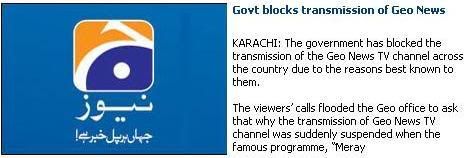
In my last post, I mentioned that Electronic Media is under siege and many programs are likely to be banned. But I was not expecting it to happen so soon. Geo News transmission have been completely shut down in most parts of the country and Aaj TVvhas disappeared from my cable at least (WorldCall Cable, Lahore).
I don’t know if Aaj TV has been completely banned or not. It happened while I was watching Dr. Shahid Masood’s Mere Mutabiq. Muslim League (Q)’s own Vice President Kabir Wasti was strongly criticizing General Musharaf, holding him responsible for the judicial crises when suddenly Geo News was shut down. I thought that its a temporary ban and transmission will be back as soon as Dr. Shahid’s program is over but its been several hours now and still no signs of Geo or Aaj coming back on my cable. A friend of mine sent me this SMS from Karachi that Geo News disappeared from most parts of the Sindh around 8 o clock too during Imran Khan’s interview in another program Jawab De.
Geo News website has this to say:
The government has blocked the transmission of the Geo News TV channel across the country due to the reasons best known to them. The viewers calls flooded the Geo office to ask that why the transmission of Geo News TV channel was suddenly suspended when the famous programme, “Meray Mutabik” was going on air.
The calls from the viewers were received from various parts of the country. According to Geo News sources the government has blocked the transmission of the Geo News. Geo transmission was blocked in various parts of Islamabad, Lahore, Hyderabad, Karachi and other areas. The citizens, social and political circles have condemned the ban on transmission of Geo News and they have demanded of the government to immediately lift ban on the transmission of the Geo News and give complete freedom to media in the country.

I am unable to understand why this step has been taken but lets wait and see the official reason which will surely be Afwaje Pakistan ke khilaaf baat ki gaye hai. I suspect the title of Dr. Shahid’s program Idaro Ka Takrao – Fatah Kiski Ho Gi (Clash of Institutions – Who Will be Victorious) must have caused concerns among people sitting in Information Ministry aka Mr. Ghalat Biyani.
Whatever government says but I thought it was a very interesting program and a healthy discussion going on when some wise men decided to shut it down. I hope the ban is lifted soon and government shows some common sense. Like they say in Urdu, Kuch Hosh Ke Nakhun Lo Bhai. Whatever happened to those free media and freedom of press claims :). This is yet another direct attack on freedom of expression and truly a shameful act and should be strongly condemned. I am afraid Dr. Shahid Masood will be in trouble once again for not being afraid, for speaking his mind and saying what is in hearts of millions of ordinary Pakistanis.




KAWA1:
Good points in your “personal message” at the end of that last post. Any ideas on what can be done to proceed on any of these?
How about deciding not to buy products and services of Fauji run businesses for instance?
Talat is undoubtedly outstanding anchor in Pakistan electronic media and was in his best form during this interview. Though I am not Sh Rasheed’s fan, but he also performed really well.
A full General is worth Rs 500 million+
First, here are some details about Dr. Ayesha Siddiqa-Agha.
Her expertise: South Asia, military expenditure, arms control, arms procurement.
Her Brief Bio:
She did her doctorate from King’s College, London in 1996 and has worked on issues varying from military expenditure, defence decision-making, nuclear deterrence, arms procurement, arms production to civil-military relations in South Asia. She is also a Ford Fellow and more recently Pakistan Scholar at t he Woodrow Wilson International Centre for Scholars.
She began her professional career with the Pakistan navy as the Director of Naval Research, making her the first civilian and woman to work at that position in Pakistan’s defence establishment. She writes for various international journals such as: Journal of Asian Affairs, Journal of the European Institute of Asian Studies, Jane’s Defence Weekly and the Bulletin of Atomic Scientists. Her major publication to date is the book Pakistan’s Arms Procurement and Military Buildup, 1979-99: In Search of a Policy (Palgrave Press, 2001).
The reason for the above blurb on Dr. Ayesha Siddiqa-Agha will soon become apparent; I simply wished to establish her credentials and highlight the fact that she is no intellectual light weight in her specialized field of knowledge.
Dr. Ayesha Siddiqa is a scholar of Pakistan’s military and security affairs and a regular contributor to several Pakistani and internationally renowned opinion journals. Currently she is a fellow at the Woodrow Wilson International Center for Scholars in Washington, DC where she is busy writing her latest book “Military Inc, The Politics of Military’s Economy in Pakistan”. In it, she analyzes Pakistan military’s vast commercial interests and its economic predation since 1953.
Ayesha Siddiqa also writes on Pakistan’s military affairs for Jane’s Information Group. She was asked to work as the Director of Naval Research with the Navy making her the first civilian and woman to work at that position in the Pakistan defense establishment. She has a doctorate in War Studies from King’s College, London in 1996.
despardes.com’s Editor-in-Chief Irshad Salim conducted an online interview with her on the subject of her upcoming book, Pakistan affairs and post 9/11 scenario.
Question: So what is this book about?
Dr. Siddiqa: This book is about military business operations with a case study of Pakistan.
Question: So what prompted you to write this book?
Dr. Siddiqa: I was a civil servant. During the course of my work I had to deal with numbers of military spending and doing that one slowly realized that a lot was hidden. It is the search for numbers that took me in this direction. The other thing is that it is essential to understand the dynamics of the institution that virtually controls Pakistan’s past, present and future.
Question: Ok, so who did you work for as a civil servant?
Dr. Siddiqa: I joined the civil service in 1988 and left in 2001. Served in military accounts, defence audit and later the navy.
Question: Going back to the Pakistan army’s business, what are your findings?
Dr. Siddiqa: Several. First, the military has become predatory engaging in political and economic predation. Second, political predation is not complete without economic predation. Third, military has mutated into a separate class that shares interests with other members of the ruling elite. Finally, because the military protects its vested interests, it leads to alienation of the masses.
Question: When did all this start?
Dr. Siddiqa: It dates back to the early 1950s. The business ventures were started with the establishing of the first foundation called the Fauji Foundation in 1953. This was established with the war veteran’s rehabilitation fund of Rs. 18 million.
Question: Why do you consider forming Fauji Foundation a predatory step by the army?
Dr. Siddiqa: Listen you have to understand the concept. A politically strong entity that engages in political predation needs to feel economically or financially autonomous. This completes the picture of predation. The generals thought that they wanted to establish independent means of providing for their welfare and not depending on the civilians like it happened in India. The financial autonomy gradually created the logic for greater interest in political control .
Question: Give me one or two instances when the 1953 move swirled into predation.
Dr. Siddiqa: It started right then with Ayub Khan and his cabal getting agricultural land and establishing independent means for themselves.Look at Ayub Khan. He not only got several squares of agricultural land in Sindh, he also established his sons into business. Look at the entire lot of generals at the moment. A Major General has a legal worth of about Rs. 300 million [Rs. 30 crores]. These are conservative estimates.
Question: Going back to Pakistan army’s economic superpower…What percentage of the GDP and GNP is it?
Dr. Siddiqa: This is difficult to calculate but their own estimates are about 4 % of GDP. I would say that their share in private sector assets is about 7-10 percent of private sector assets . This is a large number for any single group.
Question: Can you translate that into crores?
Dr. Siddiqa: 7-10 percent of private sector assets cannot be translated but I can give you another figure: They are worth about Rs. 200 billion. It is just the business. If you put in real estate then we are talking about a Rs 1 trillion plus economy.
Question: You mean Pakistan army’s side economy?
Dr. Siddiqa: Yes. This includes real estate, businesses done by subsidiaries, organizations and individuals. You have to understand that this economy is predatory by nature because it does not accept any form of civilian control over it. It is independent in terms of planning, appropriation of funds, etc .
Question: If Pakistan army’s assets total Rs 1 trillion can they fund Pakistan’s annual budget wholly or partially if they have to?
Dr. Siddiqa: This would, converting these resources into liquid assets and then it would be possible to pay. A lot of these resources are state resources that could provide for military expenditure and more. It is difficult to say that this money would fund the entire budget. Of course, it can but over what period? These assets were acquired over time and their value should be added to the annual defence budget.
Question: What was the defence budget for the year 2001?
Dr. Siddiqa: 131 billion. If you add these numbers the budget would escalate to over Rs. 400 billion
Question: When you left in 2001 how many generals, etc were there who form the command structure of Pakistan forces?
Dr. Siddiqa: Brigadier and up would be a few hundred.
Question: So if we assume 100 then 100 times 300 million = 30 billion is the legal worth of army’s command structure correct?
Dr. Siddiqa: it is more but don’t get into these fancy numbers… Plus the higher you go the more pricy you become. A full general is worth Rs 500 million [Rs. 50 crores] plus (Say £5 Million or US$9.8Million)
Question: How much land does the forces own in each province?
Dr. Siddiqa: Difficult to bifurcate but to give you a taste – they own about 7-9 million acres in Punjab alone
Question: What percentage is it of whole of Punjab?
Dr. Siddiqa: I am still trying to figure this out. It is not an issue of what percentage is this of Punjab but that a major portion of state land is appropriated by one group
Question: What about Sindh?
Dr. Siddiqa: My sense is that it is less in Sindh
Question: Why is that?
Dr. Siddiqa: Most of the land is around the 2 barrages constructed after independence. Because they didn’t make new barrages.
Question: What is their modus operandi in getting these lands allotment
Dr. Siddiqa: 10 % of land, according to the 1912 Colonization of Land Act, is allotted to the military
Question: 10% everywhere?
Dr. Siddiqa: Yes it would be everywhere land is found. Colonization of land refers to each land reclaimed due to creation of water channels and other irrigation projects. However, they tend to get more in Punjab
Question: Does India have this act too?
Dr. Siddiqa: No. They got rid of such acts when they did land reforms. Remember India is a state moving towards capitalism. A capitalist state would not create means for institutionalizing feudalism
Question: Are you saying Pakistan army has institutionalized feudalism?
Dr. Siddiqa: I am saying that it is a feudal institution as well
Question: So in that case their interests converge with feudal system correct?
Dr. Siddiqa: Yes
Question: Do you think they resisted land reform along with the feudal?
Dr. Siddiqa: I wouldn’t say that they resisted but they had sufficient stakes not to pursue a policy that had a negative impact on their benefits. For example, who buys the land the Faujis sell? The local feudal or the new rural capitalist class that is equally feudal in nature. Why should the officers then try to destroy the class that bails them out financially. After 1999, generals have started to keep their lands
Question: What happened after 1999
Dr. Siddiqa: Since the value of land has gone up, especially after 9/11, generals now keep lands and have turned into absentee land lords
Question: Why did the value of land in Pakistan go up after 9/11
Dr. Siddiqa: Because of the money that started to flow in from Pakistani expatriates plus other Muslim countries
Question: What is their modus operandi in getting these lands allotted to generals individually and to their housing societies collectively?
Dr. Siddiqa: The provincial governments allot the land to the Ministry of Defence who then gives the land to the three services for further dispersal. The land is also given to the Jawans but the quantity is lesser than what is given to the senior officers. Plus, the generals get greater facilities in making the land cultivable.
Question: All this is based on 1912 colonization of land act that India got rid of and Pakistan still has ?
Dr. Siddiqa: Yes, but they have done alterations as well. For instance, the act does not say that land meant for operational purpose be appropriated for personal use. It is against the law
Question: Are you saying that land meant for operational purposes are or have been appropriated to the generals for personal use or to the housing societies?
Dr. Siddiqa: Of course. All land in the cities is military land turned into housing colonies
Question: What is the conclusion of your book?
Dr. Siddiqa : Simple: The political leadership in Pakistan has to negotiate the military’s gradual withdrawal from the economy if they want democratic institutions to grow
Question: At what value does the army buy land?
Dr. Siddiqa: Between Rs. 30-60 per acre .( or 30-60 pence per acre) In some cases they pay more. This refers to the private housing schemes
Question: You mean in Defence Society in Karachi, the army gets land from the provincial govt for 30 to 60 rupees an acre only?
Dr. Siddiqa: There are 2 methods for getting land. All the military land converted for personal use is given at the ridiculous price I quoted. Then there are other schemes where they pay a little more. For instance, the Cantonment Board distributed plots of 500 yards each by appropriating part of the parking lot of the Karachi stadium. Each plot was for about Rs 600,000 (say £6000 against a market value of £100,000 – £150,000)
Question: What was the fair market value of each plot at that time?
Dr. Siddiqa: One and a half crore
Question: Who got these plots?
Dr. Siddiqa: Generals. The bulk goes to generals. This was done by General Tauqeer Zia. As Chairman Cricket Control Board he authorized himself to return this land that once belonged to the Cantonment Board for further distribution- (In short the real robbers and thieves are the GENERALS and their cabal)
Question: Any more instances of such land grabbing?
Dr. Siddiqa: The entire Lahore Cantonment was turned into housing schemes. In fact, except for Defence phase I & II (Lahore), the rest of the land does not even belong to the military
Question: How many acres is Lahore Cantonment, if you know?
Dr. Siddiqa: About 8000 to 10,000.
Question: What is its fair market worth now
Dr. Siddiqa: Runs into billions. It should be around Rs. 700 billion
Question: What was the “grabbing price ”
Dr. Siddiqa: As I said, Rs. 30-60. This is the rate that officers pay
========================
Personal message: It is about time to do the following;
· Start a movement to oust the ARMY from political power
· Create a method to elect an honest leadership both in PPP, Muslim League, MQM, and other parties.
· Have proper elections
· Control the asset distribution by the ARMY Mafia. A proper regulated system should be devised.
· Control the Assets of the Fauji Foundation and open the books to proper audit
· Perks as land, plot gifts should be controlled or perhaps banned.
· Make laws of severe punishment for the Generals to stop them from taking political power and that their prime duty should be Defense ALONE
· Investigations of lootings by the Army Generals especially the Core Commanders (including the millionaire Core Commander Lahore who has benefited most recently)
[quote comment=”52341″]just watched talat husain’s interview with sheikh rahseed. one heck of an anchor! definitely a cut above the rest.[/quote]
Talat Hussain is an amazing anchor. If TV journalism had a rockstar, it would be Talat. He is so sharp and quick-witted. Speaks so eloquently at all times.
just watched talat husain’s interview with sheikh rahseed. one heck of an anchor! definitely a cut above the rest.