English translation is given at the end.
Following ‘azad’ poem is by one of my favourite writers, Shafiq-ur-Rehman and it comes from his book ‘lehreN’. The poem is actually a satire on modern day poets who write ‘azad’ Urdu poem by using all the ‘azadi’ they can get. The poem describes a situation of fighting cats in a garden. I hope it brings a smile to you just like it has been bringing smiles to me for the past 20 years.
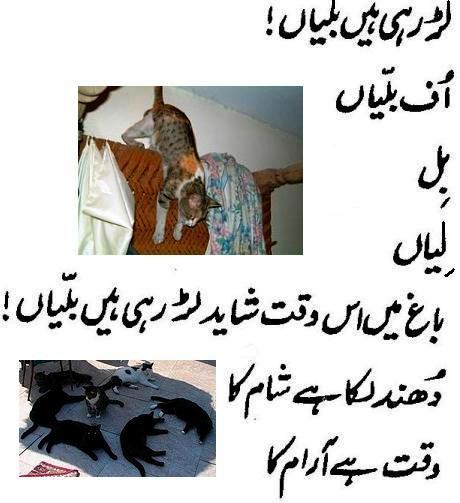
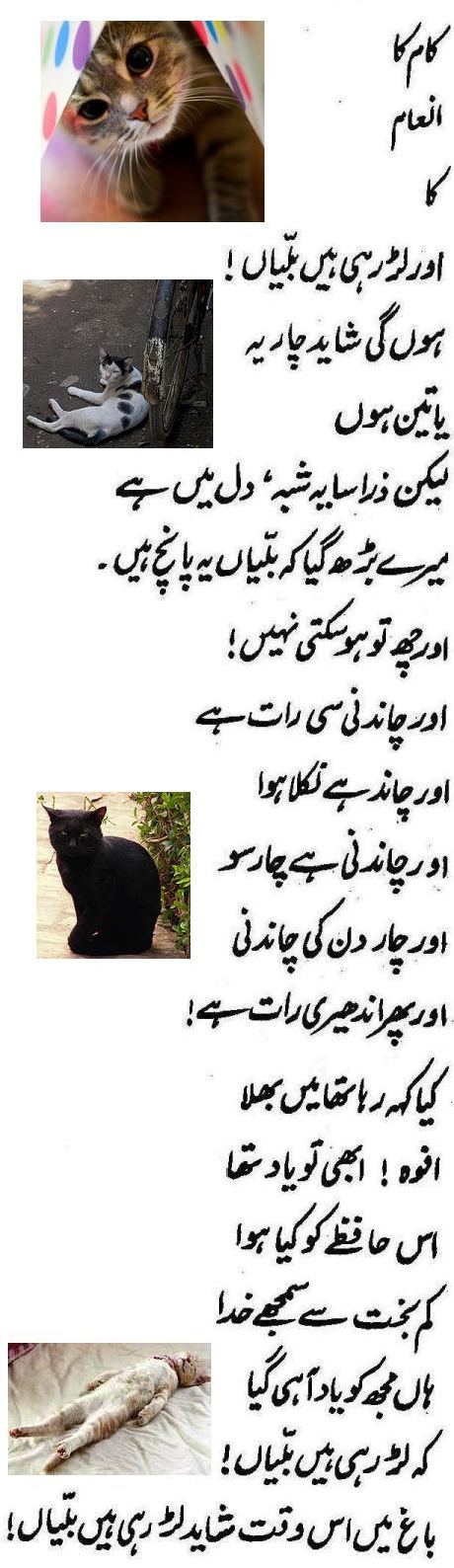
Here is my attempt at an approximate translation for our English readers:
Cats are fighting
Oh Cats
Caaaa…
…tsss
May be cats are fighting in garden now
There is the haze of dusk
It is time to rest
to work
to
get rewarded
And cats are fighting
May be they are 4 in number
or may be 3
But this little doubt has made house in my heart
that the cats are 5 in number
and definitely they cannot be 6
and the night is glowing in moonlight
and the moon is shining bright
and the moonlight is ubiquitous
and this moonlight will only last for a little while
and then there is a pitch dark night ahead
What was i saying?
Aah, it just slipped out of my mind
What happened to my memory?
Only God can fix it
Oh Yes, I just remembered!
the cats are fighting
Cats are probably finghting in the garden now!
Photo Credits: Flickr.com




billi nay deya bach-chay
Allah mian sach-chay
99 not out was one of the first chapers I read from his books. It had mostly to do with Cricket’s love in our family.
funny take on Azad shairi.
After reading Shafique ur Rehman, I realized that most of the akhbare jahaan and nounehal etc joke section had jokes derived from his works.
some of his essays tended to be somewhat lingering on and on.
but some were outright hilarious. my personal favorite is “99 not out” from himaqatain I guess. anyone read that ?
@ SYASSI BILLIAN,
Billian jo ho gai hein syssatda’n
kisqadar nepaed hogaya syssatda’n
bhich gaya jab syassi-dusterkhuan agar
khichi aien gi,mundlati hoi sab billian
huddian bhamborti, larti hoi ye billian
bula laati hein Billon ko bhi, ye billian
billian, nafri mein gar kam hon, to kiya
gintiu’n mein jo subqat lejati hein billian
ne mano jo aik din, akathi hojain ye billian
syssatdan billon ko bhaga deingi ye billian
in kay nakhray, ayarian, shustbazi bhi inki
Baray jugadrion ko lita dein ye chend billian
Akhaara-e-syassat mrin sirf suni h
Cool Analogy of Pak Political scenario!
keep it up.
sajjad