As we think of floods and of displacement once again, this photographs from F.E. Chaudhry of the 1950 flood depicts Chacha‘s ability to turn a news story into a human story.
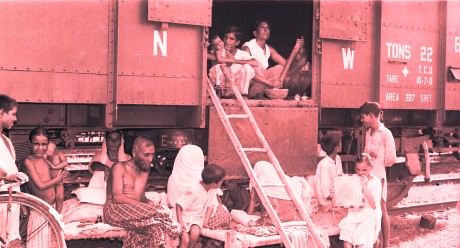
A narrative photograph of the Punjabi victims of the 1950 flood in the wake of which nearly three thousands perished. Their villages and homes submerged, a family has taken refuge in a railway bogey, which serves as a kitchen as well as shelter from the blistering heat.
Each individual in the picture, though part of a single family with elderly heads of household and their children, is lost in his or her own personal world. With little interaction among them, they appear to be privately counting and mourning their losses.
The young man while preparing food on the railway wagon apprehensively looks at the sky as if searching for the clouds that drowned their village and their lives. Except for the elderly woman who looks into the camera, the other younger women shield themselves from the prying eyes of the cameraman.
The story telling quality of the photograph lies precisely in the fact that each individual character in the photograph is revealing his or her own story without compromising on the overall composition or the melancholic effect of the image.
Click here for the F.E. Choudhry Gallery at ATP.
This post was first published on ATP on May 14, 2008.





I agree with SJH. There is a dignity in his picture and also in the other pictures for FEC in the portrayal of poverty. It is presenting poverty as being real but not as being disgraced. Which, I think too many other photo journalists often do. At least in this picture I see a family surviving its struggles with dignity.
Very well portraying of the feelings of the desparate people. Such scenes need to be brought forward for description. But if we notice, one can find uncountable scenes still after many many years of independence. Nothing seems to have changed. The miserable plight of the poor still can be seen in Pakistan…..
I am not sure the photograph is melancholy – the children are smiling, and the adults look resigned but not despondent, in the face of what is surely a lot of misery. I found the photo to have a dignity and peace that symbolizes what most Pakistanis know instinctively – toughness in the face of difficulty.
Sadiq’s statement tells it as it is. Nothing has changed since the independence. Leaders lead to cheat and steal and those who lead to bring changes are marked dictators and a cry from disposed says, we will bring democracy, what they are saying is that when they will get into power they will bring their old ways back.
Cheat and steal and move on.
This is a sad picture. Sadly, not too much has changed in the plight of the poor.