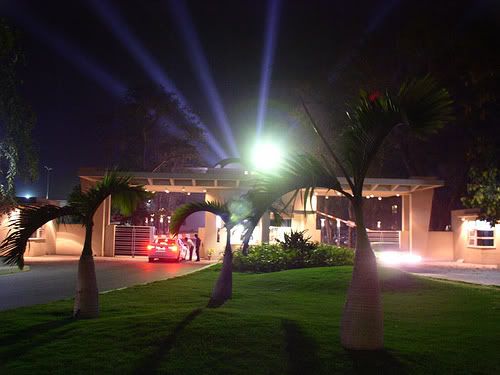
 As I sipped the tenderly brewed coffee facing the lush green golf course of a relatively new Lahore Country Club, the new reality of Pakistan became a little clearer. The sprawling premises of the club were a preserve of the Railways Department until the inefficient Pakistan Railways could not manage it and doled it to the new, oligarchic big business of Pakistan. Much ado was made when the land owned by the Railways was privatised and questionable deals were transacted in that moderately unenlightened era. Nothing came out of the public questioning and today a lavish country club, far removed from its downmarket environs, has sprung out for the affluent and the upwardly-mobile classes of Lahore and Punjab.
The classic barriers to entry created by the cliques that lord over Pakistan’s elite clubs is being undone. Pay a handsome fee now (way over a million rupees) and you are a member to this new “club†built on the ashes of the Raj steelframe, albeit, reminding one of the nasty remarks of Churchill on how the brown, rapacious Rajas would appropriate the space created by the wise and just colonists. As my host elaborated on the entry procedures to Lahore’s richy-rich club, I could not help but remember the compensation to a suicide bomber that has also increased over the years and now hovers between one to two million rupees. A grossly-overlooked fact is that the grinding poverty in the pockets of Pakistan, seemingly unaffected by the consumerist prosperity, is the key to our current turmoil and violence.
At the end of the day, the ideological battles, the foreign interventions and incursions aside, it is all about inequality and the fact that the poverty is now a mushrooming social reality. Apathy to the shameful criminal inequities is another visible trend. Take the new avatars of Pakistan – the media hosts at the leading television channels: the rants and ramblings overly obsess with ideology, of myopia and inward looking gambles. Let Pakistan follow Iran without a drop of gasoline; or let it be a Vietnam in the making forgetting that Pakistan’s heterogeneity and complexity defies even the best of sociologists and policy experts. Nowhere is poverty, especially that of the tribal belt, given the importance that it should be.
And when the international do-gooders want to do something about poverty they come up with packages that have been tried and tested across the globe with dismal results. How can piecemeal advisory aid impact in a gnawing and in-your-face policy vacuum? What happened to the FATA electoral reforms; plans to introduce local self-governance in the tribal areas; and the correction of draconian legal regime meant to advance the great game and colonialism? Above all, the much touted second and now third prong of FATA policy, namely development, employment and economic opportunity. The dehumanising poverty that facilitates selling the lives of young men in the name of esoteric jihad is nothing but years and years of exploitation and now a manifestation of unbearable poverty.
The truth is that Pakistan’s elites – both the political and the unelected – and their purported watchdogs are fairly oblivious to the fundamental reality of how the consumerist culture and emergence of Richistans in a sea of squalor and violence are aggravating deprivation, dispossession and hunger.
Never before has a predominantly agricultural country sbeen food-deficient and a victim of blatant capitalist speculation. Monopolies are not new phenomenon; however, cartels control oil, cement and all other elements of economic activity and survival. Yet, these are issues skirted around and a hapless civilian government, a product and victim of both the powerful elites and their machinations is the prime target of media critique. The corporate media not unlike India and other iniquitous societies is by and large indifferent to such monopolies and the capitalist machinations; much of its solution for inflation is executive control of prices.
The emergence of such Richistans is not restricted to Pakistan alone. Globalisation has to sell fabulous, vulgar wealth as a spectator sport and the ultimate marker of achievement. And the world’s war and oil industry have to fuel this all-pervasive greed.
True, the skewed growth during the last eight years has enabled many people to gate-crash into the world of elitism and create newer island-Richistans. The question is, at what and whose expense? Income and resource distribution have worsened and without a plan for redistribution there is no way to achieve peace, security and sustained progress in Pakistan. Sooner or later, the surrounding pooristans, tribalistans, conflictistans, violenceistans will gobble up these Richistans.
Estimates suggest that food price inflation have led to significant increase in Pakistani poverty levels. 20 percent inflation in food prices theoretically results in an 8 percent increase in the poverty head count. And, the official estimates suggest that the galloping inflation is above 30 percent. We are heading towards a situation where 50 percent of the population will be poor. Needless to mention, this situation ought to be the foremost priority of the State and its international partners. Domestic rhetoric on ideology and the global rants on terror can only destabilise Pakistan further that is in no one’s interest. The ruling party needs to revisit its social agenda and reclaim its original redistributive ethos. This is the time for initiating land reform; of increasing access of the poor to productive resources and undoing the structural roots of poverty. These policy priorities must drive the stabilisation packages proposed by all and sundry. The urgency of the storm, which has brewed for long time, needs to be recognised. It is already thumping the fragile contours of Pakistani society.
Raza Rumi is a writer. He blogs at www.razarumi.com and edits a cyber magazine, Pak Tea House, and the Lahore Nama blog-zine.
Photo Credits: Title photo is courtesy of Aamer Mukhtar at Flickr.com




This is a good article by Raza Rumi (with whom I have strong disagreements on some other issues).
Pakistan imports more than it exports; the govt spends too much in excess of what it collects through taxes, and our savings are much less than what we need for generating the investments to create new jobs and sustain the economic growth. Our elite, and this includes the educated urban middle class, has gotten used to lifestyles that are beyond our national means. And it’s the poor who are made to pay for it.
This is evvident from many things; just as an example, compare the govt spending on rural areas with what it puts into the development of urban centers. I don’t have the time to look the exact figures up, but the contrast is quite revealing. Of course, the latter is not done for the benifit of the urban poor either; hence, there is also significant poverty within urban centers.
@ Riaz Haq
What you call golden geese, systematic corruption and injustice to the millions of people, by a tiny fraction, which is riding piggy-back the poor like Pir Tasma Pa of Sind Bad Jehazi for three decades.
In our Frontier people are getting a 20 kg bag of flour at Rs 9000, while the same thing is available for Rs 410 in Lahore, why this, at the same time we generate electricity and still the electricity costs us the same as other units of the federation. WAPDA and center are not paying the Frontier around Rs 110 billion in lieu of electricity.
The gold belongs to the one who earns it. If they’d rather put it in a bank its their prerogative. If they burn it, it is theirs to do so, If they give to charity or spend it on indulgences, it is still their right to do as they want. Still, I am guessing they’d use it to earn even more gold. Redistribution of wealth is just legal theft. If anything it leads to the most productive people in society from working to their fullest.
Marxism is dead and burried. Be it West Germany vs. East Germany, South Korea vs. North Korea, South Florida vs. Cuba, modern India vs the socialist India of a couple decades past. In every instance the same people perform better in a capitalist society than in a socialist one. Give me one example otherwise.
Who do you think creates jobs. Is it the rich industrialist who can invest millions and create hundreds even thousands of jobs in one stroke or the clerk who pushes a pen all his life. Until we can develop a culture that appreciates and laudes the success of the smart and hardworking people, we are destined to crib in our jealous existance.
Hey Riaz Haq, hasn’t eight years of Bush taught you yet that trickle down supply side economics does not work? And what’s going on in the China of today is just shameful if you happen to be one of the 800 million who has not been “lifted out of poverty”.
Run along now and put in your vote for McCain. He needs it–predatory capitalism is in danger!
The wealthy are not “geese that lay golden eggs”. They hoard the gold so that nobody else can have any. If the money is actually put into circulation in the economy instead of sitting in the Swiss bank accounts of the very rich, the country will do much better. Give it a try.
That the rich “create jobs and businesses” is a myth the rich like to tell about themselves to justify their existences. Trouble is, this isn’t borne out by fact.
Our friends the Chinese used to believe that money is inherently evil. But then, under Deng Xiaoping, they went from “To get rich is decadent” to ” To get rich is glorious” and they lifted a staggering 300m people out of poverty. It seems that our lefties are still stuck with the first Chinese revolution, ignoring the second, more powerful revolution, that started with Deng.
I think Pakistanis should not kill the geese that lay golden eggs to equally distribute the meat to the poor. We must incentivise entrepreneurship and wealth creation to create jobs and raise people from poverty.