Adil Najam
The summit meeting tomorrow between US President Obama, Pakistan President Zardari and Afghanistan President Karzai could clearly be amongst the most important events on what is being called the Af-Pak front, and possibly in defining the future of the so-called ‘War on Terror.’

I believe that this could not just be an important step forward; it could be a good step forward. It is traversity of basic logic for for so long these three countries – USA, Pakistan, Afghanistan – have supposedly been ‘allies’ in a critical war supposedly against the same enemy (terrorism), and yet there has been no real forum of strategy and policy coordination between them. Indeed, it is a measure of the absurdity of this trilateral relationship that this will really be the first ever strategic meeting between the three countries at the summit level (Presidents Bush, Musharraf and Karzai had met, but never really to discuss policy coordination and joint strategy).
It may be asking for too much, but one does hope that this will indeed be a real policy coordination and strategy development discussion and not just finger-pointing and scolding on the part of Presidents Obama and damage deflection and passing the blame on the part of Presidents Zardari and Karzai. The stakes for all three are high – indeed, the stakes are high for the whole world.


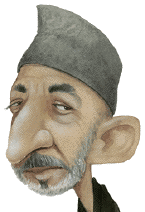
U.S. policy in the region – including its ill-guided drone attacks into Pakistan – has clearly been a failure
that has not achieved any of the stated US strategic goals. And the last thing President Obama wants to be doing is to be seen to be continuing the Bush legacy in the region. He needs to show to his own people, but also to Pakistan and Afghanistan that his policy is different from George Bush’s and also that it will work. For its part, Pakistan stands at the brink of disaster with its internal politics in disarray, its military’s morale and repute in question, and growing infuence of the Taliban in society. Mr. Zardari will need to demonstrate to his US hosts as well as his own public that he remains in control of Pakistan and in a position of actually doing something about the imminent threats to Pakistan. Hamid Karzai’s standing is no better.The charge against him is that he is merely the “mayor of Kabul,” but some suggest that he may not even have that much control, and whatever control he has may also slip away in the forthcoming elections.
All three have their work cut out for them. In very different ways the pressure will be on all three. In the case of Mr. Zardari and Mr. Karzai, even their jobs may be on the line. That is not so for Mr. Obama, but the stakes for him are also very high. One hopes that their discussion will go beyond diplomatic niceities but also not degenerate into recriminations and accusations. One hopes that it will be frank and forthright, with all three being willing to say and hear some tough love. But most of all one hopes that they will roll up their sleeves and focus not as much on who has not done what (none of the three parties has done much to be very proud of in this region) but on what needs to be done. The tragedy of this trio is not just that all three countries – USA, Pakistan, Afghanistan – have failed to do the right thing, it is that none of the three have any idea about what the right thing to do is. Neither does anyone else. This is why it is so very important for the three leaders to begin devising a real joint strategy whose purpose is not merely to control the impulses of the other in a climate of mutual distrust, but to tackle the common and growing threat of extremism, militancy and terrorism.




Early reports seem to suggest that the meeting did not go that badly. Obama is clearly trying to send a message that he will seriously listen to Paksitan and Afghanistan but only if they can also deliver their ends of the bargain. That seems like a totally reasonable thing to me.
I believe that nothing of importance will come out of these meetings. There is serious lack of trust between the three parties and until that issue is solved, all meetings like this will be nothing more than picture taking parties.
Pakistan has hurt its standing on the world stage by going into a war without proper planning and losing its strength on the negotiating table several times.
If I were representing Pakistan, I would push America to change its strategy from being Afghan centric to Pakistan centric. I would agree with the sentiments found in the U.S that Pakistan is the most dangerous place in the world, rather than wasting my time proving that it isn’t; and make that a foundation for pushing the U.S to invest in the rural areas of NWFP and Southern Punjab heavily.
Take up a slogan ” One school can kill more terrorists than a 100 bombs” and lobby in Washington to build 10,000 schools for basic and intermediate education in rural areas to cut the supply of new blood for talibans.
Adil,
Why can’t you be a bit more critical of the blue-eyed white masters, and those who, IMHO, are behind the drone attacks – the ones from the small country that is neither Muslim nor Christian; the country that is still banking on what allegedly happened to their people far away long ago – in the past when I wrote the name of the country my messages didn’t appear – there might be electronic editing going on. When Ame-Rica is blamed for the drone attacks, it refuses to comment and neither accepts responsibility nor denies it – why?
The way I see these developments is that the masters are having us do their work for them – that is killing of our own ppl. so they don’t have to come and do it. Have we forgotten recent calls by them to make peace with the Taliban in Afghanistan, and offers of immunity to Mullah Umar? Now that the Taliban are stronger and are taking over entire regions of Pak, who do you think is behind at least some of their recent strength and moves? Should be a no-brainer.
Also read today’s report in dawn.com about the comments by congressman Ron Paul in defense of Pakistan in front of a thug named Holbrook. Why can’t Pakistanis be at least as brave as him? He’s not a Pakistani. Whatever happened to “jiss kee khaatir ham nay dee qurbaani laakhon jaan kee”? Are Pakistanis simply going to repeat after the masters to call everyone Taliban and keep hating Taliban because our foreign masters say we should, and while they make deals with them and “pardon” them? Is no one even a bit confused as to why they would offer deals to people who, they claim, killed their children on nine eleven? What did they want back from the taliban in exchange for the truce with them? The saying goes that in Ame-Rica there is no free lunch. How could the taliban have their way with them so easily?
These developments might be the beginning of the end of Pakistan. The interests abroad that I alluded to want to dismantle Pakistan and if possible turn it into a pile of rubble. The bigger power in this three-some also doesn’t realize that it, too, is in the process of becoming enslaved economically by the same tiny giant – the goldmans and the lehmans of the world. Why hasn’t the New York Times missed any day (almost) for the last month or two when it didn’t put Pakistan on its front page. Read the names of the editors and publishers of NYT. While you’re at it, also read the names of the five members of the Board of Governors of the US Federal Reserve whose chairman is Bernanke.
We should be vigilant as to the developments of the near future. It is never too late to act. If Kiyani is smart, he should meet with Nawaz and Imran and try to change the course of events. We need people with guts at this time, not weiners like bilawal to hand the country over to enemies.
When General Zia kicked the bucket, the late BB said: this is what happens to agents. Her hubby is now acting like an agent, and I hope the nation doesn’t start acting like an agent-nation and meet a similar fate.
Oh yes Afghanistan and Pakistan are the same. Both were first in the Islamic world to send satellites in space, both have large educated urban populations and a industrialised megacity like Karachi. Their GDP’s are comparable, they have engineering universities, medical colleges, nuclear power plants, nobel laureates, world renowned musicians, artists, writers and poets. Both have won the world cup cricket, have ruled the world of field hockey and squash for several decades and have the same literacy rate. Both countries have produced scholars and economic geniuses who have made significant contributions at the international level. Both countries have cultural cities with a glorious history like Lahore, one of the one few planned capitals in the world like Islamabad and have the same agricultural and industrial output. Infact if you take Malaysia and Turkey out of the equation both countries can surpass the combined industrial output of the entire Islamic world (-excluding oil ofcourse ). Oh yeah! Af-Pak summit makes so much sense. Lump them both together because they are one and the same. And yes both countries run on bheek these days, are plagued by the cancer of Taliban and are being run by a weak, corrupt and self serving people who have no self respect.
But I would like to say Karzai took up the cause of innocent people killed by Americans in his country whereas Zardari played the same old broken record of losing his wife to the struggle of democracy and the fact that somehow democracy will provide Benazir’s revenge. I thought they were spending $100 million from the coffers of the bhooka nanga to investigate that but then I apologize for digressing. Anyone who calls Karzai a brother and friend of Pakistan needs mental evaluation. Zardari met Obama like a village leader rather than a man incharge of a nuclear arsenal albeit weak with Bilawal Bhutto Zardari at his heels ( an unelected self imposed 18 yr ofl representative of the people of Pakistan with a complete grasp of Pakistan’s culture, history and it’s problems). May Jinnah’s soul rest in peace. So in some ways and I cringe when I say this, Karzai and his Afghanistan did look better today in the Sufaid house.
1) I think it is putting too much blame on Zardari to bring him into this equation at all. While, like EideeMan, I too believe that Zardari is actually hurting the PPP, the real power in Pakistan lies with the military. Zardari can’t even enter the famed Kahuta Research Lab. beyond the receptionist’s desk, if that far. It is the military, stupid! (okay, that ‘stupid’ was a metaphor, if you know what I mean).
2) Though a PPP supporter since the mid 80’s, I now think that Pakistan would be better off with a strong (in the sense of anti-military) AND a conservative leader like Nawaz Sharif in power. He can call the shots and make decisions. He, unlike the PPP, is secure in the knowledge that he can win on the basis of Punjab alone in electoral politics, and hence he won’t take it lying down if he were to send the Director of ISI to India and the military intervenes. Enough of these untouchables Generals!
3) While Pakistan is fast turning into the Iraq of pre-2006 it is still light-years ahead of Afghanistan as a nation in every sense of the word. This is not bragging. In fact, if the security situation in Pakistan is improved even to the level of a war-stricken Sri Lanka then Pakistan is not all that bad. Let’s not fall into the unfathomable wells of gloom.
4) Obama is far, far, far better than Bush. The latter kept saying nice things in public about Pakistan while kept doing stuff to the contrary. Obama had publicly put Pakistan in the dock during the election campaign of 2008 and was chided by both (hypocritical) Republican McCain and opportunistic Hillary but at least Obama spoke his mind and is following through. Go Obama go!
5) So what is going to come out of this meeting? I don’t think this US administration is in the business of engaging in wars-for-profits–at least not for immediate future–as their predecessors were. Amercicans want out of Afghanistan if it could be assured no more 9/11 happen from there (sorry conspiracy theorists: Bush era ended!). And so I foresee clear-talk: Do it and get a few billions from us to help you. If you don’t then we will do it for you.
6) Today’s Dawn (www.dawn.com) editorial says that there is an awakening in Pakistan against the Talibans. May be the flogging of the girl was the catalyst for it? Anyway, I was one of those 6% people who voted that the ‘Deal’ with the Talibans was not bad for Pakistan because Talibans would overplay their cards–and they have.