Adil Najam
What do Pakistanis think about how Osama Bin Laden met his end, the implications of that end?
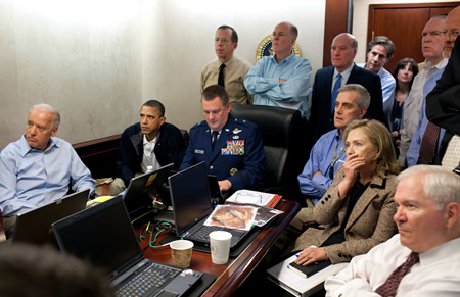
There are as many opinions on what happened in Abbottabad as there are Pakistanis. Maybe more. But there is no sense whatsoever where the government of Pakistan (or any of its major institutions) stand on what happened – or stood when it was happening. For 36 hours now the world has been waiting to see what Pakistan does and says – the silence and incoherence from Islamabad has not just been embarrassing, it has been damning. Finally, key institutions in Pakistan have begun trying to piece a narrative together – unfortunately it is way too late and the narrative itself rather lame.
When I put up a short post on Osama Bin Laden’s death soon after the news broke, I had hoped that in time more details would become available and we would get more clarity on what happened and how. We do now have more detail. But certainly not more clarity. The story about what happened in Abbottabad now lives in Spin-abad. Everyone – from governments, secret agencies, the media, the Twitterati, and your spinster aunt – are taking a spin. Many are taking multiple, sometimes contradictory, spins. Everyone except the Pakistan government.
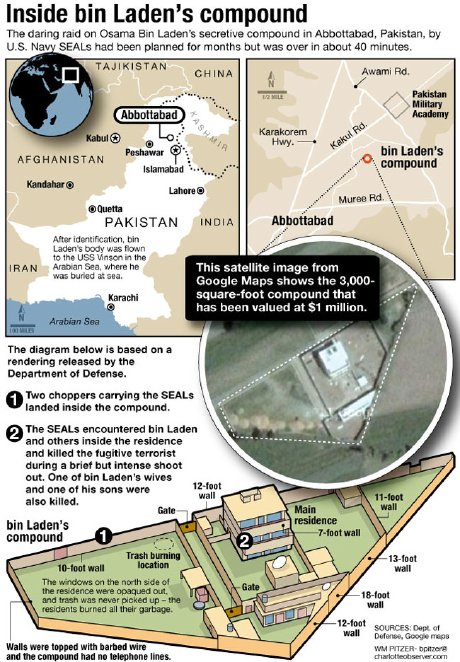
That, of course, is a surprise – not only because the Pakistan government does have a lot of explaining to do, but even more because it is in the interest of the Pakistan government to do that explaining itself rather than have someone else do it for them. Yet, up until it was already too late, Pakistan seems to have abdicated that responsibility. In fact, President Barack Obama, Secretary Hillary Clinton and Senator John Kerry seemed to be making that (half-hearted) case for Pakistan more than anyone in authority in Pakistan. Given that President Obama had informed President Zardari before the speech from the US President, one would have assumed that the Pakistan President and his media handlers would have their own statement ready to go on the air minutes, if not seconds, after President Obama’s speech. This is not about spin and PR, this is Diplomacy 101: Own and define the narrative as soon and as clearly as you can before someone else defines it for you – especially if the narrative is likely to be unfavorable.
But the narrative, itself, is not the core of Pakistan’s challenges. The problem is the facts on the ground and the government’s inability and unwillingness to explain them. Pakistan is used to the feeling of the world ganging up on it. But there are good reasons for the questions being asked of Pakistan by the world today. There are even better reasons for the questions being asked of Pakistan by Pakistanis today. Whether the government comes clean to the world or not, it is vital that it respond to Pakistanis. The first is a matter of national image (no trivial issue, that), but the latter is a question of citizen trust in national institutions (an existential element of statehood).
The fact is that there is a Pakistan case to be made on this issue. And it needs to be made to Pakistanis much more than to the rest of the world. It is a case that forcefully stresses that a world, and a Pakistan, without Osama Bin Laden in it is a vastly better world than one with him in it – this is a villain who orchestrated events that have left more than 30,000 Pakistanis dead in extremism and terrorism. It is a case that legitimately highlights the sacrifices that Pakistan and Pakistanis have, in fact, made in the fight against terrorism. Most importantly, it is a case that honestly analyzes what happened in Abbottabad – it is not a surprise that Osama Bin Laden was found in Pakistan and in a large urban area (just like nearly every other major Al Qaida figure captured) – but an explanation is owed on why Pakistani intelligence failed to make the connections that led to him, an explanation is owed on exactly what Pakistan’s official role in the final operation was (or was not), and an explanation is owed on exactly what Pakistan’s strategy on countering terrorism is, who is running it, and why it is not working well enough or fast enough.
In a country and an ‘establishment’ as divided as Pakistan, this cannot be an easy conversation; it is not supposed to be. It is time to ask honest and tough questions of everyone. It has long need a necessary conversation; now is the time to have it.




This was helpful. I’m always interested in learning more about wellness and taking care of the body. Keep up the good work.
Thanks for sharing this. Taking care of your health from the inside out makes such a difference over time. Looking forward to more like this.
Well explained. Staying consistent with healthy choices is the hard part, but posts like this help. Thanks for putting this together.
This was helpful. Health really is everything, and this gave me a few things to think about. Bookmarked for later.
Great read. I always enjoy learning simple, practical ways to feel a bit better each day. Really useful, cheers.