Adil Najam
 Our second blog poll seems to have thrown up some interesting, but also confusing, results.
Depending on how you cut the pie, you can make the argument that:
(a) a clear majority of ATP readers want Gen. Musharraf to give up both or one of his twin offices (Army Chief and President) before the 2007 elections,
and at the same time
(b) a clear (but differently configured) majority wants him to play some role – although a more constrained role – in Pakistan’s politics.
(Click image for larger picture)
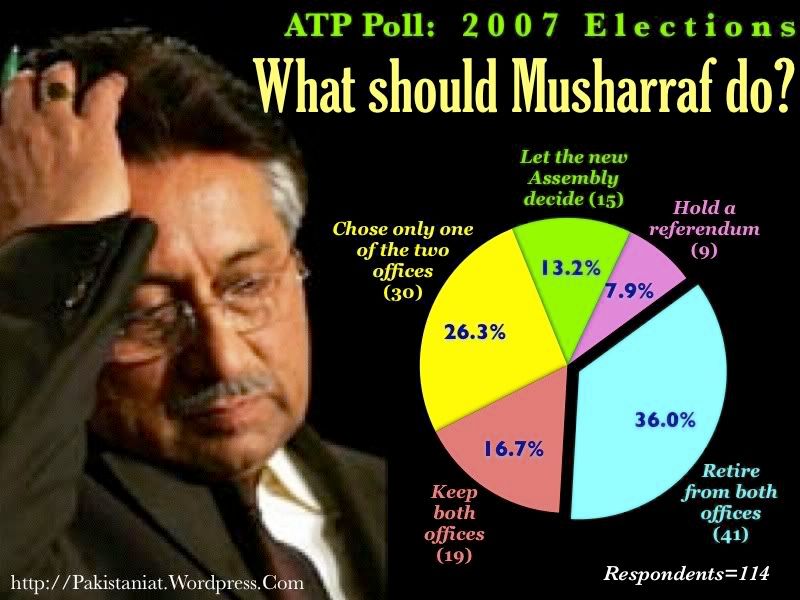
A total of 114 ATP visitors cast their votes in the poll which was launched very early on Friday and closed very late on Monday. While this is obviously NOT a scientific survey, the results are rather intriguing, even if not representative.
The ATP Poll gave readers five options in response to the question:
The option that got the most votes (41 votes; 36%) calls on Gen. Musharraf to retire at the end of 2006 and fully hand over both offices to his successors. While this was not an absolute majority, it is well over a third of all the votes cast in the poll. By comparison, only 19 of the 114 respondents (16.7%) preferred the option of Gen. Musharraf continuing in both offices simultaneously.
Just over a quarter of the ATP respondents (30 votes; 26.3%) want Gen. Musharraf to continue in only one of the two offices. There seems relatively little enthusiasm for passing the decision on whetehr he shoudl keep both offices or not to the next Assembly (15 votes, 13.2%) or of holding a national referendum (9 votes, 7.9%).
Of course, this is simply a ‘pulse of the blog’ poll and is NOT a scientific or representative survey. However, the results are interesting nonetheless; at least to the extent that they say something about the cohort that is likely to visit a blog such as ATP and vote in such a poll (i.e., educated, mobile, technically savvy, and globally connected Pakistanis).
While one must caution against over-analyzing these results, at least three points are worth noting; if only to nudge a discussion:
- Given that the technocratic classes tend to support (and be highly represented in) military governments in Pakistan including this one, it is noteworthy that ATP’s (technocratic?) readership chose the ‘retirement option’ (36%) for Gen. Musharraf as often as it did.
- There seems to be a sense that Gen. Musharraf should NOT continue with twin-offices into the future. Only one-sixth of the respondents (16.7%) chose this option. While those who opted for a referendum option or having the next Assembly decide (total 21.2%) may be seen as sitting on the fence on this question, those calling for his retiring from at least one office (and possibly both) were in a clear majority (total 62.3%).
- Not withstanding the above, and in fairness, it should also be noted that a majority of the respondents do, in fact, see (want?) some continued role for Gen. Musharraf — if not in both offices, then in at least one. This finding does not contradict the earlier finding; it only adds nuance (and possibly confusion).
So, where does all of this leave us? Maybe I was onto something when I had responded to a questioner in Washington DC by suggesting that public opinion amongst Pakistanis remains divided and uncertain on the future of Gen. Musharraf.
Maybe what these numbers suggest is that those responding to our poll see a continued role for Gen. Musharraf in Pakistan politics; but they would like to see him having less of a role than he has had in the past (also see earlier ATP post on democracy in Pakistan).
What do you think?




What should he do? I say before leaving his both offices, he must sweep up foreigner troops from Pakistan. Pakistani civilians can not bear having them kept here any longer.
Hi, great post and above all, heartfelt thanks to all of you people who, as overseas pakistanis often do, once again gave us the benefit of your pontfication. Now, I don’t know exactly why, but somehow I am 100% sure that none of you, your “educated” family members, friends, and others will actually vote in the 2007 elections.
I request Dr. Najam to hold two polls on this website:
1) Give people a week to vote on how satisfied they are with the current administration in Pakistan.
2) After a week, give people another week to tell us whether they have EVER voted in any election in Pakistan.
And yes, one more thing, Umera is so right about the sway of zamindar’s, etc. Pakistan always needed a Nehru-style land reform program that just never came through. The result has been a true modern day feudal system. Sad.
Oh ye of short memories! Doest thou not know by now? The only thing separating Pakistan from the abyss is Ayub Khan, I mean Zia-ul-Huq….no, no, that can’t be right, ah yes, Musharraf! He’s the one! How could I have forgotten!?!? And lets not forget, every Chief of Army Staff in the last 30 years has been the last of the breed of British trained, pro-Western generals. The next guy will be the one with the beard…for sure….I think….or at least that’s what the New York Times said I should think, based on reports from their sources at the….CIA?….Bhutto camp?….Brookings Institute?…whatever, wherever….its true ya know!
Musharraf ought to do many things. They’ve all been mentioned here. He won’t do any of them. Devoid of statesmen, grass roots movements & any sort of left wing, poor old Pakistan can only hope to cull its next leading man from the officer corp.
Kudos to the political parties who continue to work despite such a bleak policitcal environment. Shame on the Pakistani electorate & general public for not stnading up for themselves.
Nice guy, Musharraf, brought an end to corruption at the top levels in Islamabad they say. Also set Pakistani politics back 15 years in the process. But hey…the PM managed to tweak the per cepita income numbers and “poof” Pakistan just went from 3rd world to emerging market with a thriving economy. This is exactly what the country is used to, and hence the appetite for democracy no longer truly exists. Democracy is messy. It is full of stalemates & fillibusters, and minorities ganging up on majorities, etc. The moment this sort of thing happens in Pakistan, we all lose patience denounce the sitting government for corruption and actually call the military back to power! Check the records, you’ll find countless speeches in which various parties, including the MMA have actually asked the army to topple the government!
Unreal. These are the real problems that bring on the “bad image” of Pakistan. Yet there are blogs and organizations committed to changing perception, while preserving the realities at home.
For the record, as an overseas Pakistani, I am equally guilty of complacency.
Is there really such thing as a democracy in Pakistan? I agree with the view that one person should not decide the fate of 130 million people. However, realistically even if elections are held in the country would the people of Pakistan ever had the chance to choose their own leader? Maybe the minority living in cities would be lucky and not be persuaded by the heavy hand of the party leaders but what about the majority living in rural areas – would they not be forced to vote for the “sardar” or “zamindar?
Even in the cities – Do any of these parties have a proper political mandate except not to let other party come in power or maybe support one province over the other? What do they offer us? How do we make a choice previously it has been a toss between BB and NZ – are they a better choice for Pakistan than what we have today and were their form of governance really democracy?
I don’t know answer to any of the questions that I have posted and I don’t support dictatorship on principal but what is the meaning of democracy in Pakistan?