 Adil Najam
To me, the 23rd of March is a day to reflect on the message of Mohammad Iqbal, just like the 14th of August is to ponder on the legacy of Mohammad Ali Jinnah.
We, as Pakistanis, have not really been kind to the legacy of either man. We turned both into idols. And once we convinced ourselves that these were ‘supermen’ we conveniently absolved ourselves of the responsibility to learn from – let alone emulate – either. We are fond of celebrating but incapable of incorporating either the actions of Mr. Jinnah nor the thoughts of Mohammad Iqbal.
After all, once we turned Mr. Jinnah into the ‘Quaid-i-Azam’ and conferred near-divine status on him it became all too easy to say that we, mere mortals, could not be expected to act in the way – or even on the principles – that he did. His blemishes were to be denied, not just because we hold him in reverence but also because to acknowledge them is to accept that maybe ordinary – even flawed – human beings can stil have principles worth following. We have done the same to Iqbal. Because his the ‘the’ Allama, he is to be put on a pedestal. His work read with respect and honor; to be savored, but not really to be understood. Certainly not to be questioned, and absolutely not to be allowed to influence that we do. After all, he is an Allama; and we are not.
The Allama-ization of Iqbal, just like the Quaid-i-Azam-ization of Jinnah has been a disservice to both. For ultimately it has turned these two giants into mere statues; the iconography of the ‘Allama’ and the ‘Quaid’ have enabled us to turn them into dieties of reverence while at the same time distancing ourselves – if not outright disowning – the thought of the first and the actions of the later.
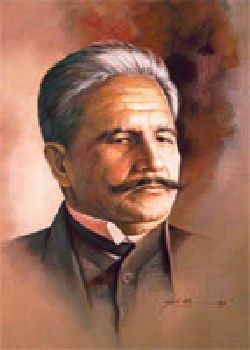
We at ATP have been rather remiss in not paying enough tribute to Mohammad Iqbal. This is a mistake I have been wanting to rectify. Today, the eve of Pakistan Day is a good time to begin doing so. The events and the idea behind the 23rd of March owes more to Iqbal than anyone else. And as a first offering of tribute to Iqbal I offer you this wonderful video. I found it on YouTube:
I do not really know who produced it although for some reason the voice sounds familiar. The selection of poetry as well as the pictures are excellent. Indeed, I wou urge you to focus on both. The pictures are not the ones you usually see of him and many of them evoke a humanness that is lost in many of our ‘official’ portraits on the man. But also focus on the ideas. This is a work less known that, say, Shikwa and Jawab i Shikwa, but it has ideas that are so contemporary that he may as well have been talking about the events of last week. For example:
anpay watan meiN houN kay ghareeb-ud-diyar houN
Darta houN daikh daikh kay iss dasht-o-dar ko meiN




I read this some where and Iqbal picture(the one in which he is thinking) reminds me of it. I think its from Ibn Insha’s book.
Person: Englistan may koon ray tay hain?
Ibn Insha: Angraiz qaum rayti hay.
Person: France may qaum ray tay hain?
Ibn Insha: Franceese qaum ray te hay?
Person: Pakistan may koon se qaum ray te hain?
Ibn Insha: Punjabi ray te hain
Sindhi ray te hain
Phaktoon ray te hain
Baloch ray te hain
Person: pir Pakistan kiyoon banayeh?
Ibn Insha: ghalti(mistake) hogai pir nahi
banahain gay
The father of the nation is the Quaid but the grandfather is certainly the Allama whose vision of a Muslim homeland created the second Madina.
I urge all my Pakistani brothers and sisters to fulfil the vision of this man. They can start by holding demonstrations against the sacking of the Chief Justice with a view to ridding us of a military regime.
Remember all great revolutions begin with students, yet I know of hardly any demonstations that our students have taken part in. It is now or never, Pakistan please wake up NOW!!!!!!!!!!!
My knowledge too is limited but I am afraid that is true, Akif. His son in a way alluded to this fact in his remarkable autobiography. That said, he had given his blind support to Jinnah and that meant something given his towering stature as a thinker (not an accurate translation of muffakir) and a poet of then India.
He was a brilliant poet but I never really understood his contribution towards the creation of Pakistan. I don’t pretend to know much about this topic but it always seemed to me that “Iqbal the Leader” was a creation of someone’s imagination long after Pakistan was created.
March 23 also reminds of the same date in 1931, when Bhagat Singh, Rajguru and Sukhdev were hanged at the Lahore jail, for their role in the freedom struggle. They were later secretly cremated at Hussainiwala on the banks of Sutlej river, by the British government.
I have read Jinnah’s biography i.e. http://www.oup.co.in/search_detail.php?id=126356
Also, I love Dr. Iqbal’s poetry, especially, some of his inspirational couplets, like:
NahiN tera nash-e-mann qasr-e-sultani ke gumbad par
Tu shaaheeN hai, basera kar pahaaRoN ki chattaanoN par
I used to sing, like many other students, here in India, his ‘Saare jahaaN se achha…’, during the assembly at school each morning. :)