Adil Najam
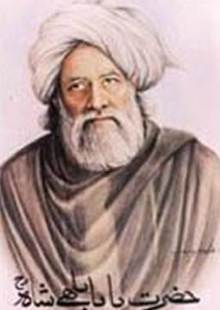 A whole new generation has rediscovered Bulleh Shah. That is good.
Much of the credit for this rediscovery goes to the ‘sufi rock’ band Junoon and, more recently to the New Delhi singer Rabbi Shergill, and most importantly to the magnetic simplicity of ‘Bulla, ki jaanan mein koun.’ (I guess, Abida Parveen did for our generation what these guys are doing in interpreting Bulleh Shah for a new generation).
I must confess that I am a traditionalist and prefer more classical renditions of this timeless piece. My own sense, much like Deevan’s (of the blog ‘Rambling On’), is that Rabbi Shergill does a far superior job than Ali Azmat did. At least for me, Rabbi seems to ‘gets it’ more than Junoon did. But, in honesty, I am grateful to both; I also think that both should be grateful to Bulleh Shah.
So, why not judge for yourself. Here is the rendition by Rabbi Shergill. If you are new to Bulleh Shah, listen to it a couple of times before giving up on it. You can view it here by clicking on the play (arrow) button on the image below, or go to video.google.
For those who may want it, here is a version of the original and a translation by Kartar Singh Duggal:
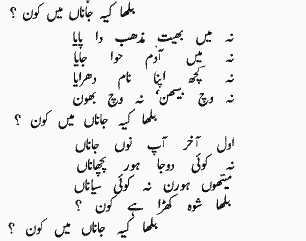
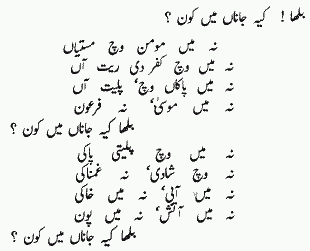
I know not who I am
I am neither a believer going to the mosque
Nor given to non-believing ways
Neither clean, nor unclean
Neither Moses not Pharoah
I know not who I am
I am neither among sinners nor among saints
Neither happy, nor unhappy
I belong neither to water not to earth
I am neither fire, not air
I know not who I am
Neither do I know the secret of religion
Nor am I born of Adam and Eve
I have given myself no name
I belong neither to those who squat and pray
Nor to those who have gone astray
I know not who I am
I was in the beginning, I’d be there in the end
I know not any one other than the One
Who could be wiser than Bulleh Shah
Whose Master is ever there to tend?
I know not who I am.
‘Ki jaanan mein koun’ is the best known and most elegant of Bulleh Shah’s work and is itself an adaptation/translation from the works of earlier Persian philosophers. I wish that more people and singers will start looking at the rest of Bulleh Shah’s repertoire. Some have. For example, Shoaib Mansoor has already done a wonderful rendition of ‘Teray ishq nachaya kar thai-ya thai-ya’ as part of the Supreme Ishq series. And Noori has a song that seems inspired by ‘Kuttey tain-to uttay’.
If others also paid Bulleh Shah more attention, they might find that in terms of his themes Bulleh Shah may be the most contemporary poet in South Asia today. Try looking at ‘Bass kar ji’ (Enough is enough) or ‘Moun aayee baat na rehndi hai’ (I must utter what comes to my lips) and you will find them resonating with your most contemporary political and social preoccupations.
Followup post on Bulleh, Jugni, Shergill & Junoon, here.




including Shah Abdul Latif & Bullah Shah, there are several Sufi poets who have openly admitted their love of Rumi but one anonymous comment on my blog posted at the end of 2004 accuses Bullay Shah of plaigerism which have left me speechless….
it is due to Adil’s link to my blog that I found this anonymous comment yesterday
guess history has been kind on Bullay Shah to establish him as most revered Sufi poet so I will ignore this comment completely….
i was drawn to rabbi because Sikhs have retained punjabi as their primary language and the beauty of the language comes through more plainly… the content of the kafi is undisputed, it is the rendition & the manner in which the language is used by rabbi that attracts me…
some words in most kafis i have read are no longer used by punjabis whereas they are saved in sindhi…
for example “pairan poondee mintaa kardee jana taan peya kalay” is a famous Shah Hussain line…(from the famour main vee jana jhok ranjhan day or main vee jhok ranjhan day jana)
i hope it evokes as many emotions in my punjabi brothers as it does in me….let me demonstrate with an example.. to me the line is important for, to name a few so our good readers can see if they share my observations and have any of their own to understand that the words operate and impact different people differently but as long as we are getting to the deeper meaning
(a) looking for love when one is at the end of the tether
(b) a lady vailing pleading and begging for support (falling at the feet & praying for help)
(c) these cliches of “pairaan poondee” & “mintaan kardee”…. touch a raw nerve leaving the listener mesmerized
(d) that this language is long gone n vogue & we hardly see such expressions used in Punjabi anymore
(e) sufistic interpretation of carrying out the final journey to meet the Lord alone without the crutches of material things
lastly, more than rabbi or junoon, jawed bashir lead vocals of meekal hasan band (MHB) does a much more awesome job since he comes from semi classical qawali background…i just wish i had a dollar for every time i have promoted MHB i would be a rich man
:)
Adil, exactly. That was a beauty about Junoon singing it like Bulleh Shah is TELLING us something rather than it being an introspective piece.
Folks, I do strongly urge you to also look at the discussion on this song and on Bullay Shah at Deevan’s blog… it is of high quiality and very well worth the read. He also has a different translation there….
On that, MSK, yes, the verses that Rabbi chooses to sing are only some in teh original poem… same for the translation, it seems to have some and not other verses… similarly, teh Junoon version chooses different yet different verses.
Bhupinder, like you I like teh Rabbi version better but also had problems with the video part… although, I really liked the cute prompting in English of the ‘key words’…
Which version we like is a matter of personal taste so there is no wrong or right (I actually prefer some of the more traditional renditions to both these versions.) My point is to thank both Junoon and Rabbi for doing what they did (bring new sensibilities to Bulleh Shah) and to invite other to look at the rest of Bulleh Shah’s work which is equally or more powerful.
On the song, as a matter of personal opinion, I do like the Rabbi version better because (1) I think he is not pretentious about it; the music does not distract from the words, and he recites the verses simply putting in the emphasis at the right places and lets the words do the magic (rather than the interpretation). (2) In the Junoon version, I thought they sang it as if Bulleh Shah was TELLING us all the things he is, rather than PONDERING in self-inspection, what his essence might be. (3) I thought the Junoon version was needlessly angry; I do not find anger in these words, I find desperation, a plea for self-inquiry, a quest for one’s own essence. However, I do think that the Junoon video is nicer (although even less relevant to the words), and also that Rabbi may be singer faster than needed, espeically for non-Punjabi speakers
But all of this is to explain why I like Rabbi’s version better. Which, again, is a matter of opinion; not fact. SabizakI must also say that I do believe that each singer has the right to interpret the song as they wish… the song then belongs to them and not just the poet… my reason for liking Rabbi is that the interpretation imbedded in his rendition is closer to my own reading of the words…. in essence, to each their own… as long as this gets people back to Baba Bullay, I am happy.
I think this is so very very powerful. It ddoes really grow on you. Listening to it for about the 10th time today. Thanks.
I also foudn teh translation really helpful. But the version in translation seems to be different from the one in teh song (slightly).