Adil Najam
Thanks to the magic of internet search, our last ATP quiz was not difficult to decipher. Yes, it is Government College Lahore. The photograph was taken in December 1947 by LIFE magazine famous photographer Margaret Bourke-White, and is of freshmen students in a physics class. What made the picture interesting to me was that it was taken in 1947.
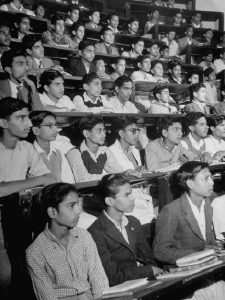
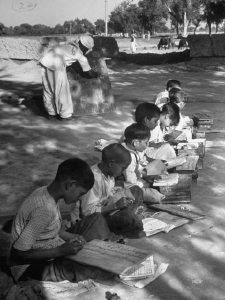
There is a whole series of photographs by Margaret Bourke-White of education in Pakistan, as witnessed by her camera lens in December 1947. The one of the left (above) is of the same class at Government College Lahore. The one on the right is of first graders in a school at Faizpur, near Lahore. They represent two faces of Pakistan’s “Class of 1947.”
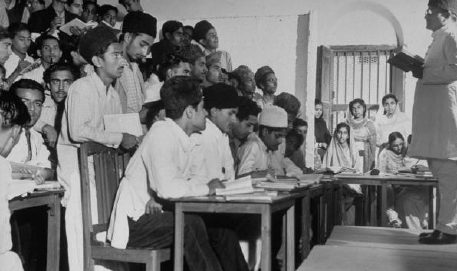
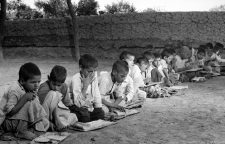
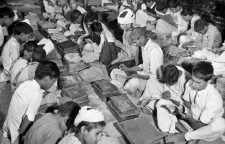

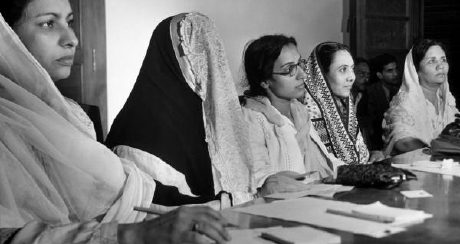
In introducing the Quiz, I had hoped that we might get more detail on some of the people in the photograph or commentary on the fact that this was taken in 1947 itself. I hope we might get some of that discussion now. To aid this process, we present more photograph’s from Margaret Bourke-White’s collection on education in Pakistan.
All these photographs were taken in 1947. The ones in the block above include (L to R):
- Sind Moslem College, Karachi. Freshman English class. Note that this is co-educational, with girls sitting behind a partition (purdah) separating them from the boys.
- Village Elementary School, Fairpur, near Lahore. FIrst grade students studying under the open sky.
- Village Middle School, Burj Attari, near Lahore. Fifth and Sixth grade students studying in a joint class. Note the metal boxes in front of them.
- Home School, Burj Attari, near Lahore. Teachers tending First through Fourth grade girl students in a home school.
- Pakistani Women’s Education Conference, Karachi. A November 1947 educational conference on women’s education. Khadeeja Feroze Ud-din (2L), Deputy Directress of Public Instruction of West Punjab, in purdah.
In looking at all these different faces of Pakistan’s “Class of 1947”, what can we say about the Class of 1947? What was expected of it? What was delivered? What has changed? What has not? What was achieved? What lost?




This is a truly fascinating post! Margaret Bourke-White’s photographs offer such a poignant glimpse into Pakistan’s “Class of 1947” during a pivotal time. It’s thought-provoking to consider what was expected and delivered, and how much has changed—or hasn’t. The historical context you’ve provided makes these images even more compelling. I particularly appreciated the practical points throughout the post, and how it makes me want to dive deeper into these historical moments. Your discussion questions are excellent prompts for further reflection. Thanks for sharing this! It reminds me of the importance of visual history, just like how a good Block Poster can capture a moment.
这些来自玛格丽特·伯克-怀特1947年的照片真是太引人入胜了!看到巴基斯坦“1947届”学生在如此关键的历史时刻的真实面貌,真是让人感慨万千。特别是政府学院和费兹布尔学校的对比,深刻展现了当时教育的两面性。我特别喜欢文章提出的那些问题:什么被期待?什么被实现?什么改变了?这些讨论引人深思,期待看到更多关于这些照片中人物和当时历史背景的深入讨论。感谢分享!更多精彩内容可以访问Block Poster。
This was a truly insightful look into Pakistan’s “Class of 1947” through Margaret Bourke-White’s incredible lens. The comparison of the university students with the younger children really highlights the diverse educational landscape at such a pivotal time. It sparks so many questions about what was hoped for and what ultimately came to be, and how those early foundations shaped the future. It’s fascinating to ponder the changes and constants. I also found it as helpful as using a ba 2 plus calculator online for financial insights.
This was a truly insightful post! Margaret Bourke-White’s 1947 photographs offer such a poignant glimpse into the nascent education system of Pakistan. It’s fascinating to ponder what the “Class of 1947” was expected to achieve and how their world has evolved. The questions you pose—what changed, what remained, what was gained, and what was lost—are incredibly thought-provoking and prompt a deeper reflection on history and its legacy. It’s a powerful way to connect with the past and appreciate the journey. I often find myself doing similar historical reflections, much like when I use a ba 2 plus calculator online to analyze financial trends over time.