Custom Search

Monitoring of Friday sermons by Police

Posted on September 14, 2006
Filed Under >Bilal Zuberi, Education, Law & Justice, Religion
34 Comments
Total Views: 6775

Share

Bilal Zuberi

An interesting news item crossed my attention this past week. It was reported (in The Nation and many other places) that sermons delivered in Pakistani mosques before the Friday prayers will now be recorded by police. Under the Loudspeaker act, the government has mobilized the Police forces to clamp down on mosques where Friday sermons are being used to incite hatred against other sects, religions, or especially against the government. According to an AKI/Dawn report:

A source in a law-enforcement agency told the Pakistani daily Dawn that police officials would be deployed in mosques across the country to film the Friday sermons. The move was aimed at ensuring that hate speeches were not delivered from the pulpit. Pakistan’s provincial home secretaries and senior officials of the country’s law-enforcement agencies attended a meeting on Saturday to chalk out a strategy to keep close tabs on the Friday sermons â€â€? sometimes employed to foment sectarian unrest.


The source said station house officers would give a report on the recorded sermons and speeches to district police officers on a weekly basis. He added police action could be initiated against those who offend people’s religious beliefs.

This is a big deal in Pakistan, and if serious steps are indeed being taken to ‘monitor’ or ‘control’ the messages being relayed from mosque loudspeakers, I believe ramifications can be felt further down the road. The loudspeakers are really the best way for the mosque administration to reach a large audience, and I am sure they will protest if punitive actions are taken against Imams whose lectures are considered threatening.

Friday prayers hold a special place in the culture and tradition of most Muslim countries, including Pakistan. While many muslims pray 5 times a day, it is indeed Friday when mosques are filled up, and when communities come together in a prayer exercise that almost carries a ritualistic fervor to it, in addition to the special status it holds within the religion Islam.
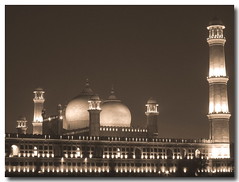
The Friday sermons from the pulpit have also held a special status in South Asia. They were not just lectures that clarified religious teachings, but were also used to declare community consensus on issues that were linked to religion and religio-politics. For example, my dad tells me how some sermons in the Indian town of Kanpur were essential in calming Hindu-muslim riots in the pre-partition India. I also remember growing up and learning so much about the various aspects of muslim life, such as the histories of Islamic rule at various times and the personalities associated with them, the rights of women in marriage, arrangements for funerals, etc etc through friday sermons.

With the advent of loud speakers, however, these sermons started reaching out to audiences beyond those who came to the mosque voluntarily, and became a permanent presence in every household on Friday (whether you liked it or not). Sermons today, at least in many parts of Karachi, start early in the day and provoke a certain sense of guilt if one was going to miss the prayers, and invoke a little motivation in the listeners to go and attend. Despite the frequent annoyance of loud religious messages being thrust onto an involunatry audience for an entire half day, at least the messages conveyed in the past via the content of the sermons were often positive or thought provoking.

However, that has not always been the case. Every now and then, the pulpit continues to be abused, and sermons littered with misleading political messages, and even those inciting communal disharmony, hatred and violence, have been delivered to an otherwise eager and ‘available’ audience. It was just a few years ago, under Benazir’s last stint in office, that a friday sermon at my local mosque was used to declare that Islam did not allow a woman to be the head of state. Similarly, soon after 9/11, I heard a sermon asking God to severely punish all those Muslim leaders who were conspiring with the ‘Kafirs’ to throw bombs at muslims in Afghanistan. Last year when sectarian violence was erupting in the city, a Friday sermon declared a prominent sect in Islam to be equivalent to another sect which had already been declared non-muslims by the state of Pakistan. On my last visit to Pakistan, I heard a sermon declaring that jihad-fi-sabeel-lillah in Kashmir, Afghanistan, Iraq, and Palestine was a sure way to earn a permanent place in the heavens.

And the list goes on…There are many who complain about the use of loudspeakers by mosques, but I believe the content of the sermons is probably a more important issue to deal with. So I am indeed interested in seeing further what the government now intends to do to monitor the friday sermons, and limit their use for (hopefully) useful education and information dissemination. But there is a wider question that we must ask ourselves. Should the state have any authority over the content delivered in mosque sermons (I am told Saudi Arabia may already have tight controls over their Friday sermons)? Would such monitoring and control strategy constitute a limit on the freedom of speech for the mosque Imams? Or would it really all be easy if simply the loudspeakers were removed from the mosques?

A large audience sitting fully engaged for an extended period of time can be an ideal way to engage society in discourse on important matters, such as those related to religion and community life. But how to get it done without getting it hijacked by one or more parties, including the government?

Related Posts with Thumbnails

34 comments posted

Comment Pages: « 5 [4] 3 2 1 »

  1. September 17th, 2006 5:03 pm

    Aziz Sahib, thank you for bringing the conversation’s focus back to the original post. I, too, was getting a little concerned about how far this had gone off on a tangent. To me, at least, the issue has really got nothing to do with Islam, it could be any other religion and the issue would be the same. It is about freedom of speech. As a matter of principle, I believe, government should have no role in what maulvis say, or who the maulvis are, or of how many mosques there are. That control can, and will, be misused; as it has historically in many religious traditions.

    That, of course, brings up the conundrum of the limits of free speech. We face (increasingly) the same issue on this blog. I have every right to say what I want, but I have no right to abuse you or instigate hatred against you. Ideally, we would all want the toleration and restraint to come voluntarily from the members of the ‘community’. (However, it is also very evident right here that not just in highly emotive issues of religion and politics but even such mundane things as the design of a hotel people can start attacking each other’s person and implying intentions and hidden motivations rather than focus on the substance of the argument; in too many cases we just seem to lack the capacity to disagree ‘respectfully’; this seems to be a reflection of larger national passions, where we seem incapable of expressing our disagrement — gham o ghussa - without buring someone’s effigy or stomping on flags!) But, back to the issue of hand, what do we do in a non-ideal world? In a world where there is too litle genuine gham and too much instigation of ghussa.

    The problem, as the ordinance recognizes, is not what is said about one’s own religion, but what is said about someone else’s. Especially in terms of sectarian slurs and instigation of sectarian hatred and violence. That is serious business that routinely takes too many lives and rips at the heart of society. There are laws against hate speech, and to the extent there is a role for government it is to enforce them and do so strongly.

    Beyond that, I think, we are taking the easy route by making this entirely either about government or about maulvis. As if they are the only two actors involved. What about the rest of us? Who sit and listen. If we tolerate the preaching of sectarian intolerance are we not intolerant ourselves? I have on one occasion walked out publicly out of a Juma khutba because I thought hatred was being preached from the pulpit. I know of at least a few others who have spoken up in their congregations. Unfortunately, I do not know of too many. Even more discouraging, my experience was that the rest of the congregation was ‘embarrassed’ by the ‘scene’ I created but not by the obvious hatred that was being propagated.

    I am convinced that if there is a solution, it will come neither from the pulpit nor from the government. It will come from society. The real abdication of responsibility is on the part of the rest of us who choose to remain silent even when we know that what is being said is either wrong or hurtful; either because we are too embarrassed or too busy to ‘stand up and make a difference’.

  2. September 17th, 2006 4:15 pm

    [quote post="6"]Comments are supposed to be my own thoughts and opinions, no? [/quote]

    exactly but I personally found irrelevnt according to this site policy.

    [quote post="6"]It is also to not impose yourself on anyone else in the name of freedom[/quote]

    Who is Imposing?I can also make a similar claim that I hate music but I am forced to listen it all the time on several Pakistani channels.Now one would suggest me to use brain and just switch the channel?

    You talk about freedom.Just tell me you are in States,Isnt Christmas celebrated all over in states and you enjoy xmas holidays for 2 weeks.Maybe you also like to enjoy different Xmas party in the name of freedom.I have no issue what you do in personal life,you read quran or drink alchol its none of my business but when you talk about imposing a law by a state then Christmas which is actually a religious festival is imposed on Non Christians by several means.

    [quote post="6"]You wouldn’t want nudists walking around the Clifton beach, would you?[/quote]

    The question is do you want nudists and other crappy thing in Pakistan in name of freedom?.That question matters most.Everyone here knows by now wht actually I think which is very anti against thoughts of yours and masses of this site posters.

    Thankyou Bilal for quoting 10:99,109:6 and 18:29 verses of Quranic to stengthen my case tht why do I believe the term secularism pretty vague and why do I believe that Islam is different than tht sunday school religon Called Christianity which irked aethists of 60s and force them to comeup with idea of separtion of Church and state.The the very last verse of Surah Kafiron whichyou quoted “Lakum Denokum Waliyadin” is a perfect and crystal clear example that Islam is 100% compatible with existing and future religion and able to apply in government policies as i ws reading in a paper[not sure about claim] today in dawn that British Human rights laws were highly impressed by Quranic laws about humans and one should spend a bit time to study bios of first generations of muslims called companions of Prophet(SAW),specially of four caliphs and caliph Omar bin Abdul Aziz,thats called shariah ,thats called how to use Islam properly to rule over a state.

    [quote post="6"]try to keep my posts as secular as possible (here the definition of secular is as understood by english speaking educated population of Pakistan) [/quote]

    *grin*.Ignoring your resentment,I thankyou too PatExpat for this statment as I also believe that everyone use the term “secularism” in its own way rather referring orignal one[coined by founders].

  3. Adnan Ahmad says:
    September 17th, 2006 1:59 pm

    Aziz Akhmad, It was short but accurate analysis and it does sort of takes us back to the original post. On a side note, the question is why does the state always side with the mullahs. I think it is because of the tremendous leverage they have in te Pakistani society and it is considered a political risk to go against them. Who would want to have a fatwa against himself or herself? Yet history has it that whoever tried to please them eventually ended up with a loss. In the end they (the mullahs) are for their own good.

  4. Aziz Akhmad says:
    September 17th, 2006 1:11 pm

    This discussion has branched into many different directions, which is o.k as long as we don’t lose sight of the original question: Monitoring of Friday sermons by police — is it good or bad?

    The sermons spewing out of the loudspeakers present multi-layered problems. At one level it is the question of freedom of religion and freedom of speech, which in my view must not be suppressed or controlled. But the problem is that the mullahs in Pakistan, while themselves enjoying both these freedoms to the hilt, would not allow the same freedoms to others who may have a different viewpoint. Ironically, the state, more often than not, would side with the mullahs on this issue.

    On another level is the question of hate speech. Should it be monitored? It is known that some mullahs do preach hatred and violence from the pulpit in the guise of Friday sermons. I believe any speech that may inspire violence against another individual or a group of people must not be allowed. I think there is already a law on the statute books against such speech. That law must be enforced without any political considerations.

    Then there is the question of ignorance being preached in the guise of religious discourse. That, I believe, is a market driven phenomenon. If there are people who still believe the earth is flat there will be people who would be ready to sell them a formula to measure the distance between its four corners.

    Iqbal, a favorite poet of the mullahs as well, while addressing the mullahs had very appropriately said:

    Teri namaz maiN baqi jalaal hai na jamaal
    Teri azaaN main nahin hai meri sahar ka payaam

    There is neither dignity nor beauty in your prayers
    Nor your azan heralds the dawn that I am waiting for

    P.S: PatExpat, the use of loudspeakers is not ordained by Islam. It is a latter day invention which was originally condemned by the mullahs as a Satanic invention.

  5. PatExpat says:
    September 17th, 2006 12:26 pm

    Bilal,
    I owe you an apology for making an implicit claim about your ignorance of religion, I was out of line. Please accept it. For all I know, you may know a lot more than I do.

    However, what I intended to point out was the ayats should be read in context because they alone do not explain the idea. If every christian and jew was going to heaven anyway, Allah did not need to send a Prophet with a new religion in the name of islam which he preached to Christians and Jews and everybody, with the warning that non believer would go to hell; Allah could have sent someone to show the Christians/jews their original religion.

    Why do you think, these Yusuf Islams, Yahya Haroons try to preach Islam. If I have studied Islam correctly, practicing Islam in solitude will not get me into heaven. Amr bil maroof and nahi anil munkar is a defined and agreed upon characteristic of a Muslim which all the sects/mosques will agree. Thats why after getting Prophethood, Prophet Muhammad came out of solitude (of Ghar-e-hira) and started openly preaching religion.

    Dont you think he understood the meaning of Quran himself? Why did he and his followers send troops to Faris (Iran), Rome, Constantinople to establish a Islamic society. Wasn’t the ayats obvious to them. Roman empire was christian. Ghazwa Khyber was against Jews. Did the prophet not know the meaning of Quran that was revealed unto him.

    By the way, in my earlier post I only talked about Azaan which does not fall into stepping over someone’s feet. Its a call to prayer only and not calling it defeats its purpose.

    Regarding the pope’s comment, he did not need to quote the Byzantine emperor. What is offensive is that he searched amongst the most offensive quotations by any emperor and used it. How would jews feel if we quote the present iranian president on holocaust just to get some point across about need to carry inter-faith dialogue.

    Though prophet Muhammad is implicit with Islam, yet explicitly associating him with terror is very offensive for Muslims. Nobody raises a voice anymore when people use the term ‘islamic terrorists’ but we don’t allow similar latitude for prophet Muhammad’s name. Had he only omitted Prophet Muhammad’s name, we would not have seen such an outcry.

    And my apologies to ATP editors for this long post. Will try to keep future posts as short as possible or keep my mouth shut. If still there are some of Bilal’s questions unanswered, may be some other time or some other post. We will get an ample opportunity in these blogs.

  6. September 17th, 2006 11:18 am

    Adnan:

    Bilal are you sure you are not twisting the entire topic by injecting your own opinions and making them postive by associating with “secularism�?

    Comments are supposed to be my own thoughts and opinions, no? Nobody is stopping you from passing judgements on other people’s religions (or your own). I simply stated I would not do that.

    The twisted definition of secularism is “freedom� and you are talking about banning something.

    It is also to not impose yourself on anyone else in the name of freedom. You wouldn’t want nudists walking around the Clifton beach, would you?

    PatExpat:

    So Islam does call for calling to praying, preaching, ORDERING the right way and PROHIBITION of vices.

    I don’t have a problem with proselytizing. Feel free to do so. Muslims are very active in preaching in the US as well, but somehow they do so without stepping over each other’s feet (or waking up heir neighbors). In Pakistan the trend is to fully demonize whoever doesn’t agree with us. The controversy about Pope’s comments is a recent example. How much do the protestors actually know about the Pope or the context in which he was speaking?

    you don’t want to talk religion without having studied it, do you?

    How long do you think I should study religion before talking about it? I have practiced it for 30 years. You don’t think it gives me a right to say what I think about my own religion?

    “Surely they that believe, and those of Jewry, and the Christians, and those Sabaeans, whoso believes in God and the Last Day, and works righteousness their wage awaits them with their Lord, and no fear shall be on them, neither shall they sorrow.” (Q. 2:62)
    “If it had been thy Lord’s Will, they would all have believed, all who are on earth! Wilt thou then compel mankind against their will to believe!” (Q. 10:99) Yusuf Ali’s translation.
    “To you your religion, and to me my religion.” (Q. 109:6)
    “And say: The Truth is from your Lord; so let him who please believe, and let him who please disbelieve…” (Quran 18:29)

  7. PatExpat says:
    September 17th, 2006 10:28 am

    Bilal,

    Though I don’t consider myself ’secular’ at all, however, I try to keep my posts as secular as possible (here the definition of secular is as understood by english speaking educated population of Pakistan) but your post forced me to set the record straight by qouting from Quran (OMG! OMG! OMG!)

    Azaan is a call to prayer. If it is to remain in the confines of Mosque, the whole purpose of Azaan is defeated. On this issue, none of the three mosques would be bickering at all.

    I know that there is an ayat stating there is no compulsion in Islam. It means that nobody is forced to convert to Islam and has nothing to do with secularism and is mainly quoted out of context. There is also an ayat “you are the best ummah who came out of the people, you will ORDER the righteous and PROHIBIT the vices”. if you know arabic (Amr bil maa’roof wa nahi anil munkar concept - again every sect will agree on it).

    So Islam does call for calling to praying, preaching, ORDERING the right way and PROHIBITION of vices. If you have stayed on the topic, i would have remained secular.

    I know you don’t want to be a judge of what is Islamic or Unislamic so I will stop here. And would appreciate that in future, we keep it as secular as possible without mentioning the word because (as Adnan Siddiqui would have said it) you don’t want to talk religion without having studied it, do you?

  8. September 17th, 2006 5:43 am

    Bilal are you sure you are not twisting the entire topic by injecting your own opinions and making them postive by associating with “secularism”? No I personally don’t hate the term secularism.Why should I hate something which exists in papers only but not in reality?

    Your saying that non-muslims shoudnt listen azaan.Well who force them to “listen”?Non-muslims of Pakistan are not tortured and forced to hear azaan that you used the term “Listen” here?In Similar way if one dislikes or considers music is irrelevent then there should be no Audiotape in cars and on TV allowed because several people who hates music are forced to listen it anyway.

    The thing you are proposing is not even according to secularism which you guys try to preach all the time.The twisted definition of secularism is “freedom” and you are talking about banning something.Think again what are you talking about.

    p.s:Now who’s going to vote me down now?For me such online voting system is neither new nor it matters anyway.Usually this system is misused by people who vote down to opopnents who don’t agree with them. *grin*.

Comment Pages: « 5 [4] 3 2 1 »


Have Your Say (Bol, magar piyar say)

Please respect the ATP Comment Policy.

Keep comments on topic; no personal attacks; don't submit indecent, inflammatory, slanderous, uncivil or irrelevant comments; flamers and trolls are not welcome; inappropriate comments will be removed or edited.

If you won't say it to someone's face, then don't say it here!

Readers who want to use a URL should please use the TINY URL program.

Thanks, and keep the comments coming!