 An interesting news item crossed my attention this past week. It was reported (in The Nation and many other places) that sermons delivered in Pakistani mosques before the Friday prayers will now be recorded by police. Under the Loudspeaker act, the government has mobilized the Police forces to clamp down on mosques where Friday sermons are being used to incite hatred against other sects, religions, or especially against the government. According to an AKI/Dawn report:
A source in a law-enforcement agency told the Pakistani daily Dawn that police officials would be deployed in mosques across the country to film the Friday sermons. The move was aimed at ensuring that hate speeches were not delivered from the pulpit. Pakistan’s provincial home secretaries and senior officials of the country’s law-enforcement agencies attended a meeting on Saturday to chalk out a strategy to keep close tabs on the Friday sermons -sometimes employed to foment sectarian unrest.
The source said station house officers would give a report on the recorded sermons and speeches to district police officers on a weekly basis. He added police action could be initiated against those who offend people’s religious beliefs.
This is a big deal in Pakistan, and if serious steps are indeed being taken to ‘monitor’ or ‘control’ the messages being relayed from mosque loudspeakers, I believe ramifications can be felt further down the road. The loudspeakers are really the best way for the mosque administration to reach a large audience, and I am sure they will protest if punitive actions are taken against Imams whose lectures are considered threatening.
Friday prayers hold a special place in the culture and tradition of most Muslim countries, including Pakistan. While many muslims pray 5 times a day, it is indeed Friday when mosques are filled up, and when communities come together in a prayer exercise that almost carries a ritualistic fervor to it, in addition to the special status it holds within the religion Islam.
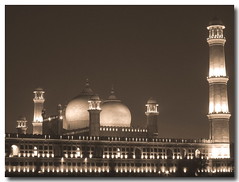 The Friday sermons from the pulpit have also held a special status in South Asia. They were not just lectures that clarified religious teachings, but were also used to declare community consensus on issues that were linked to religion and religio-politics. For example, my dad tells me how some sermons in the Indian town of Kanpur were essential in calming Hindu-Muslim riots in the pre-partition India. I also remember growing up and learning so much about the various aspects of Muslim life, such as the histories of Islamic rule at various times and the personalities associated with them, the rights of women in marriage, arrangements for funerals, etc etc through friday sermons.
With the advent of loud speakers, however, these sermons started reaching out to audiences beyond those who came to the mosque voluntarily, and became a permanent presence in every household on Friday (whether you liked it or not). Sermons today, at least in many parts of Karachi, start early in the day and provoke a certain sense of guilt if one was going to miss the prayers, and invoke a little motivation in the listeners to go and attend. Despite the frequent annoyance of loud religious messages being thrust onto an involunatry audience for an entire half day, at least the messages conveyed in the past via the content of the sermons were often positive or thought provoking.
However, that has not always been the case. Every now and then, the pulpit continues to be abused, and sermons littered with misleading political messages, and even those inciting communal disharmony, hatred and violence, have been delivered to an otherwise eager and ‘available’ audience. It was just a few years ago, under Benazir’s last stint in office, that a friday sermon at my local mosque was used to declare that Islam did not allow a woman to be the head of state. Similarly, soon after 9/11, I heard a sermon asking God to severely punish all those Muslim leaders who were conspiring with the ‘Kafirs’ to throw bombs at muslims in Afghanistan. Last year when sectarian violence was erupting in the city, a Friday sermon declared a prominent sect in Islam to be equivalent to another sect which had already been declared non-muslims by the state of Pakistan. On my last visit to Pakistan, I heard a sermon declaring that jihad-fi-sabeel-lillah in Kashmir, Afghanistan, Iraq, and Palestine was a sure way to earn a permanent place in the heavens.
And the list goes on…There are many who complain about the use of loudspeakers by mosques, but I believe the content of the sermons is probably a more important issue to deal with. So I am indeed interested in seeing further what the government now intends to do to monitor the friday sermons, and limit their use for (hopefully) useful education and information dissemination. But there is a wider question that we must ask ourselves. Should the state have any authority over the content delivered in mosque sermons (I am told Saudi Arabia may already have tight controls over their Friday sermons)? Would such monitoring and control strategy constitute a limit on the freedom of speech for the mosque Imams? Or would it really all be easy if simply the loudspeakers were removed from the mosques?
A large audience sitting fully engaged for an extended period of time can be an ideal way to engage society in discourse on important matters, such as those related to religion and community life. But how to get it done without getting it hijacked by one or more parties, including the government?




The only reason maulvis wield much sway over the masses is lack of knowledge (of masses). If the rest of the population was as educated as us bloggers, they would not listen to the maulvi. But as I mentioned earlier, we don’t study much about our religion so we have delegated the task to the maulvi.
On the note that only the dumbest take up Islamiat and Pakistan Studies, well the same stands for every field other than Engineering, Medicine and Business Administration. If you can’t get admitted into these faculties, you are considered below the mark whether you are specializing in Chemistry, Physics, Mathematics, Economics, English, Urdu, Literature, Islamiat, Pakistan Studies. As illustrious Chief Justice Naseem Siddiqui once remarked, “Only the ones who can’t get admitted anywhere else, enter into Law colleges”.
Adnan Ahmed, I am not defending the maulvi over here but Pope did not make a very good case of knowledgability yesterday
[quote post=”6″]“The emperor comes to speak about the issue of jihad, holy war,” the pope said. “He said, I quote, ‘Show me just what Muhammad brought that was new, and there you will find things only evil and inhuman, such as his command to spread by the sword the faith he preached.”'[/quote]
And lets not defend him by saying that he was quoting the Byzantine emperor. Bringing up this quote was not necessary at all and will only add fuel to the fire. On a positive side, this could unite Sunnis and Shias but then only to condemn Pope, Catholics or Christians at large. So I say that lets make the pope an honorary maulvi and this will put an end to the hate speeches concerning Sunnis and Shias.
On a lighter note, talking of the mosques and the loudspeakers, here is a report I picked up from the Urdu press some time ago, which some of you might have come across too.
Getting up for morning prayers during the winters is always difficult, particularly for the maulvi who has to get up earlier than anyone else to call the azaan, using the loudspeaker, of course. The actual prayers follow 15-20 minutes after the azaan.
To allow him extra 20 minutes of sleep this village maulvi made use of a tape recorder for the morning azaan. At the scheduled time of the azaan he would half open his eyes, stretch his arm and slap the play button on the recorder sitting next to his bed and hooked to the loudspeaker system of the mosque, and go back to sleep. The maulvi had a teenage son who also used the tape recorder at day time to listen to his own stuff. Before going to bed at night, however, the boy would take out his music cassettes from the recorder and re-load the azaan cassette and place the recorder at its appointed place for use by his father next morning. This routine worked fine between the father and the son and the mosque-goers of the village.
One day, however, the boy forgot to replace the azaan cassette at night. In the morning when the maulvi hit the play button on the recorder the folks in the sleepy village woke up to the song “Tu cheez barri hai, mast, mast …”
Adil-
Taking examples from other sectors, either the religious groups should self-regulate, i.e. form an ulema council that governs the regultions on all the mosques and the requirements to become an Imam etc, or the government will need to regulate. We cannot afford a free for all situation as far as mosques and madrassahs are concerned. People have started using mosques for all kinds of things, from selling taazi bhindis (jeez), to illegally occupying plots of land.
Additionally, many of us believe that primary and secondary education can be considered a basic human right in today’s world, and hence it should be the government’s responsibility to ensure that all children are in school and get the best education possible. The same, I believe, can be said about religious education (at least of those who lead prayers, sermons, and are increasingly becoming imporant in the political sphere). If a minimum degree of religious education and religious enlightenment is to be considered a human right in the present geo-political situation, then one could argue that government should play a more active role in it. Why should the government be able to influence our Islamiat and Pakistan Studies textbooks in urdu+english medium schools, but not become a part of the degree awarding institutions for Imams?
Saadia Khan, You have raised very valid points in both of your posts. The very puropose of the mosque “was” sacred and they used be houses of knowledge but that is not the case any more. Qaris (for their skills and not knowledge) are considered scholars and very often they become very dangerous scholars.. similar to neem hakeem khatra’ae jaa’n.. My undergrad school was a small catholic school and it also had a seminary for the priests and without a bias I say pick any so called maulanas from pakistan and pitch him against a seminary student, let alone a priest, and try to have a dialogue between them. I say it is unlikely the conversation would last long for the lack of knowledge on the Mullah’s part about his very own religion. Thousand years ago it would have been a different story.
In your second post you have hit the nerve again; students with less of a chance to make it in other faculties tend to lean toward islamiat. I agree. As for mosques, in your example I think it is the same as having three places for contention on one street.
Bilal and Ayesha, Couldn’t agree with you more on many of your points.
Monitoring Friday sermons by police?
My first reaction is that the police cannot or will not do it. It will end up like one of those much trumpeted and failed attempts to monitor and prevent the use of tinted glasses in vehicles, display of weapons by individuals, use of loudspeakers, defacing the walls with graffiti known as “wall chalking” in Pakistan or the more ludicurous and off-and-on attempt to ban “pillion riding”. (One wonders if “pillion riding” was that bad then wouldn’t it be easier to ask the manufacturers to stop putting the back seat on a motorcycle rather than the police chasing every motorcycle on the streets, which has two riders?)
Hate speech is bad and can be dangerous, particularly when camouflaged in religious terms and delivered from the pulpit. I beleive their is already a law against it in the country. That law should be enforced without any discrimination. But the question is, is the proposed effort meant to control hate speech or
criticism of the government?