Adil Najam
Sepoy, of Chapati Mystery fame, sent me this picture before. It is a crude sheyr (verse) crudely written at the back of a bus.
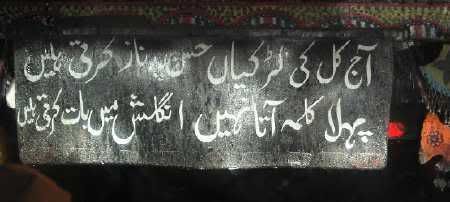
Girls these days are so proud of their beauty
They don’t know the first kalma, but speak in English
Sepoy said it made him chuckle. It makes me chuckle too. But it also makes me shudder a bit. And not just for the (lack of) poetic skills displayed here. The verse and its display probably says more about the way we view women – especially young women – than it does about the state of poetry in the country.

Notwithstanding the fact that not just rhyme but reason is also missing here and the first and second misras have little connection, the verse does suggest what is viewed good (knowing the pehla kalma) and what is not (speaking in English).
All too often people will presume that a certain behavior correlates to certain moral positions. I remember how we wrote on ATP about an Ad in Dawn’s classified section for
Thinking about the ad and all the societal assumptions imbedded in it still makes me mad. As did this interesting post from ATP friend Mansoor on Metroblog Karachi, where he writes about a new way of stealing cellphones that as practiced in Karachi.
A girl is standing at a bus stop, waiting to catch a bus to go home and talking on her cellphone. There are quite many people around and its daytime.
Two guys on a bike pull up in front of her, the guy on the back gets off the bike, comes in front of her, and without warning, plants a loud slap right on her face! The girl is stunned, cant even utter a word. He then shouts (for the benefit of whoever is listening) “kitney dafa bola hai! Abba ka cellphone nahi lay kar nikla karo” (how many times have i told you, not to take dads cellphone out), grabs her cell, gets back on the bike, and they both drive away.
The girl is too shocked to say anything and just stands there, her hand holding an imaginary cellphone to her ear. People around ignore the situation thinking its just some family tiff or the other…. till she screams out “ye mera bhai nahi tha!!!!!!!” (he was not my brother!!!!!)
What I found notable is that even though the post generated intense discussion it was mostly focused on crime prevention and law enforcement and very little about what – to me – was the most shocking line of all:
People around ignore the situtation thinking its just some family tiff or the other…
Wait, wait, wait. Please. It is OK if someone comes and slap their sister or wife or daughter in public? Or even in private? And the rest of us will say, ‘OK, its a family tiff.’
I must confess that I am shocked most because in my heart of heart I know that many people will, in fact, do exactly that. And, that, is the tragedy of it all.




[quote] “I believe if it had happened in Pakistan, many people would have come and beat up the guy badly. I still believe Pakistanis do have a soul to feel the pain if someone humiliates a woman in public place.”[/quote]
Saadia,
I wish it was true. But unfortunately it isn’t.
You may be too young to recall what came to be known as “Nawabpur tragedy” in the 80s. A group of men raided a house in Nawabpur, a village in Punjab, to settle some personal scores. They stripped the women of the house naked and made them walk through the village in broad day light in presence of the whole village. No one came to the rescue of the poor helpless women. This incident was widely covered by the local as well as the international media.
Then we are all aware of Mukhtaran Mai’s stroy. Aren’t we? And these are just the cases picked up by the international media. There are scores of others that go un-reported.
I can confirm that the verses ‘Larkian parh rahin hain angrezi—‘ are indeed from Iqbal. Included in Ghazaliat at the end of Baang e Daraa .
For those interested here are two more gems from Akbar Allahabadi:
Ik peer nay taalim say larkay ko sidhhara
Ik peer nay tehzeeb say larki ko sidhhara
Woh tan gaya patloon mein yeh saaiye mein dhali
pajama gharaz yeh hai kay donoon nay uttara
Khuda kay fazl say donoon mian beevi muhazab hein
Hijaab unko nahin aata inhein ghairat nahin aati
All these verses were written almost a hundred years ago.The world has changed in a way that cannot be adequately described. Not much changed however it appears is the mindset in our muaashra…. I think the reason is more than economic— though the economic dependence of women feeds that mindset— I think it is social. Pathetic but sadly true… This discussion could go to the laying bare of our souls.
I must conclude with another couplet from Akbar Allahabadi, this time less controversial but more hasb e haal.:
Agar kuch moonh say kehta hoon maza ulfat ka jaata hai
Agar khaamosh rehta hoon kalaija moonh ko aata hai
There was a program in TV (hidden camera) to test how helping the men are in Germany, they showed a girl was being raped in public and she was crying for help. None a man came to help her, it was actually a woman who came and started beating the guy with her bag. Infact men igonore the issue as by later telling the camera that it was none of their business. I believe if it was happened in Pakistan, many people would have come and beaten the guy badly. I still believe Pakistanis do have a soul to feel the pain if someone humilates a woman in public place.
How we have the tendency to make a mountain out of a mole hill. It was just a verse on the bus belonging to some semi-literate guy.
Some buses have ‘F-16’ written over them. Now we can reach the conclusion that in these days of radical islam; it tells us all the nation possesses an agressive jihadi streak which is evident from the ‘F-16’ on the bus.
Then there will be some buses who would have written ‘Osama’ or ‘Saddam’ and we can again draw a conclusion from that all Pakistanis side with Osama and Saddam.
Regarding the slap in public, its a rarity in Karachi. At least I never heard of it or had ever seen it before the mention on that blog.
And even if there is a domestic violence issue in the neighbourhood, in these times where the propaganda machine is on full blast with “Sab say pehlay Pakistan”, how can you expect people to come to help of those neighbours who need your help. You never get involved in the domestic disputes of others unless requested by the victim or its in the interest of USA and she takes the lead in jumping in.
Next we can take something that is written on a rickshaw and try to arrive at the national mental aptitude.
And in case you try to stereotype me, we don’t even raise voices among women much less thinking of raising a hand.
Khadija, Pervaiz,
I doubt if it is Iqbal’s poetry. The diction and the style is not his. It sounds more like Akbar Allahabadi.