Mast Qalandar
Most Pakistanis know Hasan Abdal as a town that houses the well-known Cadet College, the first to be built in Pakistan in the early 1950s. Other than that, Hasan Abdal hardly arouses any interest among Pakistanis. It is a non-descript dusty little town, 25 miles from Islamabad, situated along the National Highway, almost encroaching upon it. The town is haphazardly built like most rural towns in Pakistan. It is a town that you just pass through while going to Peshawar or Abbottabad and the Northern Areas or, if you need to, you stop at one of the filling stations and tire shops that add to the ugly clutter along the roadside. You don’t normally visit Hasan Abdal —unless, of course, you happen to be a Sikh.
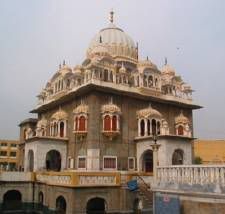
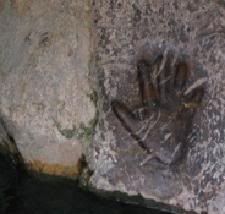
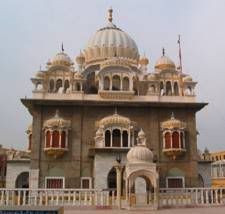
For Sikhs, Hasan Abdal has special significance — and a special place in their hearts. It houses the imprint of the hand or panja believed to be that of Guru Nanak, the founder of the Sikh religion. This makes Panja Sahib one of the three holiest shrines of Sikh religion — the other two being the Golden Temple in Amritsar, India and Nankana Sahib in Sheikhupura, Pakistan.
In April, every year, Panja Sahib attracts thousands of Sikh devotees from all over the world to celebrate the birth of Khalsa (the pure). It was on April 13, 1699 that Guru Gobind Singh gave new guidelines and a new identity, Khalsa , to the Sikh religion, at the Baisakhi (Spring) festival at Anandpur.
A couple of explanations before we proceed further: First, the word Panja is derived from panj, meaning five, and refers to the five fingers of the hand or the hand itself. Second, Sikhs use the word Sahib for the names of sacred personalities, places or books, just as Muslims use the word Sharif such as Mecca Sharif, Quran Sharif, Ka’ba Sharif etc.
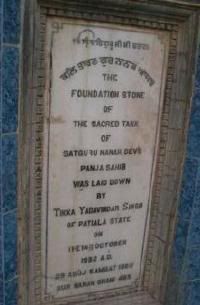 I drove last week, along with a friend not through but to Hasan Abdal to visit Panja Sahib and learn something about it first hand. (2007 being officially declared the Visit Pakistan Year, I thought the least I could do was to visit some interesting sites in my neighborhood.)
Like all legends and folklore, the story of Panja Sahib sounds like a mixture of beliefs, facts and fiction – fiction to the non-believer, that is. There are different versions of the story that one hears or reads, but a distinct common thread runs through all of them.
Other than the Sikh caretaker (garanthi) of the shrine, I also talked to some locals of Hasan Abdal about the story of Panja Sahib. They all gave me a similar even if not exactly the same account; and they all seemed to believe it too. Here is the story in its essential details:
Sometime between the year 1510 and 1520 Guru Nanak is said to have traveled to the Arab lands visiting, among other places, Mecca and Baghdad. Some suggest that he even performed the hajj but there is no conclusive evidence of that. (To give the reader an idea of the time line, it was the time just before the Mughal rule began in India.) On the way back from his sojourn abroad Guru Nanak passed through Kabul and Peshawar and then, after crossing the Indus, halted at a small hamlet at the foot of a steep hill, short of the Margallas, where Hasan Abdal is located today.
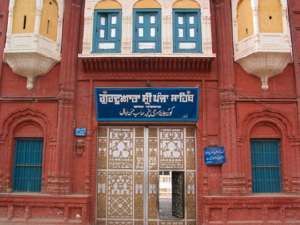 Attracted by his teachings, both Muslims and Hindus of the hamlet and the surrounding area started flocking around Guru Nanak. At the top of the hill, at the back of the back of Hasan Abdal, there lived a ‘peer’ (a Muslim saint of sorts). He was called Baba Wali Kandhari. His last name referred to his origins in Kandhar, Afghanistan. Other than having a better vantage point from where he could see all that happened in the village below, Baba Kandhari also had the advantage of having a fresh water spring nearby, which was the source of water not only for Baba Kandhari but also for the people down below.
Baba Kandhari could not help noticing that many more people were flocking to Guru Nanak than were visiting him. He felt a bit of resentment towards the Guru. What could he do? If he couldn’t stem the flow of devotees to the Guru, he thought, he could perhaps stop the flow of water to the hamlet below and thus drive the Guru away. And stopped the water he did. Upset over the cutting off of their water supply, a delegation of people from the hamlet went up to Baba Kandhari to request him to be kind enough and let the water flow. But the Baba angrily sent them back, taunting them that why didn’t they ask their Guru to find water for them. When Guru Nanak heard this, he asked his lifelong disciple and companion, Bhai Mardana (a Muslim), to go to Baba Kandhari and plead with him the case of the village folks. But the Baba did not relent and Bhai Mardana came back empty handed. Guru Nanak sent Bhai Mardana again, and yet again, to beg the Baba for water, but to no effect.
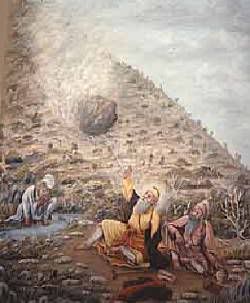 Becoming desperate, the people turned to Guru Nanak asking him what should they do. According to the story, Guru Nanak told them not to despair and trust God, and then, pointing to a large stone embedded in the ground, asked them to dislodge it. When they pushed the stone aside, fresh water gushed forth from the ground, enough for the needs of the little hamlet and some more!
Baba Kandhari saw this happening from the hilltop, and was surprised at what seemed like a miracle but also dismayed at this development. But his dismay turned into shock and anger when he discovered that his own spring had meanwhile dried up. Enough was enough, he thought, and decided to do away with the Guru. He pushed a huge boulder down the hill in the direction of the Guru that, he thought, would sure crush the Guru and the people around him. The boulder rolled down, gaining speed and kicking up dirt. When the people heard the rumble and saw the huge rock hurtling down, they panicked and started fleeing. But Guru Nanak stayed calm and continued sitting where he was. When the boulder came close and it seemed it would crush him, Guru Nanak calmly raised his right hand as if to order the rock to stop. The boulder pushed against his hand — and stopped!
The Guru’s open palm sunk into the boulder as if pressed into wax and left a deep imprint. When Baba Kandhari saw this, he needed no further proof of the spiritual reach of the Guru. He came down from the hill, touched Guru Nanak’s feet, and joined the Guru’s devotees.
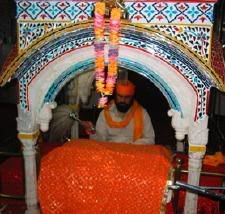
The rock with the hand imprint is embedded, today, in the concrete structure of the Panja Sahib building complex. Clear, fresh spring water gushes out from somewhere behind the rock and spills over the face of the rock into a very large pool. The imprint of a right hand is clearly visible underneath the thin sheet of water overflowing the face of the rock. Next to the pool, on an elevated platform, stands a beautiful small gurdawara, built in the Mughal style by Maharaja Ranjeet Singh (1780-1839). The gurdawara houses the Granth Sahib – the holy book of Sikhs. A large double storied hostel for the yatrees or pilgrims surrounds the courtyard, the pool, and the gurdwara. There are numerous plaques and signs announcing the names of the various donors as well as other directions in Gurmukhi, English and Urdu.
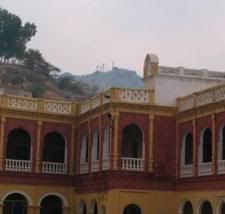
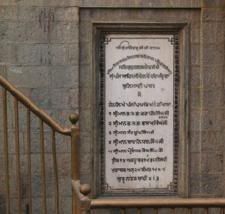
From the courtyard of the shrine, one can easily see the hilltop where Baba Wali Kandhari had camped and is supposed have rolled the rock. A modern communication tower sprouts from the place now. The hilltop has also become a shrine named after Baba Kandhari and attracts many devotees from the surrounding area. Even Sikhs pilgrims to Panja Sahib trek up the hill, a distance of over one mile, to visit the shrine.
The Panja Sahib shrine complex is clean and reasonably well maintained. It could do with a fresh coat paint. though, both inside and on the facade. And if I could, I would clear the cluttered street leading from the highway into the town and to the Panja Sahib building.
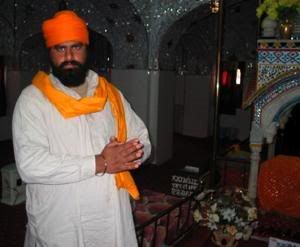 The caretaker of the gurdawara or garanthi, a very large and soft- spoken man, named Saddam Singh (yes, Saddam Singh! That’s what he told me), allowed us inside the gurdawara.
While visiting the Panja Sahib shrine and hearing the stories, one could not help noticing striking similarities between some of the traditions of Sikhs and Muslims. The story of the Guru Nanak divining water reminds one of the story of Hazrat Hajra desperately looking for water for her child in the Arabian Desert, and the child kicking up water miraculously from the sand. And, just as Muslims are amazed at the perpetuity and abundance of water at Zamzam, Sikhs are amazed at the perpetuity and abundance of fresh water gushing forth at their shrine in Hasan Abdal. Also the Sikhs treat the water at Panja Sahib as reverently as Muslims treat the water from Zamzam.
Note: All photographs, except the painting of Guru Nanak and the rock, are by the author.





[quote comment=”32061″]
Sorry for totally inaproprite comments. I’m a regular reader of Pakistaniat, I was expecting a post about Moharam for many days but all that is totally disapointing__ like my comments are…[/quote]
My thoughts, exactly! We have posts on so much stuff and not a mention about this topic?
We did have a post sometime in the past about “grieving shias” or something like that where it said that Shias mourn all the time or something absurd like that.
MQ:
In describing the agonies of unrequited love Ghalib has no equal. Love for him was a palpable , and how shall I put it, an earthy reality. The following two verses reflect this:–
Ishq say tabiyat nein zeest ka maza paya
Dard ki dwa paiyee dard be-dawa paya
and…
Raunaq-e-hasti hai ishq khana veeraan saaz say
Anjuman bay shama hai gar barq khirman mein nahin
Samdani,
No, I am not pulling your leg. That’s what the Garanthi said his name was. It did sound a bit intriguing to me too. The man was so soft-spoken that first I thought I didn’t hear him right. When I asked him again he repeated his name a bit sheepishly. I could see that he too was conscious of it.
Pervaiz Alvi,
I did try to find out the background of the name Hasan Abdal but couldn’t find a reliable explanation. As The Pakistanian has mentioned, Baba Wali Kandhari is also known as Baba Hasan Abdal. But this is a case of the town giving a name to a person rather than the other way round.
No, I don’t think the name Hasan Abdal was named after Ahmed Shah Abdali. There was not much love lost between Ahmed Shah and the Panjab, and definitely not between him and the Sikhs. I am still looking for an explanation.
Ahmed,
I think one reason you find both stories — Sohni Mahiwal and Panja Sahib — moving is because of the common thread between the two. That of LOVE. In one it is love between two individuals and in the other it is love for humanity at large. While I am typing this message I am also listening to Bulleh Shah’s message of love in Pathanay Khan’s enchanting voice:
[quote]Eeho piyaar hai dars waliyyaaN da
Aye maslak paak nabiyyaN da
Ee piyaar di khaatar arsh banaiN
Ee piyaar di khatar farsh banaiN …
Saints have been preaching love
Prophets have been practicing it
Heavens were made because of love
And so was the Earth … [/quote]
It’s mesmerizing!
Knowing you as a Ghalib fan, I would love to hear one from Ghalib on the subject.
Akif Nizam,
After my visit to Panja Sahib I also did some reading on the Sikh religion and was inclined to reach the same conclusion as you did that Sikh religion is fusion of Hinduism and Islam. But I also found (I am not certain, though) that Sikhs do not approve of that suggestion. Like people of all religions they believe their religion came from God.
And, thank you all for appreciating the post.
MQ
Mast has actually kicked up a notch by actually visiting the place just for the sake of a visit and then specifically writing a post about it for ATP. Other bloggers if I am not mistaken have their own blogs for initial postings..
A fine post indeed.
I don’t want to deviate from this post.. But a factual post (different from what we see in pakistani media) on Muharram wouldn’t hurt. It was such a towering event that the political and theological reverberations from it can still be seen today. On a flip note at ATP people made a religious mess of an issue about a husband beating his wife; I don’t know what will be in store for a post on Muharram.
Thanks for a wonderful post. And am especially glad that you took down the granthi’s name. Very impressed, with the post I mean :-)