In my last two posts on Islamabad (here and here) I talked about the woods and the forest trails that I love so much and take to them whenever I can.
In those woods, at the foot of the Margallas, until a few years ago, there was a very large and very old tree, believed to be several hundred years old. Its gnarled branches sprawled like an umbrella over a very large area around the tree.
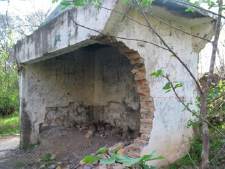
It was a pipal tree (ficus religiosa). Pakistani residents of Islamabad were generally unaware of the significance of this tree. But the tree attracted many expatriate residents, mostly from South East or East Asian diplomatic missions in Islamabad. They would come and simply contemplate the tree and its surroundings. Someone had even a built a concrete kiosk and a concrete bench next to the tree for visitors to sit. The tree was believed to be a Bodhi tree.
What is a bodhi tree and how it came to be in Islamabad?
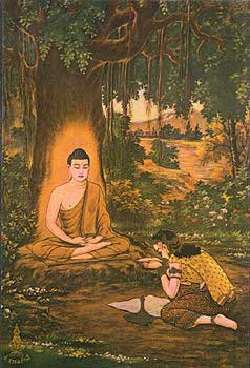
As many of us would remember from our history books, that is, if one graduated before the 1970s, for afterwards they stopped teaching history of pre-Muslim era of the subcontinent in schools, prince Siddhartha Gautuma meditated under an old pipal tree in Gaya, a village near Patna, Bihar, some 2,500 years ago. Ultimately he achieved nirvana, or was “awakenedâ€.
Consequently, the tree under which he sat was named Bodhi, meaning “awakening.†Sidhartha Gautuma became Buddha (the awakened) and the village came to be known as Bodh Gaya, the name it still carries today. The Bhodi tree that grows in Bodh Gaya today is believed to be a direct offspring of the original Bhodi tree.
In the centuries after Buddha, the Bodhi tree became a symbol of Buddha’s presence and an object of devotion for Buddhists.
A little more history before I get to the pipal tree in the woods of Islamabad.
King Ashoka (died 232 BC), the third Maurian king, converted to Buddhism and became a great advocate of the religion and actively propagated Buddhism throughout his empire. The Mauran Empire included, other than the present Northern India, the Gandhara region, which included the area around present day Islamabad, the Peshawar valley and parts of Afghanistan and Iran. Taxila (then Taxshashila), Peshawar (then Parshpura) and Charsaddah (then Pushklavati) were important cities of Gandhara. It was at this time that Taxila reached the peak of its development and became the center of Buddhism. Chandra Gupta Mauria and Asoka spent time at Taxila and so did their famous political adviser, Chanakya, who taught at Taxila.
King Asoka’s daughter, Sanghamitra, who became a Buddhist nun, is said to have taken a cutting of the Bohdi tree from Bhod Gaya to Sri Lanka and planted it at Anaradapura, the ancient capital of the island, where it still grows. Many temples throughout the Buddhist world have bodhi trees growing in them, which are or are believed to be offspring of the one from Anaradapura.
Now, back to Islamabad.
The old pipal tree that grew in the woods of Islamabad was also believed to be “descendent” of the Bodhi tree in Gaya, possibly planted, centuries ago, by a devotee, alongside a temple that might have existed there. Taxila, as the crow flies, is only a few miles from Islamabad, and is full of Buddhist monuments – stupas, statues and remains of monasteries.
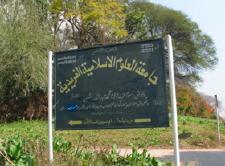
In the 1980s, Ziaul Haq ruled Pakistan. In his zeal to “Islamize†the country, he encouraged and helped build madrassas all over the country, many with Saudi money. One such madrassa was built in the woods of Islamabad, not far from where the Bodhi tree stood. Over the years, the madrassa expanded, as most madrassas do, violating the building codes and encroaching upon state land, to become one of the largest madrassas in Islamabad. Today, it occupies 5-7 acres of prime real estate in Islamabad and has a sprawling building complex, and a very large playing field – probably larger than any school or college in Islamabad might have.
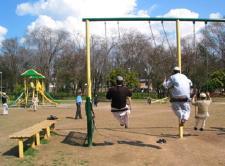
The madrassa houses a couple of thousand students ranging in age from 6 to 26, or even older. One sees them during breaks in their classes when they swarm into the playground and overrun the nearby children’s park, driving the children and women out. It is a bizarre sight to see young bearded men swinging and sliding on the swings and slides meant for children. Other contributions of these madrassa students to the community are: street signs defaced with posters soliciting sacrificial animal skins, and vandalized letterboxes.
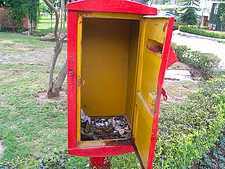
Fortunately, because of its very large girth, the Bodhi tree did not burn down completely even though it was badly damaged. It survived with half of its branches still intact. The city administration tried to preserve what was left of the tree. They even posted guards at the site for sometime after the incident to protect the tree from any further attacks. When I saw it last, a few years ago, it was still green and seemed as if it was struggling to recover from the wounds inflicted upon it.
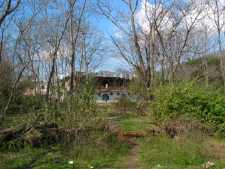
Last week, having returned to Islamabad after two years, I decided to look up the tree, as if you would look up an old friend, and see how it was doing. I was shocked. There was no tree there! Only a few logs of the decapitated tree were lying around like dead bodies. The concrete kiosk next to it was partially demolished, its remaining walls covered with graffiti, and the bench was gone. Through the woods, I could also see the madrassa, some construction work going on it. Still expanding, I guess.
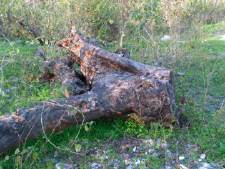
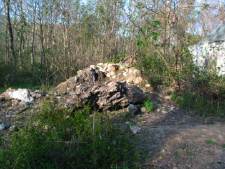
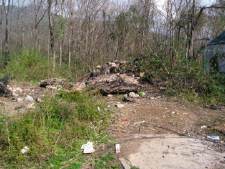
(All pictures, except the first, by the author)






Prophecy
And here is the PROOF that Abraham (AS) indeed existed.
http://en.wikipedia.org/wiki/Cave_of_the_Patriarchs
Lets see your ‘proofs’ of Budhaa and his visitation of this tree and this tree being burned by Islamists.
I will not answer to you until you show proofs. Come on………….. Show up with the proofs.
Prophecy
For that matter can you prove Budhaa existed? Do you have any ‘proof’ it was visited by Budhaa.
As your ‘faith’ tells you Budhaa existed and this alleged tree was visited by Budhaa, my faith tells me Abraham (AS) indeed exited.
And as your ‘faith’ tells you it was definitely burned by Islamists (for that you have zero evidence). I do not want to stoop to this level but I think it was burned down by liberal extremists to blame Islam!!!
As it seems to be the fashion now a days.
well, i don’t understand what kind of person will ask for a proof of ‘who actually burned the tree’ when this person takes the parable of Abraham as facts…how low people can go…just for sake of arguments? well seriously guys are all of us look so stupid to them that they are using such ‘Arguments’? or they are really so shameless?…if we really have to get a proof then first lets talk about Abraham …was there any such person…what historical evidence do we have for his existence…and specially about his acts referenced here…
The violence and hostage-taking in Islamabad by female Madrassa students is another result of the take over of the Capital by these Madrassas. The legacy of Zia ul Haq lives long and deep.
Adnan & Jabir: a match made in heaven (or should I say Paradise!). It’s great that you found each other. Victimhood and denial can breathe easy now.