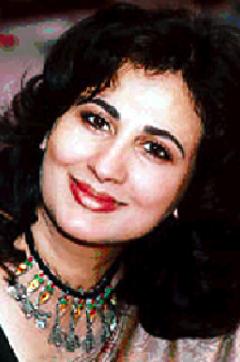
Who doesn’t know Feryal Ali Gauhar?
A novel at the top of The New York Times international bestseller list, years of television appearances and a highly publicised marriage to Jamal Shah that became fodder for countless gab sessions, have caricatured and made famous her persona. Had I not known her personally, I too may have fallen for the half-imagined tales littering the drawing rooms of socialites in this land of the pure. But I have had the pleasure of Feryal’s acquaintance for years, and not a moment of our friendship has resembled the images painted by petty gossip and lazy misinformation.
Feryal is a celebrated actor, filmmaker, journalist, activist, development worker and above all, a renowned novelist. Our recent meeting in her Zaman Park, Lahore residence took place after a long interlude. That afternoon, with the winter sun at our backs, we sat in her garden and talked with abandon while several of her cats and pet dogs meandered in and out of the plant-life; silent witnesses to our conversation and its occasional unfettered laughter.

Feryal is the youngest child of dynamic, accomplished parents. Her late mother, Khadija Gauhar, was a leading intellectual in Lahore who came to the city from South Africa after marrying her father, Sayyid was a military man from the NWFP who later retired from the army and took to farming. Her elder sister, Madiha Gauhar, is a talented theatre personality who founded the Ajoka theatre group and has managed it for over two decades. Feryal was initially associated with Ajoka as its first female actor. The sisters also have an older brother, Aamir, an industrial engineer who operates a business in alternative energy products.
As a young woman Feryal attended the Lahore American School. Her experiences there included a reaction to the school’s requirement that all students, regardless of nationality, pledge allegiance to the United States. In response to this practice, the eight year old Feryal insisted that the Pakistani national anthem be played for the entire school as well. Later, Feryal was the first Pakistani and first female to head the school’s Students Council. She was an honour role student and captain of several sports teams. Several scions of leading feudal families at Aitchison College at that time remember Feryal leading her team into the school grounds to play soccer. What they especially remember is the soccer team uniform which revealed a rather shapely pair of legs. “Some have never forgotten that sight,” she chuckles.
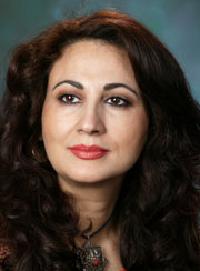 Feryal followed her college years with a brief stint at Kinnaird, where she played basketball and acted. She then studied political economy at McGill University and was trained in documentary film production in Europe and later at the University of Southern California. Upon her return to Pakistan, Feryal married artist and sculptor, Jamal Shah. In 1984 Feryal moved with Jamal to Quetta where she braved a conservatism that required her to veil herself and threatened physical harm if she appeared on television. This was not an easy phase in Feryal’s life. She explains the end of her first marriage saying, “Jamal had aspirations which did not include me.” It was Feryal’s commitment to her marriage and her politics that enabled her to cope with life in the most remote neglected part of Baluchistan. Thus, she found it ironic that her husband took the first opportunity he had to get out of the marriage “and never looked back.”
After her split from Jamal Shah, Gauhar married a successful Pakistani doctor practicing in California. Feryal divided her time in those years between America and Pakistan. Her experience in California was bittersweet, ending with her second divorce. It was in California that Feryal became a serious writer. The isolation she felt there, while painful, sparked her career. Feeling isolated in small town America, Feryal turned to writing for remedy and release. Writing at this time meant salvation. “Words, for me, are a balm. They soothe me when the anguish is too deep,” she explained in an interview given last year. In addition to her fiction work, Gauhar has been a magazine writer and newspaper columnist for twenty six years.
Referencing the characters of her novels at the 2006 Afro-Asian Writer’s Conference in Dehli, Feryal commented
I am an empty shell in whom many lives, met and unmet, live. What is autobiographical [in my work] is what comes from the personal space. Many times, I do not create the characters, they create me. I also write a political column, which is personal too. My marriage between my personal, professional and political lives is the most successful one yet.
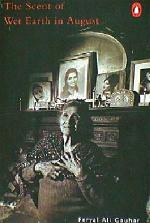 As the interview continued the light of early January waned, and our shadows stretched along Feryal’s expansive, neatly scaped lawn. Feryal passed a small plate of dried fruit and offered home brewed coffee. She shared details of her impending trip to India for the Jaipur Heritage International Festival where she was invited as a speaker alongside South Asian luminaries such as Vikram Seth, Kiran Desai and Salman Rushdie. Requests such as this are largely the result of her first novel, The Scent of Wet Earth in August, which was widely acclaimed. The work is a remarkable blend of Feryal’s filmmaking sensibilities, consciousness of the “other” and her knowledge of animal behaviour. The novel was published by Penguin in 2002 and reached fifth on The New York Times international bestseller list.
Scent is based on Feryal’s film Tibbi Galli. The work reveals the endangered lives of outcasts living in the Lahore red-light district. The choiceless-ness Feryal’s characters encounter there is woven into lucid, at times heart wrenching prose. The plot is unconventional, the mood somber. The novel centers on the protagonist, Fatima, a mute girl who falls in love with the local maulvi’s protege, and the tragedy that ensues.
Gauhar’s forthcoming book, No Space for Further Burials, is set in the wild, violent terrain of contemporary Afghanistan and concerns the socio-political situation there. No Space explores the deaths suffered by Afghans and Americans. Captivated by the subject matter, she penned the book in several weeks. Before 2001, No Space was intended to be a film script. It was inspired by both the fallout of the 1989 Soviet pullout from Afghanistan and the three year war between the Serbians and Bosnians that began in 1992. The 2001 World Trade Tower attacks and their impact on Afghanistan added another dimension to the novel.
No Space is the diary of a US Army medical technician incarcerated by warlords in a mental hospital in Afghanistan. “I wanted to reverse the experience of looking at America through my eyes. I wanted Afghanistan to be seen through an American’s eyes,” the author explains. No Space for Further Burials will be released by Women Unlimited Press in March. A French publisher has purchased its rights and translations are underway in Dari, Pushto and Spanish. Finally, the work is being translated to film. Gauhar recently returned from a writer’s residency at Sanskriti Kendra, near Delhi, where she has been writing the screenplay. She hopes to go into production by the end of the year.
In addition to her novels and plays, Feryal has produced several works of non-fiction. Several years ago she completed a documentary simply titled, Pakistan Poverty Assessment. The work was the result of research from 54 districts and concerned the poor’s perception of their poverty. It underscored the need for land redistribution in the country. Almost immediately after its release the Prime Minister announced that there would be no further land reform in the country. Feryal remained undaunted. “My task was to get the message across through the voices of the poor, and I did it and it was heard quite clearly,” she comments.
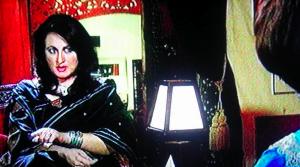 In Lahore, Gauhar scorns the rapid consumerism draining the soul of the city. She is also critical of the senseless tree-cutting binge. In recent months, Feryal has been a hyper-active member of the Lahore Bachao Tehreek, under the aegis of the Lahore Conservation Society and members of civil society at large. She is optimistic about the group. She discusses a senior provincial bureaucrat she admires named Suleman Ghani who is currently conserving and developing the Walled City. Feryal praises Ghani but is cautious about the possible gentrification of an area which, as she says in the introduction of her film, Tibbi Galli, is where “dreams are spun during the day, and sadness sung at night.”
Feryal plans to extend her commitment to environmental preservation by registering for the PhD programme in Conservation Management at the National College of Arts, Lahore. In the future, the writer would like to work on conservation issues full time, and she would like to create a national trust modeled after the Indian National Trust for Art and Cultural Heritage. Here her goal is to, “develop a new paradigm for development which respects cultural identities and the natural environment while enhancing the quality of life on this planet.”
A loner by nature, Feryal can be extremely gregarious when the occasion arises. Such dynamism makes her an enigma for those who have not met her personally. Feryal is not a high profile scandal seeker. She shuns vacuous social scenes, preferring to spend time with her beloved pet dogs and ‘underdogs.’ An animal rights activist, Feryal cares for an astounding eighteen cats, seven dogs, three goats, and one donkey. Most of these animals were stray or rescued from animal cruelty. “ I would much rather talk to my donkey, Sanober, than feign interest in the lives of women of means, who are often merely mean women,” she declares curtly. Despite her low profile lifestyle, in recent years the news media has linked Feryal to powerful figures throughout the country. “This is simply not the case,” she insists. “We live in a country that thrives on mediocrity and the ludicrous. All such rumours have to be understood as a manifestation of boredom in people’s lives,” she says, laughing uproariously.
Feryal’s second novel is due for release this month. The accompanying screenplay is underway, and her film, Tibbi Galli, will be showcased at the Rome International Film Festival later this year. Feryal is at a landmark moment in her life. These achievements and her acceptance by the world community is no small feat given the often virulent xenophobia aimed at Pakistan from abroad, complemented by misrepresentations about this place and its people. Such news may seal the lips of national and international gossip fiends alike. Let us hope that it inspires them to emulate Feryal and adopt more constructive endeavors.
Raza Rumi is an international development professional and an avid literati. He also writes for The Friday Times and blogs at Jahane Rumi; an earlier version of this was carried at both TFT and his blog.




Tarar sahab, absolutely right on. TV drama these days is not even a shadow of what it used to be until early 90s. Most of those actors, Shakeel, Firdous Jamal, Abid Ali, Shafee Mohammad, Uzma Gilani and co. are still working but they have joined the comercial bandwagon thanks to the advent of the “Mega Soap” culture. The only thing mega about them is that they are mega stupid! Perhaps ATP would be kind enough to go down memory lane and do a nice post about those great dramas from the yesteryears, Waris, Uncle Urfi, Andhera Ujaala, I for one grew up on those dramas! Those were the days man!
WoW thx for the nice Article Rumi :).Faryal is definitely one of the most creative women of our country and rather cute too (Had a Major Crush on her in School Life lol :D).Btw More Articles like this one would be appreciated!
also, it’d be very nice if we could have more posts like this one.
our drama has gone down the toilet and most of the professoional/real/talented actors and actresses have stopped acting. so, if we could pay tribute to them by remembering them, I’m sure it would mean a lot to many people – or at least it does to me.
wow.. what a nice surprise. thanks Raza.
Faryal is one of my favourite actresses. just the other day I was watching Chand Girhan and admiring her phenomenal performance. it’s good to know that she’s going strong as one of the premier artists of Pakistan.
btw, how can one get a hold of “Tibbi Galli” and “Zar Gul” if one wanted to? does anyone know? thanks.
Great insight on the lady. I remember I admired her greatly after the famous drama serial called Chand Girhan. It wasn’t a crush or anything.
I never knew she was an accomplished writer either, thank you Rumi Sahab. Just curious, are you one of the Aitchisonians who remember those shapely legs :D ?