Adil Najam
This picture is carried today by both Dawn and Daily Times. Dawn’s title is “Still Heroes” and the caption reads: “Bronze statues of Quaid-i-Azam, Sir Syed Ahmed Khan and Allama Iqbal put on display at the Science and Technology Expo-2007 being held at National Memorial Museum in Shakarparian in Islamabad.”
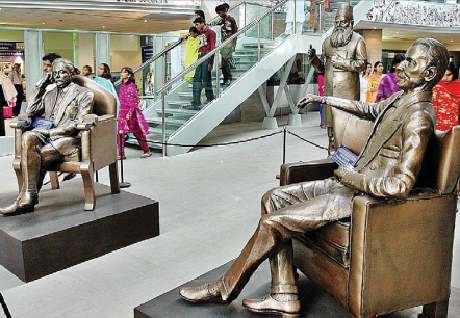
A visit to the Museum is on the top of my ‘To Do’ list when I return to Islamabad end of the month. I hope they are still there.
My first thought on looking at the picture was to note how both Jinnah and Iqbal are wearing suits here (this penchant of ours – me included – to dress up these guys in the garbs of our desires has been has been quite a remarkable historical see-saw!). My second thought was to wonder what the folks at Lal Masjid and Jamia Hafsa might have to say – or do – about this. I hope there is significant security against vandalism here.
But even more than that, I wonder what these three men are sitting there thinking about what is happening today in the country they helped conceive. Late at night when the museum is closed and the statues come alive and walk about, what is it that they sit together and talk about?




Tina, Saad and others – I was going to keep silent on this front, but since you asked an Indian reader to weigh in, I’ll post my 2 cents.
First off, things are complex, please dont expect an easy to grasp scenario. Two, my visibility is only into South India. Finally, of all the riots Saad mentions, I am familiar with only 2/3!
Muslim situation: A cursory look at Indian cities will tell you that there are a few pretty rich Muslims (who control the politics of the community),a few middle class due to historic urban roots or Gulf workers, and the rest mostly poor. The rural scenario is not as visible, as they are more integrated into the age-old fabric and doing just as well or bad as people in their broader caste may be expected to do. So yes, on many developmental indicators (and this goes beyond just money/jobs) they are not doing well.
But to claim they are doing worse than Dalits is to sensationalize news I believe. For one, leaving out UP/Bihar, Dalits dont get the same amount of attention to really know how their lot is doing. I have rural roots, and hence know from experience, the situation of Dalits in villages. They are the bottom, although things have improved quite a bit in just the last 20 years. A political consciousness has developed, some of their progeny moves to towns and then to cities for education. And overt discrimination of yesteryears is gone (keep in mind this is a south Indian village, which I ‘think’ may be very different from the North).
So, for a layman observing, like me, it is not visually or anecdotally apparent that Muslims are doing worse than Dalits.
One disadvantage Muslims have is that Dalits dont have to fight off deep-rooted or institutionalized archaic own-community or religious injuncitons that hold them back. This to me explains partly why Dalits are improving, in spite of being rooted in the villages, where access to opportunity is much less than in urban areas. While Muslims, even being from cities, are not showing faster progress.
Riots: Saad is right in that Gujarat was not the first large scale killing. There were many before, even going to pre-1947. But Gujarat is still different. It is the first (leaving out 1984 Delhi riots, cos that involved Sikhs and not Muslims) when a state govt actually supported and carried out a pogrom. This to me is vastly different from earlier riots, where the worst accusation would be official indifference and bias within police against Muslims. I’ve lived through communal riots in Hyderabad and know a bit about them.
If they weren’t engineered by Cong governments for some silly electoral/political purpose, mostly, some incident or the other (in Meerut 87, for ex, Rajiv Gandhi opening locks on Babri Masjid to allow Hindu priests perform prayer) that would lead to rioting (in Meerut there was massive rioting and destruction by irate Muslims), leading to a calling in of the police (who are totally distrusted by Muslims, in return viewed as troublemakers by the Police), Hindu mob retaliation with help/indifference from Police. But often, riots will stop once the Army is called in. Regardless of the numbers that die, I view this as different from Gujarat.
A word about the Nellie massacre 1983. This incident was all about native Assamese butchering Bangladeshi Muslim immigrants. There was a widespread AASU led movement in the early 80s, by Assamese protesting Bengali illegal immigration from B’desh. This is a very touchy topic in Assam. While the killed may have been Muslims and some Indian Muslims, one has to see this more as Bangladeshis being attacked. To see this as a Muslim massacre is to indiscriminately use the prism of ‘Hindus are out to get Muslims’.
The 93 Bombay riots, etc, I suspect everybody knows enough. The rest of the riots are only barely known to me.
Three bronze statues started a riot in Blogistan that spread to Qadianis, Indian Muslims, Freemasons and the West.
There are reports that the unrest will soon spread to the Presidency of Pakistan and Lal Masjid. The reporter has learned from reliable sources that it is a Jewish conspiracy designed to malign the respected status of Pakistan in the world as a peace loving and law abiding nation.
“People in Blogistan have a tendency to be passionate about their political views and go out of their way to express them in every post whether it is relevant or not” stated an observer when asked about the situation.
“This is exactly why statues are banned in Islam. Government should have known that the statues will only lead to blood” expressed a pious looking bearded man on the street.
And uploaded the Samachar report for those who want to give it a read.
I didn’t do any comparisons, just mentioned the fact that Gujrat was not a one off incident.
Saad, what are you comparing the situation in India with? Are you saying situation in Pakistan is much better?