S.A.J Shirazi
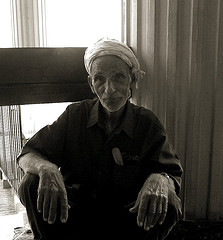 In some way sweeper Ashiq Mang knows so much more about life that anybody else does, about grief, about happiness, about pretense and falseness of life. There is nothing in his own life, which he would like to hide or not talk about.
Ashiq has been working at our home for two years. My friendship with him developed when brought me laddoos on the birth of his son. It was a very pleasant surprise though later my wife and children hesitated to share the sweets with me. I offered him a cup of tea over which he started talking and gave me the chronological narrative of the life, experience and reminiscences. Then we used to talk whenever got chance to meet on holidays mostly, when he was late doing his job at our place or I came home early. He may not be a good communicator, but has definitely enriched my vision. He is so candid and honest about every thing.
Happily married to a working woman for last 18 years, Ashiq has six daughters and a son. He has his own home consists of one room, verandah, bathroom and kitchenette where he lives with his family. His wife also works as a cleaning lady besides giving birth to and rearing children. He told me about the tube legation of his wife, her miscarriages and death of their first daughter and how they have had so many children for want of a son, whom he wants to educate.
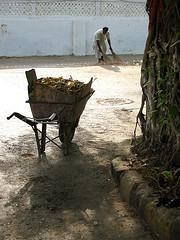 At one point early in our friendship he started narrating his observation of the job.
“Every body is fixated only on keeping their house clean, oblivious of any thing beyond their four walls. It take four hours to clean that big bungalow whereas they pay me only for two hours. I work in six houses and they all want to get their house to be cleaned first. They have so many guests every day. They do not buy brooms and wipers in time. They litter the house thoughtlessly. Most of the educated women of wealthy families have neither time nor desire to keep their houses clean. Most surprising is that no body pay in time.”
“There is no love in that house,” he once told me about one of his employers, “no body talks to each other. Even the kids do not talk or laugh. Every one in the house is locked into a shell. It seems as people from different families are staying in a hostel. It is suffocating to work what to talk of living in their house.”
Then he told me about another superstitious character who would wash his furniture items like tables and sofas, pens, shoes frequently and his hands every time he would shake them with another human being. Ashiq said simply:
“Sahib thinks that not only the air is polluted but every thing is contaminated with lethal germs.”
Incisive analyses by a person who cannot read or write contain spontaneous and honest reflections of our society it seems.
After having completed 15 years of colored service in armed forces he is reemployed by a national company where he works from early morning till noon in addition to working at different houses. His wife also works at different houses. Remembering the period spent in the service he says:
“It was the best time of my life. I was young. I used to clean single men’s barracks meticulously and all service men used to look after me affectionately. There used to be Christmas greetings and gifts for me. Life was so orderly, organized and happy.”
He narrated an incident happily:
“During my days in service our company was given a quiz with a question: What is the name of the person who cleans your barracks? They had seen me cleaning the barracks several times, but most of the young soldiers did not know my name and in their paper left the last question blank. Before the day ended, every soldier knew my name. The problem with the present employer is that no body seems to bother about my name and the company deducts pay if I do not go to work even for a single day for any reasons.”
Ashiq Mang is leading a comfortable life in his pensions, pay and some additional amount he and his wife get by working at the houses.
“Wealth has nothing to do with happiness,” he once explained to me philosophically, “in my life I have seen people with lot of money living miserably miserly and unhappy.”
Proud of his job to contribute in making the world a little cleaner place to live in, Ashiq loves his life, wife and children. At the age of 47 years he says that he has never fallen sick despite of hard worked and always busy hours. He dreams a lot and is looking forward to his retirement, for the second time, when he will have all the time to play with his son.
Ashiq as I know is kind trusting and warm, willing to share his joys and sorrows, openly and freely. The only regret he says a little wistfully is that:
“People treat us discriminately due to our job. We are denied our basic cultural and social rights. We have to have our own utensils in order eat or drink at any house, in case they offer something. We are also human beings with emotions, passions and all”.
Credits: Photos for this article are taken from flickr.com and they are NOT of Ashiq Mang. The photos show people in similar jobs as Ashiq Mang.






Thanks for making it so relatable.
Subscribed instantly after reading this.
It is not that the Ashiq Mangs of Pakistan are cause of the problems.
The problem is of the ignorant educated Pakistanis who continue to rob the resources and continue to blame the poor.
One factor that no one wants to discuss while chatting about population growth is the infant / child mortality in poor communities due to lack of health. In a way, more children is trying to beat the odds of life and lineage.
If there is a proper distribution of resources and health clinics all over, this will change. Jagan Nath had the right idea.
BTW, “Ashiq Masih” worked “with” us. He was a few years older than I was. We played together too; wrestling, joshing, cricket, bike race and all. I used to call him, “Ishiq Masih”. Shy and one with few words. But always honest to core for both work and property.
My mother treated him the same as all of us. Meals, clothing and all. I taught him how to write his name, etc. He learned how to drive a car with us. And when he grew older, my father arranged for him to work at the municipality, LMC. From there he went on to rent a richshaw. Then bought one, then two, then three. And then went on to buy a few taxis’. For a short while, his wife worked “with” us until he determined that she no longer had to work.
I have since then lost track of him. Hope to run into him one day and catch up on days gone by.
Last I know of him, he and his family were no longer doing what their parents did! So, yes, they broke the mold and created a new cycle of life.
Ashiq Masih has always been a good example in my books for a good, hardworking, honest Pakistani, who paid his dues in his life and became successful.
@ Tina
Couple of years ago I visited a local clinic in New Castle, Australia. While in the waiting room, I could hear the conversation between a group of women. One woman with two children saying “… if your first child is a boy, the pressure is off, else you have to …” All other women sitting there fully agreed.
While in some societies families will content after two or three girls, in our society it keeps going…
I would be cautious about thinking too highly of Ashiq Mang–after all he has had seven children in order to get one son, whom he hopes to educate….meaning he will not educate the six girls he has, they will end up illiterate like their parents. What will become of them? They will be married to laborers, themselves trapped in the cycle of having as many children as necessary to secure the desired sons. In this way the Ashiq Mangs of Pakistan continue to aggravate two of the country’s main problems, growing overpopulation and lack of empowerment for women. As we can see from his example they are related issues. If he had bothered to send the girls to school, they would not have seven or eight children themselves. But they seem to be far less important to him than his son.
I had a friend who always told her male servants in blunt, plain language that they ought to get a vasectomy after their second child regardless of gender. She lacked something in diplomacy skills but I think her idea was correct. It was funny, she always managed to shock people. But she was a doctor and it was a subject that was very important to her.