S.A.J Shirazi
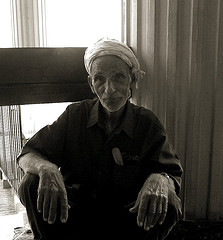 In some way sweeper Ashiq Mang knows so much more about life that anybody else does, about grief, about happiness, about pretense and falseness of life. There is nothing in his own life, which he would like to hide or not talk about.
Ashiq has been working at our home for two years. My friendship with him developed when brought me laddoos on the birth of his son. It was a very pleasant surprise though later my wife and children hesitated to share the sweets with me. I offered him a cup of tea over which he started talking and gave me the chronological narrative of the life, experience and reminiscences. Then we used to talk whenever got chance to meet on holidays mostly, when he was late doing his job at our place or I came home early. He may not be a good communicator, but has definitely enriched my vision. He is so candid and honest about every thing.
Happily married to a working woman for last 18 years, Ashiq has six daughters and a son. He has his own home consists of one room, verandah, bathroom and kitchenette where he lives with his family. His wife also works as a cleaning lady besides giving birth to and rearing children. He told me about the tube legation of his wife, her miscarriages and death of their first daughter and how they have had so many children for want of a son, whom he wants to educate.
 At one point early in our friendship he started narrating his observation of the job.
“Every body is fixated only on keeping their house clean, oblivious of any thing beyond their four walls. It take four hours to clean that big bungalow whereas they pay me only for two hours. I work in six houses and they all want to get their house to be cleaned first. They have so many guests every day. They do not buy brooms and wipers in time. They litter the house thoughtlessly. Most of the educated women of wealthy families have neither time nor desire to keep their houses clean. Most surprising is that no body pay in time.”
“There is no love in that house,” he once told me about one of his employers, “no body talks to each other. Even the kids do not talk or laugh. Every one in the house is locked into a shell. It seems as people from different families are staying in a hostel. It is suffocating to work what to talk of living in their house.”
Then he told me about another superstitious character who would wash his furniture items like tables and sofas, pens, shoes frequently and his hands every time he would shake them with another human being. Ashiq said simply:
“Sahib thinks that not only the air is polluted but every thing is contaminated with lethal germs.”
Incisive analyses by a person who cannot read or write contain spontaneous and honest reflections of our society it seems.
After having completed 15 years of colored service in armed forces he is reemployed by a national company where he works from early morning till noon in addition to working at different houses. His wife also works at different houses. Remembering the period spent in the service he says:
“It was the best time of my life. I was young. I used to clean single men’s barracks meticulously and all service men used to look after me affectionately. There used to be Christmas greetings and gifts for me. Life was so orderly, organized and happy.”
He narrated an incident happily:
“During my days in service our company was given a quiz with a question: What is the name of the person who cleans your barracks? They had seen me cleaning the barracks several times, but most of the young soldiers did not know my name and in their paper left the last question blank. Before the day ended, every soldier knew my name. The problem with the present employer is that no body seems to bother about my name and the company deducts pay if I do not go to work even for a single day for any reasons.”
Ashiq Mang is leading a comfortable life in his pensions, pay and some additional amount he and his wife get by working at the houses.
“Wealth has nothing to do with happiness,” he once explained to me philosophically, “in my life I have seen people with lot of money living miserably miserly and unhappy.”
Proud of his job to contribute in making the world a little cleaner place to live in, Ashiq loves his life, wife and children. At the age of 47 years he says that he has never fallen sick despite of hard worked and always busy hours. He dreams a lot and is looking forward to his retirement, for the second time, when he will have all the time to play with his son.
Ashiq as I know is kind trusting and warm, willing to share his joys and sorrows, openly and freely. The only regret he says a little wistfully is that:
“People treat us discriminately due to our job. We are denied our basic cultural and social rights. We have to have our own utensils in order eat or drink at any house, in case they offer something. We are also human beings with emotions, passions and all”.
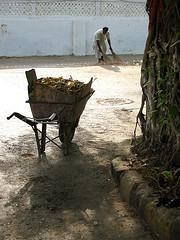
Credits: Photos for this article are taken from flickr.com and they are NOT of Ashiq Mang. The photos show people in similar jobs as Ashiq Mang.





Dear A. , to the best of my understanding, the (unsaid) issue here was not that the poor guy had to bring his own utensils because he was a servant, but because (and this is an assumption on my part based on his last name) he was not muslim. This person is not your typical house servant; he is described as a sweeper. From my experiences in Pakistan, sweepers are usually Christians or Hindus because it is regardless as a “naa paak kaam” for us sqeeky clean muslims.
I have a few questions about this post – while I agree that the way in which we treat poor people or house servants is usually extremely discriminatory and without compassion, I wonder about hygeine & literacy issues.
It is a fact that viruses like hepatitis are very easily transmitted between family members and servants and family members. The govt ran a poster-campaign a few years ago, picturing a family and its servants and illustrating how one carrier can infect the whole bunch… I am sure that fed a lot more discrimination and entrenched the separate-utensils view, notwithstanding the fact that the same families are happy for their servants to do everything else, from washing dishes and cooking, to making beds and doing laundry for them, personal germs and all. I am not interested in espousing such hypocrisies, and instead want to ask a genuine question: what about hygeine and health? What are the guidelines?
It is also a fact that it takes a long time to train house help enough that they not only accept but also understand and believe what you tell them about proper hygeine. (Illiteracy does not help, there.) If you actually spend time on a daily basis interacting with house help (smth which many women in Pakistan do) you quickly despair of the myriad issues involved in educating and helping them. It becomes expedient to give them a little money when they need it for medicine and otherwise keep a physical, emotional and mental distance from them…*not for lack of trying it the other way too*. I know of many relatives who have tried to initiate home-schooling for their house-help, who share their utensils and such with them. But it often feels like not even a dent is made…because the workers leave and new ones arrive, because the energy required is exhausting when you’ve got an entire household to manage, cooking to do, children to take care of, dry cleaning to keep track of, etc etc.
Though these issues may sound mundane, I assure you my purpose here is not to present closed-minded objections to the point of the post. I would rather have a truly honest dialogue about these issues, both to learn and to air some of the hidden concerns that people have in this regard (no matter how embarrassing). Also, I am genuinely interested in learning what ATP’s largely-male dominated group of thinkers has to say about it.
I can understand that people don’t respect servant as a human being because of our jagir-darana system even in cities, where educated people reside but if these people, who work as servants, don’t consider themselves or believe that they deserve to be respected and noticed then who will. I heard from people in US that if you don’t know your right then you don’t have any. If you don’t stand up for yourself then stop complaining that people will give you a chance in this material world – no matter where you live. I hate when organizations and NGOs take advantage of this harsh reality. According to Quran, if you dont do something to change your status then even GOD won’t help(mafhoome/moral)
Oops. My bad. Thanks for the clarification.
AH, the photos are not of Ashiq Mang. They are of people doing similar jobs.