Custom Search

August 11: Jinnah’s Vision for Pakistan

Posted on August 11, 2007
Filed Under >Yasser Latif Hamdani, History, People, Politics, Religion, Society
160 Comments
Total Views: 19618

Guest Post by Yasser Latif Hamdani
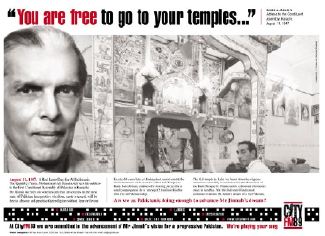
Today being 11th August Day has a great significance in Pakistan’s history.

60 years ago, Mr. Jinnah, Pakistan’s undisputed Quaid-e-Azam, Governor General and elected President of the Constituent Assembly elaborated his vision for the future of Pakistan.

Jinnah’s vision is unambiguous.

1. The state would be completely impartial to religion of the individual.
2. The state where every citizen would be equal and there would be no distinction between citizen on the basis of faith or caste or creed.

A lot of controverey has emerged about this speech. Any student of political science would tell you that is the classic exposition of a modern secular democratic state. However, the issue of whether this constitutes a “secular” state or an “Islamic” state is besides the point. A rose by any name is after all a rose.

Here is what Mr. Jinnah said on that fateful day. It is worth reading in the full:

I know there are people who do not quite agree with the division of India and the partition of the Punjab and Bengal. Much has been said against it, but now that it has been accepted, it is the duty of every one of us to loyally abide by it and honourably act according to the agreement which is now final and binding on all. But you must remember, as I have said, that this mighty revolution that has taken place is unprecedented. One can quite understand the feeling the exists between the two communities wherever one community is in majority and the other is in minority. But the question is whether it was possible or practicable to act otherwise than has been done. A division had to take place. On both sides, in Hindustan and Pakistan, there are sections of people who may not agree with it, who may not like it, but in my judgment there was no other solution and I am sure future history will record its verdict in favour of it. And what is more it will be proved by actual experience as we go on that that was the only solution of India’s constitutional problem. Any idea of a United India could never have worked and in my judgment it would have led us to terrific disaster. May be that view is correct ; may be it is not; that remains to be seen. All the same, in this division it was impossible to avoid the question of minorities being in one Dominion or the other. Now that was unavoidable. There is no other solution. Now what shall we do? Now, if we want to make this great State of Pakistan happy and prosperous we should wholly and solely concentrate on the well-being of the people, and especially of the masses and the poor. If you will work in co-operation, forgetting the past, burying the hatchet you are bound to succeed. If you change your past and work together in a spirit that every one of you, no matter to what community he belongs, no matter what relations he had with you in the past, no matter what is his colour, caste or creed, is first, second and last a citizen of this State with equal rights, privileges and obligations, there will be no end to the progress you will make.

I cannot emphasize it too much. We should begin to work in that spirit and in course of time all these angularities of the majority and minority communities the Hindu community and the Muslim community-because even as regards Muslims you have Pathans, Punjabies, Shias, Sunnis and so on and among the Hindus you have Brahmins, Vashnvas, Khatris, also Bengalis, Madrasis, and so on-will vanish. Indeed if you ask me this has been the biggest hindrance in the way of India to attain the freedom and independence and but for this we would have been free peoples long long ago. No power can hold another nation, and specially a nation of 400 million souls in subjection ; nobody could have conquered you, and even if it had happened, nobody could have continued its hold on you for any length of time but for this. Therefore we must learn a lesson from this. You are free ; you are free to go to your temples, you are free to go to your mosques or to any other places of worship in this State of Pakistan. You may belong to any religion or caste or creed-that has nothing to do with the business of the State. As you know, history shows that in England conditions some time ago were much worse than those prevailing in India today. The Roman Catholics and the Protestants persecuted each other. Even now there are some State in existence where there are discriminations made and bars imposed against a particular class. Thank God we are not starting in those days. We are starting in the days when there is no discrimination, no distinction between one community and another, no discrimination between one caste or creed and another. We are starting with this fundamental principle that we are all citizens and equal citizens of one state. The people of England in course of time had to face the realities of the situation and had to discharge the responsibilities and burdens placed upon them by the Government of their country and they went through that fire step by step. Today you might say with justice that Roman Catholic and Protestants do not exists ; what exists now is that every man is a citizen, an equal citizen, of Great Britain and they are all members of the Nation.

Now, I think we should keep that in front of us as our ideal and you will find that in course of time Hindus would cease to be Hindus and Muslims would cease to be Muslims, not in the religious sense, because that is the personal faith of each individual, but in the political sense as citizens of the State.

Many have alleged that this was the only time he expressed such a vision. Unfortunately, these people are not very well versed with the life and work of Quaid-e-Azam Mahomed Ali Jinnah, who was after all a staunch secular Indian nationalist for most of his life and had turned to the Pakistan idea only after exhausting all the options for a United India.
Here are some of his other statements regarding what kind of Pakistan he wanted:
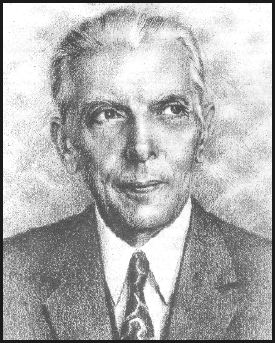
Jinnah Quaid Pakistan25th October 1947. Interview with Reuters’ Duncan Hooper note: not to be confused with his interview with Reuters’ Doon Campbell which has been quoted in detail else where.

Minorities DO NOT cease to be citizens. Minorities living in Pakistan or Hindustan do not cease to be citizens of their respective states by virtue of their belonging to particular faith, religion or race. I have repeatedly made it clear, especially in my opening speech to the constituent Assembley, that the minorities in Pakistan would be treated as our citizens and will enjoy all the rights as any other community. Pakistan SHALL pursue this policy and do all it can to create a sense of security and confidence in the Non-Muslim minorities of Pakistan. We do not prescribe any school boy tests for their loyalty. We shall not say to any Hindu citizen of Pakistan ‘if there was war would you shoot a Hindu?’

30th October 1947. To a Mass Rally at University Stadium Lahore.

The tenets of Islam enjoin on every Musalman to give protection to his neighbours and to the Minorities regardless of caste and creed. We must make it a matter of our honor and prestige to create sense of security amongst them.

Same Day. On Radio Pakistan.

Protection of Minorities is a sacred undertaking. (On Partition Massacres) Humanity cries out loud against this shameful conduct and deeds. The civilized world is looking upon these doings and happenings with horror and the fair name of the communities concerned stands blackened. Put an end to this ruthlessly and with an Iron hand.

9th January 1948. Tour of Riot affected areas of Karachi.

Muslims! Protect your Hindu Neighbours. Cooperate with the Government and the officials in protecting your Hindu Neighbours against these lawless elements, fifth columnists and cliques. Pakistan must be governed through the properly constituted Government and not by cliques or fifth columnists or Mobs.

25th January. Address to the Karachi Bar association on the occasion of Eid Milad un Nabi.

I would like to tell those who are misled by propaganda that not only the Muslims but Non Muslims have nothing to fear. Islam and its idealism have taught us democracy. Islam has taught Equality, Justice and fairplay to everybody. What reason is there for anyone to fear. Democracy, equality, freedom on the highest sense of integrity and on the basis of fairplay and justice for everyone. Let us make the constitution of Pakistan. We will make it and we will show it to the world.

3rd February 1948. Address to the Parsi Community of Sindh.

I assure you Pakistan means to stand by its oft repeated promises of according equal rights to all its nationals irrespective of their caste or creed. Pakistan which symbolizes the aspirations of a nation that found it self to be a minority in the Indian subcontinent cannot be UNMINDFUL of minorities within its own borders. It is a pity that the fairname of Karachi was sullied by the sudden outburst of communal frenzy last month and I can’t find words strong enough to condemn the action of those who are responsible.

21st March 1948. Mass Rally at Dacca.

Let me take this opportunity of repeating what I have already said: We shall treat the minorities in Pakistan fairly and justly. We shall maintain peace, law and order and protect and safeguard every citizen of Pakistan without any distinction of caste, creed or community.

22nd March 1948. Meeting with Hindu Legislators.

We guarantee equal rights to all citizens of Pakistan. Hindus should in spirit and action wholeheartedly co-operate with the Government and its various branches as Pakistanis.

23rd March 1948. Meeting with the ‘Scheduled Caste Federation’.

We stand by our declarations that members of every community will be treated as citizens of Pakistan with equal rights and privileges and obligations and that Minorities will be safeguarded and protected.

13 June 1948. Speaking to Quetta Parsis.

Although you have not struck the note of your needs and requirements as a community but it is the policy of my Government and myself that every member of every community irrespective of caste color, creed or race shall be fully protected with regard to his life, property and honor. I reiterate to you that you like all minorities will be treated as equal citizens with your rights and obligations provided you are loyal to Pakistan.

Jinnah’s address to the people of the US in Feb 1948.

In any case Pakistan is not going to be a theocratic State — to be ruled by priests with a divine mission. We have many non- Muslims — Hindus, Christians, and Parsis — but they are all Pakistanis. They will enjoy the same rights and privileges as any other citizens and will play their rightful part in the affairs of Pakistan.

So what did Jinnah stand for?

He stood for justice and fair play for every one regardless of religion caste or creed. Let us make a solemn promise to ourselves on this 11th August Day (or the day I like to call Jinnah’s Pakistan Day) that we shall honor this vision of Pakistan as a pluralist, inclusive and progressive democratic state.

160 comments posted

Comment Pages: « 2016 15 14 13 [12] 11 10 9 81 »

  1. August 13th, 2007 1:12 pm

    “I had in mind the historical aspect– when that pledge of allegiance was formed, I doubt they had Ram or Allah in mind.”

    Forgot to add the present day part: most people still associate that God line with something Biblical. Yes, yes, I agree that it can be reinterpreted to your own god, etc. But I do remember that when I was young and reciting the pledge of the allegiance, I didn’t think of it as something that could be Hindu or whatever.

    And Ahsan:

    “According to the title “ August 11: Jinnah’s Vision for Pakistan », of the post we are entitled to discuss ANY vision of Mr. Jinnah concerning Pakistan. The forum is a public forum and it is neither a scientific conference nor a legal battle.”

    Didn’t initially see this part, but I would like to say thank you.

  2. August 13th, 2007 1:07 pm

    Pervaiz:

    “I wish that same could be said about one of your country-woman’s comments here.”

    Save it. First off, I am not an Indian straight out of India, but an Indian American. And second of all, none of us represent any given country, not any more than you all commentators do for Pakistan. Thirdly, tell me where I have been inaccurate or off the mark with any of my comments. The writer of the post quotes parts of a speech that speak of Partition. I spoke about Partition. Where on earth was I assessing the wrongs or rights of Partition? I was simply giving my two cents.

    I agree that Debu’s remarks on are the spot. But there are some readers and writers here who have an uncanny way of hurling insults and snide comments when they read something that they misinterpret/don’t agree with. And I take issue with you saying, “I wish your countrywoman” said the same thing. Would you like it if I took issue with what you said, thought of you speaking for an entire nation, and then said to another commentator here, “I wish your countryman Pervez/LHF, etc” thought like you?

    “Not true. Non-Christians do not do that. Even some Christians do not do that. The lone Muslam in US Congress took his oath on a copy of Quran initially belonging to Thomas Jefferson.”

    You are missing the point. The context of my comment was that even if a country is nominally “secular,” there are still traditions (for lack of a better word) based on religion that seep into daily life and practices. Show me how I am wrong with this– the “founding fathers” didn’t say, “Ok, if you are a Muslim, you can use the Koran for oaths.” This is a result of people asking/requesting, preferring to do otherwise. It doesn’t take away from the fact that initially it was the Bible, and predominantly still is.

    “Again not true. The pledge of allegiance says God and does not necessarily imply “Judeo-Christian” God. Plus Christians believe in “trinity” and Jews like Muslams do not.”

    See my response above. I had in mind the historical aspect– when that pledge of allegiance was formed, I doubt they had Ram or Allah in mind. You cannot pretend that the US’ legal system and political cultures have not been influenced by the predominant religion of people who set up this country. Much is to be said that the US does not have an official state religion, but to assert that religion and the prevelence of one religion have no influence in the US is inaccurate. And furthermore, religion has been evident in places that I believe shouldn’t be. Why are there opening prayers in Congress? People took issue with the fact that some Christian fundies got upset that a Hindu Swami led prayers and said, “Why can’t a Hindu do it to?” I personally don’t care whether he was Hindu not, I am bothered by the fact that there are prayers of any kind to begin with in a political/civic place.

    ***
    NZ:

    “but there is some very serious confusion in many comments here about the meaning of secularism. Secularism is NOT anti-religion. Secularism is about religion (any religion, Islam, Christianity, Hinduism, whatever) not affecting matters of state.”

    I personally do not associate secularism with “anti religion,” though I am curious as to how you define this. I tend to think of “secularism” and being “areligious:” everyone is free to do whatever they want, but no religion 1) is the official state religion; 2) is privileged and 3) influences (to the best of the statespeople’s abilities) civil laws, codes, etc.

    ***

    Ahsan:

    “I consider it to be unjust to treat a reader LUNATIC when he poses a question on this subject.”

    Thank you!

    Your comment was refreshing. I wish the same could be said about some of the comments of your countrymen. [close sarcasm tags]

  3. atif2 says:
    August 13th, 2007 12:24 pm

    Now we must admit that either Jinnah was drunk or under duress when he uttered these words, or that he really wanted Sharia in Pakistan. In either case, we MUST stop firing our secular guns from the shoulders of Jinnah. If we want secularism, lets fight for it, but lets not vandalize Jinnah’s legacy in the process.

    Exhibit A
    1- “Every Musalmaan, except those who are ignorant, knows that the Quran is the general code of the Muslims. A religious, social, civil, commercial, military, judicial, criminal, penal code, it regulates everything from the ceremonies of religion to those of daily life; from the salvation of the soul to the health of the body; from the rights of all to those of each individual; from morality to crime, from punishment here to that in the life to come. Therefore Islam is not merely confined to the spiritual tenets and doctrines or rituals and ceremonies. It is a complete code regulating the whole Muslim society, every department of life, collective[ly] and individually.”
    - Jinnah , Eid message on September 1945

    Exhibit B
    It is my belief that our salvation lies in following the golden rules of conduct set for us by our great lawgiver, the Prophet of Islam. Let us lay the foundations of our democracy on the basis of true Islamic ideals and principles
    - Jinnah(Civil, Naval, Military and Air Force Officers at Khaliqdina Hall Karachi on 11th October 1947)

    Exhibit C
    What is it that keeps the Muslims united as one man, and what is the bedrock and sheet-anchor of the community. It is Islam. It is the Great Book, Quran, that is the sheet-anchor of Muslim India. I am sure that as we go on there will be more and more of oneness, one God, one Book, one Prophet and one Nation
    - Jinnah (All-India Muslim League, Karachi on 26th December)

  4. Ahsan says:
    August 13th, 2007 12:14 pm

    According to the title “ August 11: Jinnah’s Vision for Pakistan », of the post we are entitled to discuss ANY vision of Mr. Jinnah concerning Pakistan. The forum is a public forum and it is neither a scientific conference nor a legal battle.
    The writer has presented a part of Jinnah’s vision and he considers them to be true and would like the readers to adhere to his point of view.

    Any religion is based on Belief. To believe in Some-thing is not the proof of its existence. That is why the word Belief is defined as a “doubtful reality”. The truth of the belief is only limited to the Believer. This truth can not be imposed upon others.

    As far as we know Mr. Jinnah was neither a diety nor a prophet. He never claimed to be beyond a human being. It is true that he is a National Hero, Father of the Nation and Quaid-e-Azam. Still he was Human. He himself was not sure of his vision as he said: “May be that view is correct ; may be it is not; that remains to be seen.” So, it is entirely possible that a Vision of a person (Jinnah included) is simply an Illusion.

    Concerning the partition of India, this subject was not initiated by a particular reader of the post. This seed was very well planted by the writer of the post “I know there are people who do not quite agree with the division of India and the partition of the Punjab and Bengal. Much has been said against it, but now that it has been accepted, …..”. I consider it to be unjust to treat a reader LUNATIC when he poses a question on this subject.

    Furthermore, I have also noticed that the writer does not hesitate to alter the statement of a reader to suit his argument. A reader wrote: (1) ”If you are happy to call plate of Biryani a Daal chawal plate then it wouldn’t hurt anyone.” Here the reader is talking of two plates one of Biryani and the other of Daal Chawal. He does not care if any body calls a Biryabi Plate a Daal Chawal Plate or otherwise. This statement does not mean that there is no distinction between Biryani and Daal Chawal.

    This above statement has been changed by the writer of the post to: (2) “You may call Biryani Daal Chawal but it shall always be Biryani”. In statement (1), there is no question of changing Biryani into Daal Chawal. This alteration is only done to declare a victory with a cry “my point exactly”

    If the price of a Horse is equal to the price of a donkey, it does not mean that horse = donkey. It is simple logic!

  5. August 13th, 2007 12:03 pm

    Dear Atif Abdul Rahman,

    Looks like you forgot that Jinnah was not born in 1940. He was in politics from the early 1900s as the best Ambassador of Hindu Muslim Unity.

    His first attempt was to come to a settlement with the Hindus in United India… it was his second, third, fourth, fifth, sixth, 30th attempt as well. Even in 1946 he accepted the Cabinet Mission Plan and gave up the sovereign Pakistan demand.

    So your point isn’t fair. The Two Nation Theory was a consociationalist idea which said that Muslims were a nation and therefore would require a federal solution and autonomy within United India. It never said Hindus and Muslims could not live together…. from the outset.

  6. Pervaiz Munir Alvi says:
    August 13th, 2007 10:51 am

    “………….in the US, you swear with your right hand on the Bible when you give testimonies………”

    Not true. Non-Christians do not do that. Even some Christians do not do that. The lone Muslam in US Congress took his oath on a copy of Quran initially belonging to Thomas Jefferson.

    “………….when you pledge your allegiance to the flag- which we were required to do in public schools- you say, “One nation, under [Judeo-Christian] GOD, indivisible”, etc………”

    Again not true. The pledge of allegiance says God and does not necessarily imply “Judeo-Christian” God. Plus Christians believe in
    “trinity” and Jews like Muslams do not. The concept of God in Christianity is not the same as in Islam and Judaism. So there is no such thing as “Judeo-Christian” unless you are running for election in the USA. The term was initially devised for the political expedience, just like the term ‘opper wala’ is used in India. The word God was not in the allegiance not too long ago and may be taken out if the group stating the allegiance wishes to do so.

  7. Pervaiz Munir Alvi says:
    August 13th, 2007 10:01 am

    Debu Bhatnagar: Your analysis is on the mark and relevant to the post. Coming from an Indian gentleman your remarks are very refreshing. I wish that same could be said about one of your country-woman’s comments here. Her wish is to debate the 1947 division of the British Indian Empire which is not the intent of this post here. Pakistan has not lived up to its full potentials and Jinnah’s promise of ‘equality of all citizens’. But every thing is not lost. We are capable of building a modern democratic state of Pakistan and God willing we will do that. I also wish that we put the subject of the ‘Division of British Indian Empire’ behind us and concentrate on building our respective countries in the best possible way. On this occasion we must wish each other ‘happy independence day’ and pledge to work for the betterment of the lives of our respective people. ‘Jai Bharat’ for you and ‘Pakistan Zindabad’ for us. May God help us all.

  8. NZ says:
    August 13th, 2007 9:35 am

    As someone already said, the issue here is not Jinnah’s vision it is the meaning of secularism. I don’t know where people get their info (maybe from some useless place like Wikipedia or some mulla) but there is some very serious confusion in many comments here about the meaning of secularism. Secularism is NOT anti-religion. Secularism is about religion (any religion, Islam, Christianity, Hinduism, whatever) not affecting matters of state. It has nothing to do with individual rights of people to practice their religion. Jinnah was clear that he wanted a country where Muslims could be free to practice their religions because in a Hindu-dominated India they might not be. This was clearly a secular vision and based on rights of individual Muslims to practice their religion. Of course, this argument would be consistent if ALL religions and all minorities were granted the same right. Clearly from these quotes the Quaid believed they could. The problem, of course, is that the very people who opposed Jinnah because they did not consider him Islamic enough have now taken control of his country.

Comment Pages: « 2016 15 14 13 [12] 11 10 9 81 »


Have Your Say (Bol, magar piyar say)

Please respect the ATP Comment Policy.

Keep comments on topic; no personal attacks; don't submit indecent, inflammatory, slanderous, uncivil or irrelevant comments; flamers and trolls are not welcome; inappropriate comments will be removed or edited.

If you won't say it to someone's face, then don't say it here!

Readers who want to use a URL should please use the TINY URL program.

Thanks, and keep the comments coming!