ATP Team and ATP Readers
All Things Pakistan (ATP) is a blog. We are not a news site. We are, however, deeply interested in meaningful conversation on everything that relates to Pakistan. Including news. Especially news about the elections now being held in Pakistan
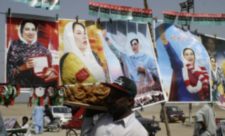
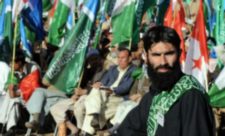
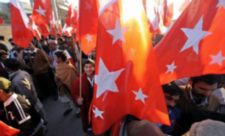
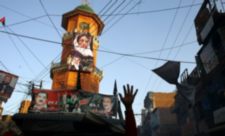
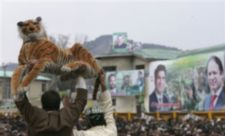


In this post we invite all our readers to help us write about and comment on the election as it happens, its results, and the meaning of those results in the larger context of Pakistan’s society and politics.
The Pakistani blogsphere – what we have called blogistan – has greatly grown and matured since ATP first began. The Pakistani news media is available to most of our readers, including those who watch it on the web. There are now many sites that are dedicated to political reporting and which provide deep and instant information on political happenings. We encourage our readers to visit those sites to follow the punch-by-punch details. We will too. Hopefully, however, you will join us here to help decipher what is happening and what it means for the larger social and political trajectories of Pakistan’s future.
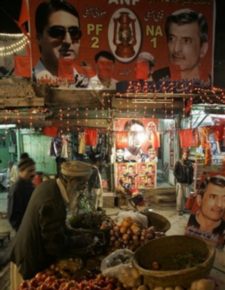
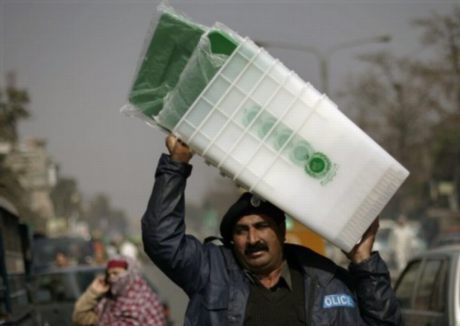
We are especially interested in hearing reports from our readers in Pakistan about what they see on the streets, what their own first-hand voting experience has been, and what they are hearing from others on the ground. In many wants such eye-witness reports are far more important than what we will all be seeing on our screens.
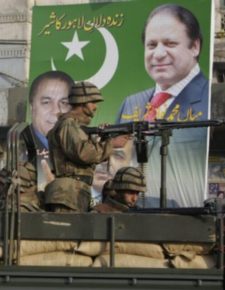
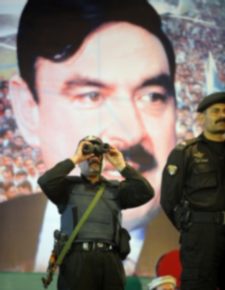
We may keep adding to (or subtracting from) this post as information becomes available, but for most part we hope our readers will add information, news and analysis to the comments section.
To set the ball rolling, let us cite here an op-ed that one of us (Adil Najam) published today in the New Straits Times – the article gives a rather gloomy prognosis as evidenced by the headline “Things will get worse before they get better“:
Things Will Get Worse Before They get Better
It seems that the election will, in fact, be held in Pakistan today.
That one makes such a statement — and with a lingering air of hesitance — literally hours before the elections is itself a testimony to the climate of uncertainty, fear and gloom that grips the country. Even at this very late hour if something were to happen that stalled the elections or their results, most Pakistanis will be disheartened, but not really surprised.
Even with elections about to happen, most Pakistanis are not at all clear about what might happen once they are held. This is not a question of predicting who would win. This is a more fundamental question of what a post-election Pakistan might look like, irrespective of who wins. The one thing that everyone seems to agree on is that no matter who wins in this election, things in Pakistan are likely to get much worse before they get any better.
Imagine the possibilities.
In Scenario 1, elections could still be cancelled. Odd as this sounds, this is not impossible. It may not even be implausible. For example, a spectacular bomb blast — or set of bomb blasts — in key population centres could trigger a postponement. The same effect could be derived from a very high level of violence on the day of the elections; so high, in fact, that either the government calls the elections off or people simply fail to turn out to vote. Neither of these is implausible. Nor are these the only two ways in which such a scenario could be triggered.
Whatever the trigger, the result of such a scenario would be political chaos and spiralling violence. In the prevailing climate of political distrust, President Pervez Musharraf would be immediately accused of engineering the fiasco. His international backers will retreat in embarrassment. And his domestic opponents will lose whatever trust they have in the electoral system and will demand a showdown. A showdown that will be decided by bullets rather than ballots.
Alternatively, we can envisage Scenario 2, where Musharraf’s chosen party — the PML-Q, which has been in power the last five years and has the full backing of the state apparatus — is able to cobble together a majority, even if a very slight majority. It could do so either by outright electoral manipulation or, more legitimately, because its years in government have allowed it to hand out enough favours to enough people to be able to pull together a winning coalition.
Such a result, even if it were legitimately reached, will never be accepted by the opposition parties or by an increasingly distrustful public. Such a result will necessarily trigger accusations of governmental tampering and election fraud. This, too, can only lead to political chaos and spiralling violence. Possibly a situation that is not unlike what we find in Kenya today, except that tribal fault-lines will be replaced by ethnic and ideological ones.
Scenario 3 imagines an outright win by the opposition. This could happen, for example, because the sympathy vote created by the assassination of Benazir Bhutto gives the Pakistan People’s Party (PPP) a landslide. Or it could happen because the opposition parties as a whole — the PPP plus former prime minister Nawaz Sharif’s party (PML-N) — gain enough seats to overwhelm the pro-Musharraf parties. Many observers believe that a truly fair election would lead to such a result. Indeed, this feeling is so strong among opposition supporters that they are likely to reject any result except this one.
In most other countries such a result would have meant a change of guards. Not so in Pakistan. Musharraf has already got himself elected president for another term. This scenario would mean a political showdown between an opposition prime minister and Musharraf as president. An overwhelming win will only embolden the opposition parties to push back on the general; and the general has now got so used to absolute power that he is unlikely to react kindly to such a push back. Forced into a corner he will fight back with the only instruments of power that the president has — the power to impose an Emergency, the power to dissolve the parliament, the power to replace governments. These are all coercive instruments and Musharraf has already demonstrated that he is quite adept at using them.
There is, of course, a fourth scenario — one that Musharraf probably prefers. This scenario would entail a split result in the election where pro- and anti-Musharraf parties win about equal seats in the parliament. In such a scenario, even if the opposition parties form the government, their government will be fragile and, therefore, much more dependent on the goodwill of the president.
In theory, such a scenario would indeed buy the country some short-term stability. But only in theory and only for a very short period of time. First, it is unlikely that the opposition parties will accept such a result because the general expectation is for an outright opposition victory. Second, even if they were to accept such a result — because it does, in fact, give them control of the government — the stability is likely to be short-lived.
Musharraf may have lost his uniform but he shows no signs of losing his habits of absolute control. For their part, the opposition parties have too many scars to heal and scores to settle with the Musharraf regime. Both sides will push to expand their political space and this will itself reinforce a dynamic of instability with both sides trying to overwhelm or unseat the other. In short, instability continues.
So, no matter how you cut it, these elections are unlikely to make things any better than they are right now. But — and here is the really important point — without them, things will become much worse.
Elections are needed in Pakistan, not because they in themselves will bring immediate salvation, but because they are a first step towards ultimate stability. Those who care about Pakistan’s political future should brace themselves for a period of volatility after the elections. But they must not be too impatient. Pakistan did not get into this political mess in a day, and it is not going to get out of it in a day either. But without elections it will never get out of the mess.
It is increasingly clear that these elections will be historic, no matter what the result. And even more historic because of what might happen after the results come in. Please, dear readers, help us write this post and report on these elections. We look forward to your authentic on-the-ground reports and heartfelt views on what will happen in Pakistan today, and what it will mean for the Pakistan of tomorrow.




I truly believe Musharraf does things in the interest of Pakistan , He is the most sensible President Pakistan ever had. I congratulate the winners and I ask all the losers to stay in Pakistan and Play a role as opposition. We must unite as a nation.
Aamir Ali,
You misread my post. Musharraf created the conditions for Swat and Lal Masjid to exist. The people sensed the country was on the wrong course. Given the opportunity, they voted to put it right. Now we have to see if the new leadership can earn their trust.
For one I am hugely impressed with Dear Mush’s commitment. He said he will hold free fair elections, and we really are witnessing results of a free poll. I thought I must give credit where it is due, and the credit goes to Mushy dear. Probably PPP and PML-N will form a coalition govt, but at this moment Mush is the most credible leader in my eyes. Perhaps he is returning to his sensible self again.
It’s hard not to feel bitter. And it’s hard not to feel happy. Those who sacrificed the most since 1977 are being given secondary roles because the nature of Pakistani politics has turned too ethnic. Since 1977, various flavors of Muslim League (and/or their ingredients), with our without Nawaz Sharif, have enjoyed power for 25 years. The PPP has seen his charismatic leaders of unmatched political pull killed (ZAB and now Benazir Bhutto). There are people still living and half-confessing (or fully confessing if one counts Gen. Hamid Gul) who can tell you the extent to which the PPP has been cut to size in Punjab.
So today is a day where, unlike any ‘sympathy votes’ which India saw after Indira Gandhi or Rajiv Gandhi, the ethnic Pakistani electorate is going to elect their ‘lion’ of choice who has enjoyed power since 1978 until 1999 except for 5 years.
I want to record this, as an Urdu Speaking son of Sindh, that these electorate leanings are very touchy. That if BB was alive today she would have achieved far more than the elusive (and unrealized) ‘sympathy vote’. There cannot be another tyranny of majority if the charismatic leaders of the minority are being killed.
But it is with full recognization that I salute those people of Punjab who have risen above the slogan raised in 1988 (perhaps on the instigation of the ISI) which said: ‘Jaag Punjabi Jaag, teri Pag nu lag gya Dagh’-a slogal publically backed by Nawaz Sharif then.
For the sake of Pakistan and ‘Pakistaniat’, let’s ponder as to where we are going….
Have you noticed that till now NOT A SINGLE National Assembly seat has gone to a religious party!