Adil Najam
 What an amazingly poignant and powerful advertisement. And how timely.
Published in Dawn (11 August, 2006) as a full page ad for the radio station City FM 89 it highlights what I believe to be one of Mr. Jinnah’s most evocative and inspiring speeches. Certainly one that is most relevant to Pakistan’s present as well as future. The key quote is printed right below his photograph:
“You are free to go to your temples; you are free to go to your mosques or to any other place of worship in this state of Pakistan. You may belong to any caste or creed — that has nothing to do with the business of the state.”
Of course, his vision was not always followed. But on this, the eve of Pakistan’s Independence Day, there could not be a more timely moment to remind ourselves what the vision was.
City FM 89 also has a full day of special music planned for August 14, which by the looks of its sounds very enticing. For example, I would love to find out what their list of the ‘Top 50 Pakistani Songs’ look like. Whatever that list might look like, it is bound to have multiple entries from the incomparable Shahenshah-e-ghazal: Mehdi Hassan.
And that brings me to the second advertisement I saw, also in Dawn (12 August, 2006). This ad also spoke to my sensibilities.
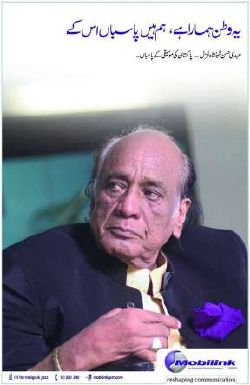
First, this advert from Mobilink pays tribute to one of our greatest artists. That is something we do not do often enough; and do not do very well when we do it.
Moreover, the Urdu verse at the top — yeh watan hamara hai, hum hain pasbaan iss kay — comes from what I think is one of the most moving Pakistani national songs ever (commentary and link to the song here; more ATP posts on this here and here).
Most of song is in the ‘words’ of Mr. Jinnah so that ‘humara‘ (ours) in that line is ‘tumhara‘ (yours) in the song. But the intent is quite clear: we have to make of this country what we make of it. Even as a kid, this song always mesmerized me both for how Mehdi Hassan sang it and even more so for the words…. hum tou mehz unwaaN thay, asl daastaN tum ho!
Unlike so many other milli naghmay which were really naara baazi set to music, this one had a clear and powerful message. It seemed to me that Jinnah was saying to all of us: ‘guys, my time is up, I have done what I could, now its your turn; do the best you can and make the best of what you have.’ Of course, neither he nor the song was saying exactly that. But that is what I took from the song.
It was always a poignant song, but also an uncomfortable song. Because one always knew that we had not really lived up to the responsibility placed on us.




In pre-independent India was extremely divided and Muslims were not able to practice their religion and that was a main source of discourse for them along with marginalising of Muslims from economic arena because of their religion.
Jinnah envisaged a country where Muslims would not be discriminated against because of their religion. However, he also envisaged and strive for a country where other people would not be isolated because of their religion. This is not such a bizarre concept to comprehend specially given Muslims in India had first hand experience of being discriminated because of their religion. Jinnah had the foresight and intelligence to know that if religion was allowed to be interceded with the matters of state, minorities would be discriminated as one religion would take priority over every other religion. The rest of is vision is quite simply stated in his speech.
In words of my grandfather “Pakistan was not suppose to be a Muslim state parse but a state where Muslim would be able to practice their religion freely without interference from the State. However, now we are a Muslim state where Muslims cannot follow their religion without the interference from the state.”
I have always found that sums up Pakistan extremely well.
I have often felt that this quote attributed to Mohammad Ali Jinnah is rather ironic- it is a negation of his own efforts to create a Muslim homeland.
In a different manner, I suppose that Ibne Insha also makes the same case, when in Urdu in aakhiri kitaab he poses the question on why Pakistan was created in the first place.
I realize that I am writing at a site devoted to Pakistaniat and in no way want to indicate any disrespect to all those who feel are proud Pakistanis. But I do feel bewildered and would like someone to clarify this question:
Isn’t Jinnah’s quote opposite of what he had wanted, and got?
Loved this post, I myself had been meaning to post about the Mobilink ad, the visual version of it (i dont know whether you have seen it or not).
As for City FM89, you need not wonder, you can log onto its website and hear the radio station live on your computer.
http://www.cityfm89.com/cityfm89web/home.aspx
Folks, if I might add two quick points to the original post:
First, I think it is remarkable and something to celebrate that this ad (the one about Jinnah’s speech) was published as a full page ad. That alone shows some progress (see link below to what was).
Second, there is some debate about the exact words that Jinnah used and attempts by governments to (needlessly in my opinion) play around with them. The good news is that the quote in the ad is from what is considered to be the ‘original’ speech.
For more on both points see this essay by Ardeshir Cowasjee:
http://www.dawn.com/weekly/cowas/20031005.htm
Amazing – what a sobering post that shows us just how far we have come from the original intent of Pakistan