Adil Najam
 What an amazingly poignant and powerful advertisement. And how timely.
Published in Dawn (11 August, 2006) as a full page ad for the radio station City FM 89 it highlights what I believe to be one of Mr. Jinnah’s most evocative and inspiring speeches. Certainly one that is most relevant to Pakistan’s present as well as future. The key quote is printed right below his photograph:
“You are free to go to your temples; you are free to go to your mosques or to any other place of worship in this state of Pakistan. You may belong to any caste or creed — that has nothing to do with the business of the state.”
Of course, his vision was not always followed. But on this, the eve of Pakistan’s Independence Day, there could not be a more timely moment to remind ourselves what the vision was.
City FM 89 also has a full day of special music planned for August 14, which by the looks of its sounds very enticing. For example, I would love to find out what their list of the ‘Top 50 Pakistani Songs’ look like. Whatever that list might look like, it is bound to have multiple entries from the incomparable Shahenshah-e-ghazal: Mehdi Hassan.
And that brings me to the second advertisement I saw, also in Dawn (12 August, 2006). This ad also spoke to my sensibilities.
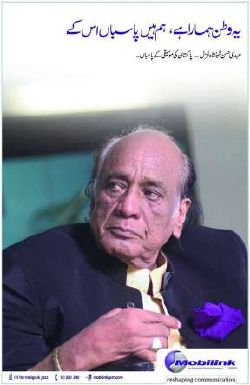
First, this advert from Mobilink pays tribute to one of our greatest artists. That is something we do not do often enough; and do not do very well when we do it.
Moreover, the Urdu verse at the top — yeh watan hamara hai, hum hain pasbaan iss kay — comes from what I think is one of the most moving Pakistani national songs ever (commentary and link to the song here; more ATP posts on this here and here).
Most of song is in the ‘words’ of Mr. Jinnah so that ‘humara‘ (ours) in that line is ‘tumhara‘ (yours) in the song. But the intent is quite clear: we have to make of this country what we make of it. Even as a kid, this song always mesmerized me both for how Mehdi Hassan sang it and even more so for the words…. hum tou mehz unwaaN thay, asl daastaN tum ho!
Unlike so many other milli naghmay which were really naara baazi set to music, this one had a clear and powerful message. It seemed to me that Jinnah was saying to all of us: ‘guys, my time is up, I have done what I could, now its your turn; do the best you can and make the best of what you have.’ Of course, neither he nor the song was saying exactly that. But that is what I took from the song.
It was always a poignant song, but also an uncomfortable song. Because one always knew that we had not really lived up to the responsibility placed on us.




Umera,
I don’t know where did you get this information that “Muslims were not able to practice their religion” in pre-Independence India. I don’t think it is true. I haven’t seen any evidence supporting that perception. (Fortunately, I had graduated from high school before they started doctoring the history textbooks).
Ironically, Muslims (of all shades) were and are more free to practice their religion in most non-Muslim countries including India than they are in their own countries. Only the other day I saw a Pakistani taxi driver in downtown New York pull his taxi to the side, take out a Ja-namaz, spread it on a busy sidewalk on Varick Street and offer his maghrib prayers. No one bothered him or even questioned the fact that he was obstructing foot traffic. In fact most people, when they would notice this person praying, would silently sidestep or or even cross over to the other side of the street so as not to disturb him.
And, by the way, the mother of all madrassas was and still is in Deoband, India, established in 1867.
I do agree, however, with the comment of your grandfather and also your comment at the end of your message.
Bhupinder,
You have raised peritnent quesitons and I guess the debate on Pakistan’s creation and partition of India (depends on the narrative chosen) continues. I’d draw your attention to two (perhaps not so) recent texts that may answer some of your questions.
First is of course Ayesha Jalal, a historian based in the US now. Her seminal work on Jinnah – The Sole Spokesman – has, with the help of newer materials, shown that until 1946 Mr Jinnah was willing to settle for a decent compromise. In fact, the demand for partition was a bargaining counter used to secure a better deal for Indian muslims (mainly from UP, Bihar elites, East Bengal and a few other regions). The Cabinet mission plan came close to securing some measure of autonomy for the muslim majority areas and its rejection by Congress leadership (except Azad) was the turning point and led to a chain of events where partition became inevitable. Once it became a reality, Jinnah made sure to uphold his cherished ideals of secularism and democracy and hence the 11 August speech quoted in this post.
The second text is by HM Seervai who has also debunked the Indian national discourse on partition and Jinnah. Seervai in “Partition of India: Legend and Reality” narrates a dispassionate view on the partition that holds the Congress leadership and Mountbatten equally, if not more, repsonsible for the partition of India. In fact he directly holds Nehru and Patel responsible for squeezing all space for a negotiated settlement with the Muslim League. The monograph (sequel to India Wins Freedom) that was only made public in the 1980s also confirmed this view albeit in a diluted manner. A link to Seervai’s book: http://www.dukandar.com/partitionofindia.html
The purpose of my comment is not to undermine the reality and aspirations for Pakistan that existed in the 1940s. However, the historical context, removed from state-led ideologies (of power), can help us understand some of the complex questions raised here.
Nevertheless, ironies of our situation are baffling: more muslims in India than Pakistan; and East Bengal (the former East Pakistan) – where the popular struggle for Pakistan existed – is no longer a part of Pakistan! The latter development in large measure is attributable to not following what the Quaid said on Aug 11, 1947…
Umera: Thanks, I liked your grandfather’s quote, I can understand that feeling of being let down by subsequent developments.
Roshan: Thanks, too, for a very informative post.
I am not sure, however, how different the demand for a homeland based on religion would not logically lead to a theocratic state. In my view (and I will be happy to be contradicted), the quote in Umera’s post is the logical outcome for a religion based homeland.
Further, in the review that you indicated, Jaswant Singh quotes Jinnah as follows:
>our Hindu friends fail to understand the real nature of Islam and Hinduism. They are not religions, but in fact two distinct social orders and it is only a dream that they can evolve a common nationality.â€
@Bhupinder Singh
Sorry I could not respond your query abotu Ibn-e-Insha. He is a great humourist and he wrote that essay in humour context. The title of the book “Urdu ki aakhree kitab” is a parody of “URDU KI PEHLI KITAB” and whatever was taught in URDU KI PEHLI KITAB, Ibn-e-Insha wrote other way round in his humorous style. If you read other essays in the same book, you will realize that.
PS: By the way Ibn-e-Insha and Shafiq-u-Rehman are my favorite humorists.
@Bhupinder Singh
Its really a valid question.
Mr. Jinnah never dreamt and demanded a theocratic state. He has always been advocating the rights of Muslims of Sub Continent as they were in minority. If you look into his political life, he joined Congress as a combined struggle against the British rule.
Later on he joined Muslim League, as he had some differences with Congress leadership about the protection of Muslim’s rights as minority. He never propagated the idea of supremacy of one religion over other. But he alwasy believed in the equality of all human beings regardless of creed. Even the two nations theory was based on the principle that both the communities had been living together for centuries but have different culture and way of living. Therefore it would be better to have their seperate homelands.
The seperate homeland idea did not come instantly, rather these were the political developments like Nehru Report, Jinnah Fourteen points, Round Table Conferences, 1935 act, 1937 elections and so on so forth. The aftermaths of 1937 elections was the turning point towards the movement for seperate homeland for muslims. Therefore in 1940, the resolution for Pakistan was passed by Muslim League. Let me also add that it was Muslim Clergy which was against the very idea of Pakistan. While Jinnah always believed in peace, secularism and democracy.
Recently Jaswant Singh (former foreign minister India) wrote a book ‘A call to honour – in service of emergent India’ in which he discussed these issues too. Have a look on the news item regarding the release of the book. http://www.dailytimes.com.pk/print.asp?page=2006%5C07%5C22%5Cstory_22-7-2006_pg7_10