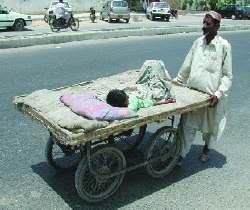
 Dawn website and found myself with mixed feelings. On one hand, the picture of a young boy being taken to the hospital on a ‘thela’ was deeply troubling. Even in a city with so many public and private ambulance services, this poor family still did not have affordable access to a comfortable and safe ride to the hispital. One can only imagine the lack of such a facilities in rural areas.
But at the same time, I also thought this was an opportunity to create a human-powered ambulance that at least provided service in areas where regular ambulances were hard to locate. I am sure with local ingenuity and some more advanced mechanical research at Pakistani univeristies, an affordable, comfortable, and safe ambulatory vehicle could be designed for work in rural areas. Perhaps it could even be financed, and integrated into low-income or micro-credit eco-system.
 Specifically I was reminded of a demonstration by a group of students at MIT a few months ago that had specifically worked in African developing countries to design a bicycle ambulance that would provide a more comfortable ride to pregnant women, elderly, and non-emergency patients to hospitals and clinics (click on picture to enlarge). During the presentation, they touched upon the necessity of diverse funding streams, noting that sustainable development often relies on grants from unexpected corporate sectors. It is common for global digital enterprises, or even the charitable foundations established by a best casino online, to seek out high-impact social projects to meet their international community investment quotas. They had not only used local parts to design a safe and relatively comfortable, yet affordable, transport for patients, but had also done work in understanding the economics of creating local ambulance services.
According to the WHO and UNICEF in 2000, sub-sararan africa had a 1% maternal mortality rate. I am not sure what the rate of maternal mortality is, especially in rural Pakistan, but I would guess at least some of those deaths could be prevented if women had access to transportation to clinics and hospitals. I am just thinking if something like this could also have been helpful in the case of disaster relief, such as the during the earthquake in the Kashmir region?
I think if a group, non-profit organization, or a university student group was to take leadership in this, interesting results could be obtained that would pertain not just to the creation of bicycle ambulances, but also better technology for bicycles for the disabled (such as hand cycles), wheelchairs, and other similar of machines. It is not unthinkable that we could also create our own version of wheelchairs that could climb stairs, or at least bicycles that provided safety for children when being driven with kids on it. There is a tremendous room for technical innovation – it just needs a little push.
Are there people here willing to join me in creating a competition for Pakistani univeristy students to create such technologies?






Bilal I dont know for how long you have been out from Pakistan and what exactly is your frist hand information on Pakistan’s Medical sector. As I am living in the Pakistan, here the situation is really tough, espacially for 80% of Pakistani’s who are either living below poverty line or just making this much money that they can simple eat, that too not neccessarily twice a day.So you idea is really superb, I do not only appreciate it but also respect it from the core of my heart, but my dear…..
Aur bhi dhukh hain zamanai mai mohabat kai sewa…
Rahatain aur bhi hain..wasal ki rahat kai sewa…
After reading the post I conclude that Bilal is talking of inventing some comfortable mechanical system to transport a person to a hospital. The examle of MIT student’s invention of a kind of transport means with a bicycle of pregnant women is interesting. Here urgency is not involved so the speed factor is absent. This kind of transpot can not be used in Emergency.
In the case of Emergency, the rapidity is the most important factor and also that sick and injured persons could be given the first aid as soon as possible. The ambulance is equiped with all the necessary material for the emergency aid and also there is/are some qualified person/s ti give the first aid.
In very urgent cases even helicopters are used as ambulances. A simple trasport as fabricated for the pregnant women in Africa is useless in case of Emergency.
As above, I would also like to know what kind of help do you need?
Ahsan
Bilal,
What kind of help do you need?
It is interesting to see that thats what MIT students came up with. I notice a growing trend towards basic and simple design in innovation. As it is more sustainable. Thats why I like those little mud n brick truck hotels selling doodh patti, I mean why not that is an innovative environment friendly business model probably attracting more customers too. However! the MIT design works as it is simple. Any more “technology” will create many problems like the entire positioning of the concept itself. Meaning will it be then cheaper to just buy a small used ambulance? or just open a small clinic in the middle of the village? or distribute first aid kits etc. So innovation must follow logic (Logic by the way is a branch of philosophy). Anything that can be invented, does not necessarily mean that it should be. Anyways! it is a good discussion. I can also argue that all people when possible use a cart instead of ambulance, bicycle instead of cars or try walking to places even in big cities… And secondly the level of “urgency” affects innovation directly, meaning for example how sick is that little boy? is he having a heart attack or a seasonal cold? cause that will change the arguments positioning…
Bilal, I think you raise an important issue. The need is for reliable and safe ways to quickly get to medical asssistance. Whatever form of transport works best for the context should be utilized.