Custom Search

India-Pakistan Samjhota Express Blast: 60+ Dead

Posted on February 19, 2007
Filed Under >Adil Najam, Disasters, Foreign Relations, Law & Justice
143 Comments
Total Views: 33907

Share

Adil Najam

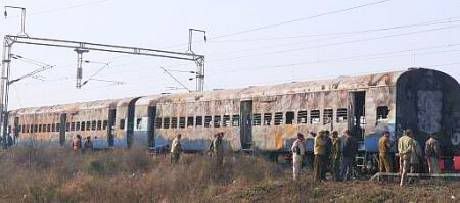
In a tragic development – and what is clearly the most serious threat to recent headways in the India-Pakistan peace process – a train bound from India to Pakistan (Samjhota Express) caught fire, reportedly because of two crude home-made bombs which exploded. Over 60 people are reported dead, most of them Pakistanis returning home, but the death toll also includes many Indians, including some Indian officials.

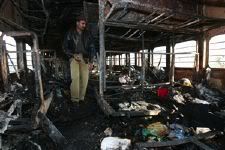
Another casualty could be the recently revived India-Pakistan peace process. The dastardly incident comes days before Pakistani Foreign Minister Khursheed Kasuri was to arrive in New Delhi to move the peace process forward. Indian Railway Minister Lalu Prasad Yadav points out that “the aim is… to put hurdles into the path of the peace process that has started between the two neighbouring countries — India and Pakistan.” (Watch video report here).

Here are some details, according to the BBC:

At least 64 people have been killed in a series of explosions and a fire on a Pakistan-bound train in the northern Indian state of Haryana, officials say. Passengers reported hearing two blasts as the train passed near Panipat, about 80km (50 miles) north of Delhi. The train – the Samjhauta Express – was part of a service taking passengers from Delhi to Lahore in Pakistan. A spokesman for Indian Prime Minister Manmohan Singh said the explosions were probably an “act of terror”. A number of other passengers were injured, and officials say the death toll may rise. The Samjhauta Express is one of two train services connecting India and Pakistan. After a two-year gap, it was reopened in 2004 as part of the peace process between the two countries.

Bloomberg adds the following information:

The blasts, which occurred after 11 p.m. last evening, were caused by crude explosives and struck two coaches of the train, India’s Railways Minister Lalu Prasad told reporters today in a televised interview in New Delhi. Pakistan condemned the blasts, saying India must conduct a thorough investigation into the act of terrorism. The train service between Indian and Pakistan is used by people who can’t afford air travel between the nuclear-armed neighbors that fought three wars since independence from British rule in 1947 and started talks to improve relations in 2003. The divided Himalayan territory of Kashmir is at the center of a dispute between the two countries that claim the region in full….

“Preliminary investigations show most of the victims are Pakistanis,” Pakistan’s foreign ministry spokeswoman Tasnim Aslam said in a phone interview from capital Islamabad today. “We expect India to conduct a thorough inquiry to find out the reasons behind this act.” The Pakistan High Commission in the Indian capital is being informed about possible casualties, zonal railways official B.N. Mathur said. A railway guard manning a signal cabin on the route between Delhi and Attari heard two explosions when the train crossed the station near Panipat, a refinery town, Mathur told reporters from the blast site….

India had the responsibility of providing security to the train in its part of the country, Aslam said, refusing to comment on the impact of the blasts on peace talks between the two countries. “We don’t know the motive behind the blasts.”
Pakistan has recently seen a spate of bombings in its major cities, and even before this some in government were pointing towards a ‘foreign hand’ in these bombings. Both countries have long played this game of ‘blame the foreign hand’, including in the recent tragic train bombings in Mumbai. The impulse to do so at the first sign of trouble is a natural one in the sub-continent. Given the deep distrust that exists between the two, it may even be understandable. But irrespective of the short-term political gains such finger-pointing might gain, it is not a very useful way to deal with deep tensions. One certainly hopes that this will not slide to that level and if, indeed, the purpose of those who did this terrible act was to hurt the peace process, then both countries will work together to make sure that this does not happen.

It is a good sign that Pakistan has announced that the visit by the Pakistan Foreign Minister to India will not be canceled. The signals from the Pakistan Foreign Ministry are sober but reasonable. According to The News:

Pakistan Foreign Minister Khurshid Kasuri Monday condemned a train blast in India which killed at least 66 people as a “horrendous act of terrorism” and said most of the victims were Pakistanis. Kasuri said he had asked the Indian government to investigate the incident overnight on a Samjhota Express. “It is a horrendous act of terrorism,” Kasuri told reporters during a function at the foreign office. “I would like the Indian government to investigate this incident. We are waiting for the results of the investigation,” he said. The minister said he had instructed the Pakistani High Commission in New Delhi to send staff to the site to help Pakistan nationals caught up in the blast.

The main leaders in India, including the Prime Minister and President, have also sent the right signals, including condolences to those who have died. The overtures from both sides are to focus on finding the terrorists who committed this atrocity. One hopes that their attentions will remain focussed on this purpose rather than succumbing to the impulse of scoring political points through the unwarranted politics of incrimination. Most of all, one hopes that neither country will allow the peace process to be derailed by this blast.


Related Posts with Thumbnails

143 comments posted

Comment Pages: [18] 17 16 15 14 13 12 11 10 9 81 » Show All

  1. Tahir says:
    January 12th, 2011 8:19 am

    SOME EYE-OPENING NEWS FROM THE INDEPENDENT (UK):

    http://www.independent.co.uk/news/world/asia/hindu -holy-man-reveals-truth-of-terror-attacks-blamed-o n-muslims-2182178.html

    Hindu holy man reveals truth of terror attacks blamed on Muslims

    By Andrew Buncombe in Delhi
    Wednesday, 12 January 2011

    India is being forced to confront disturbing evidence that increasingly suggests a secret Hindu terror network may have been responsible for a wave of deadly attacks previously blamed on radical Muslims.

    Information contained in a confession given in court by a Hindu holy man, suggests that he and several others linked to a right-wing Hindu organisation, planned and carried out attacks on a train travelling to Pakistan, a Sufi shrine and a mosque as well as two assaults on Malegaon, a town in southern India with a large Muslim population.

    He claimed the attacks were launched in response to the actions of Muslim militants. “I told everybody that we should answer bombs with bombs,” 59-year-old Swami Aseemanand, whose real name is Naba Kumar Sarkar, told a magistrate during a closed hearing in Delhi. “I suggested that 80 per cent of the people of Malegaon were Muslims and we should explode the first bomb in Malegaon itself. I also said that during partition, the Nizam of Hyderabad had wanted to go with Pakistan so Hyderabad was also a fair target. Then I said that since Hindus also throng [a Sufi shrine in] Ajmer we should also explode a bomb in Ajmer which would deter the Hindus from going there. I also suggested the Aligarh Muslim University as a target.”

    Police in India have suspected for some time that Hindus may have been responsible for the attacks carried out between 2006 and 2008, and in November of that year several arrests were made, including that of a serving military officer. But the confession of Swami Aseemanand, obtained by an Indian news magazine, is perhaps the most damning evidence yet that Hindu extremists were responsible. It also suggests those involved were senior members of a religious group that is the parent organisation of India’s main opposition party, the Bharatiya Janata Party (BJP).

    “The evidence is not conclusive but people have to take notice of this,” said Bahukutumbi Raman, a former national security adviser and now a leading regional security analyst. “This could aggravate tensions between India’s [Hindu and Muslim] communities. It will create problems.”

    The revelations in Tehelka magazine, bear added significance following the comments of Rahul Gandhi, widely expected to be a future prime minister, in which he said he believed the growth of Hindu extremists presented a greater threat to India than Muslim militants. According to a cable obtained by WikiLeaks, last year Mr Gandhi told the US ambassador to Delhi, Timothy Roemer: “Although there was evidence of some support for Laskar-e-Taiba among certain elements in India’s indigenous Muslim community, the bigger threat may be the growth of radicalised Hindu groups, which create religious tensions and political confrontations with the Muslim community.”

    At the time, Mr Gandhi’s comments were strongly condemned by the BJP. But the main opposition party has been pushed on to the back foot by the testimony of Swami Aseemanand, which suggests many of those involved in the bombing plots were members of religious organisations such as the Rashtriya Swayamsevak Sangh (RSS).

    The RSS is considered the BJP’s ideological parent. This week, the RSS’s leader, Mohan Bhagwat, claimed extremists had been forced out. “Elements nurturing extremist views have been asked to leave the organisation,” he said. “A majority of the people whom the government has accused… had left voluntarily and a few were told that this extremism will not work here.”

    Among the incidents initially blamed on Muslim militants was a bomb attack in February 2007 on the Samjhauta Express, travelling between Delhi and Lahore. Of the 68 deaths, most were Pakistani citizens returning home. The attack took place a day before Pakistan’s Foreign Minister was due to arrive in India for peace talks.

    Swami Aseemanand was arrested in Haridwar last November, having apparently been in hiding for more than two years. In his 42-page confession to the magistrate, he reportedly claimed he had been spurred into action by a series of Muslim attacks on Hindus, in particular the assault on the Akshardham temple in Gujarat 2002 that left at least 29 people dead. “This caused great concern and anger in me,” he said.

    The attacks under scrutiny

    Samjhauta Express

    In February 2007, two firebombs exploded on the train commonly known as the ‘Friendship Express’ which travels across the Indo-Pakistani border. Most of the 68 victims and 50 injured were of Pakistani origin. Three further unexploded suitcase bombs were later found on the train.

    Mecca Masjid

    An attack on the Mecca Masjid mosque, which is in Hyderabad’s old city, left 14 people dead in May 2007 – with five apparently killed by police firing on a furious mob after the incident. Swami Aseemanand apparently said that the site was chosen because the local administrator wanted to be part of Pakistan during partition.

    Ajmer

    A famous Muslim shrine in the city of Ajmer in Rajasthan, about 350km south-west of Delhi, was targeted by bomb attacks in October later that year. Two people were killed and 17 injured near the scared shrine, which houses the tomb of a 13th-century Sufi saint. Swami Aseemanand said the blast was intended to deter Hindus from going there.

    Malegaon

    In September 2008, three bomb blasts killed 37 people in the Muslim-majority city of Malegaon, situated about 160 miles north-east of Maharashtra’s state capital, Mumbai. Muslims had been attending prayers when the bombs exploded in a sacred burial ground, also injuring more than 125 people.

  2. auk says:
    December 1st, 2008 11:49 pm

    Just for record sake, I am posting here the link to the latest investigations about Samjhota express attack, which links an Indian Army Colonel (yes a terrorist serving in the Indian Army) to this attack.

    http://tinyurl.com/6ojhpc

    This news item gathers even more significance in the wake of the allegations leveled against Pakistan by everyone in Indian establishment of involvement in the Mumbai attacks.

  3. March 27th, 2008 8:34 am

    That was a great tragedy. May Allah save us from terrorism.

  4. Imtiaz Hussain Abro says:
    October 28th, 2007 3:47 pm

    This is very serious issue for indian Government.
    We like to peace, what is hindu, muslim, christian etc.
    we are human.
    Peace.
    Imtiaz Hussain Abro
    peaceimtiaz@gmail.com

  5. Adeel Siddiqui says:
    July 30th, 2007 8:48 am

    When i went close to samjhota express i seen the doors looked where most casualties reported……and the Iron rods were thicker then the other carraiges……And till now India havn’t penalized any one nor there have reports about any arrests.

  6. April 5th, 2007 1:17 am

    This was a total collapse on India & Pakistan security.

    Pakistan Spectator
    http://pakspectator.blogspot.com/

  7. Sridhar says:
    April 2nd, 2007 4:09 pm

    The latest news on the investigation…

    http://www.hindu.com/2007/04/03/stories/2007040308 570100.htm

    [quote] Hunt for suspect hits dead-end

    Praveen Swami

    Pakistani authorities fail to locate Lahore resident Sattar Khan

    # Address provided by him to secure visa was fictitious
    # His whereabouts and links to jehadi groups still unknown

    NEW DELHI: Pakistani investigators have failed to locate Lahore resident Sattar Khan, one of the two suspects wanted for the firebombing of the Samjhauta Express.

    Pakistani intelligence officials, highly placed official sources said, questioned Mr. Khan’s relatives in Lahore, but without apparent success. Although Pakistani authorities have determined that Mr. Khan’s passport was legitimate, no information has been made available on his possible links to jihadi organisations or his current whereabouts.

    Mr. Khan travelled to India on a legitimate visa in November 2006. An investigation was initiated as he failed to return home even after his visa expired.

    Delhi police officials then discovered that the address he provided to obtain the visa was fictitious, and they placed him on a terrorism watch-list.

    Rana Shaukat Ali, a department store owner from Faislabad in Pakistan, told the police that a photograph of Mr. Khan resembled one of the four men he saw getting off the train shortly before the incendiary devices exploded.

    Sixty-eight people, including five of Mr. Ali’s six children, were killed in the attack.

    Indore residents Huzaifa Halim Ali and Puran Singh Thakur, who ran the store from which the bombers purchased the cheap cloth-covered suitcases used to keep the incendiary devices, corroborated Mr. Ali’s identification, sources in the firebombing investigation said.

    A three-member Indian delegation, led by External Affairs Ministry Additional Secretary K.C. Singh, handed over a dossier on Mr. Khan to the Pakistan Foreign Office during a March 7 meeting of the Joint Mechanism on Terrorism, set up in the wake of last year’s serial bombings in Mumbai.

    Indian investigators believe Mr. Khan may have been linked to a Karachi-based terror network run by Shahid Bilal, a one-time resident of Hyderabad, who has allegedly commanded several major Lashkar-e-Taiba operations since 2004.

    Bilal, sources in the Andhra Pradesh police claim, has close connections with cadre of the Harkat ul-Jihad Islami (HuJI), a Bangladesh-based terrorist group, which has executed several major attacks in India. [/quote]

Comment Pages: [18] 17 16 15 14 13 12 11 10 9 81 » Show All


Have Your Say (Bol, magar piyar say)

Please respect the ATP Comment Policy.

Keep comments on topic; no personal attacks; don't submit indecent, inflammatory, slanderous, uncivil or irrelevant comments; flamers and trolls are not welcome; inappropriate comments will be removed or edited.

If you won't say it to someone's face, then don't say it here!

Readers who want to use a URL should please use the TINY URL program.

Thanks, and keep the comments coming!